








Donald Trump says he hopes to make it into heaven. But when asked whether he could forgive some of his political enemies if that were the price of getting into paradise, the president gave an answer that left little room for interpretation.
His answer? No. He would rather hold on to his hatred.
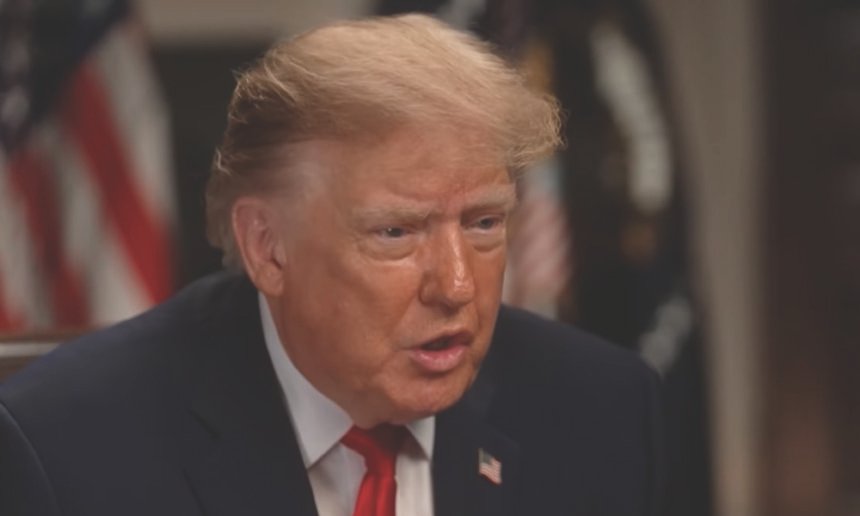
During a Sunday interview with he New York Times columnist Ross Douthat on CBS’s 60 Minutes, Trump described himself as a religious person who hopes to reach heaven.
“I hope so,” Trump said. “I don’t want to go to hell.”
But Douthat quickly put that claim to the test with a hypothetical question rooted in one of Christianity’s central teachings: forgiveness.
He asked Trump to imagine standing before God, with the only requirement for entering paradise being that he show love and forgiveness toward people he had spent years attacking, including former FBI Director James Comey and former House Speaker Nancy Pelosi.
Could he do it?
“Well, then I wouldn’t be real, would I?” Trump replied, dismissing them as “extremely dishonest people, very bad people.”
Douthat pressed him for a direct answer.
“Is the answer no, then?” he asked.
“The answer is no,” Trump said.
Even after Douthat reminded him that he was imagining himself standing before the judgment throne of God, Trump refused to budge. He repeated that some of his political enemies were “very bad people” and admitted he hated them.
Douthat gave the president one final opportunity to reconsider, pointing out that he had lived an extraordinarily fortunate life and asking whether he really couldn’t find it in his heart to forgive some of the people he despises.
“Can I be honest? I probably cannot do that. No,” Trump replied. “Because I do hate some of my enemies and I always will.”
That exchange quickly set off a firestorm online, with critics pointing out the obvious contradiction between Trump’s desire to reach heaven and his open rejection of forgiveness — a principle repeatedly emphasized in the Bible.
Former Republican congressman Joe Walsh didn’t mince words, calling Trump “an utterly horrible human being” and describing him as incapable of shame or forgiveness.
Others pointed directly to Matthew 6:14-15, which says that those who refuse to forgive others should not expect forgiveness from their heavenly Father.
Jesuit priest James Martin also shared a message from Pope Leo XIV: “When forgiving seems like a defeat, forgive.”
Political commentator Kevin Vallier called the exchange one of the most remarkable things he had ever seen, asking whether Douthat had just gotten Trump to admit he would choose hell rather than forgive Nancy Pelosi.
Even some Trump supporters appeared uncomfortable with what they heard.
Jess Fields, who said she had largely supported the president over the years, described the interview as painful to watch, adding that she didn’t want anyone speaking that way or teaching children to behave that way.
Another commenter took aim at religious conservatives who have supported Trump, writing: “Imagine living with such deep hate. Evangelicals, and Catholics who voted for this should bow their heads in shame.”
And one commenter offered a pointed reminder of what the country should learn from the spectacle: “I hope this country never again mistakes a man’s bitterness for strength.”
For a president who frequently invokes Christianity and the support of religious voters, Trump’s answer was striking. He says he hopes to enter heaven, but when confronted with one of the faith’s most basic teachings, he made clear that forgiving his enemies isn’t something he’s willing to do.
Watch the clip below and share your reaction: