








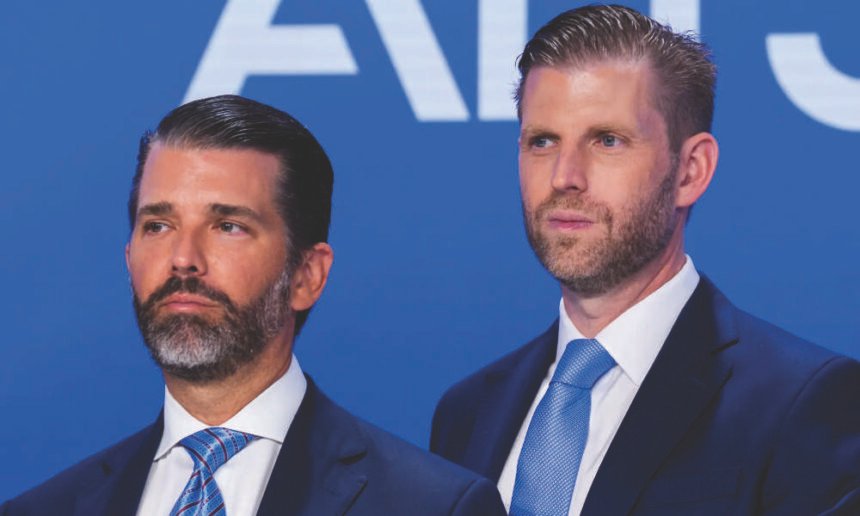
Donald Trump Jr. and Eric Trump could face serious legal questions over their family’s cryptocurrency business as Democrats prepare to take control of Congress and launch a new wave of investigations into the Trump family’s financial dealings.
At the center of the controversy is World Liberty Financial, the crypto venture co-founded by the president’s sons. The company marketed its token as a decentralized financial product, suggesting that no single company or insider could control what happened to investors’ money.
But allegations surrounding a feature that allowed insiders to freeze investors’ tokens have raised questions about how much control the company actually retained — and whether buyers were given a misleading picture of what they were purchasing.
World Liberty’s smart contract included an administrative function that allowed insiders to freeze a token holder’s wallet, preventing that person from transferring or selling their tokens. That is a significant contradiction to the image of a decentralized platform — and one that investors may not have fully understood when they bought in.
The potential legal exposure is significant. Under New York law, first-degree grand larceny is a Class B felony that carries a maximum prison sentence of 25 years.
The issue became public after crypto billionaire Justin Sun, who invested roughly $45 million in the venture, accused World Liberty of concealing the feature.
In September 2025, World Liberty froze Sun’s tokens following a dispute. Sun subsequently sued the company, alleging that his holdings were wrongfully restricted and that the venture threatened to destroy them.
The controversy raises an obvious question: If investors were led to believe that World Liberty was decentralized, while company insiders retained the power to freeze their holdings, were buyers misled about what they were actually purchasing?
That question could become particularly important if investigators obtain internal communications showing what the company’s founders knew about the feature and how it was described to prospective buyers.
The Trump family made a fortune while investors took losses
The financial stakes are enormous.
According to reporting cited in the investigation, World Liberty generated at least $1.2 billion in cash for the Trump family during the first 16 months after launching its token. Its governing documents direct 75 percent of token-sale revenue to a Trump family entity.
Meanwhile, the token has suffered a brutal collapse. WLFI peaked at approximately 31 cents in September 2025 before falling to around 4.6 cents by November 6, 2026 — a decline of roughly 85 percent.
Ordinary investors absorbed those losses while the Trump family collected a massive share of the venture’s revenue.
The combination of alleged misleading marketing, insider control and substantial financial benefits is precisely why the company’s structure deserves scrutiny.
It also raises comparisons to other major cryptocurrency scandals in which executives were convicted after prosecutors demonstrated that they misled customers about how their businesses operated.
Braden Karony, the former head of SafeMoon, was sentenced to 100 months in federal prison after being convicted of misleading investors about the security of funds backing the cryptocurrency. Alex Mashinsky, the former Celsius chief executive, received a 12-year sentence after misleading customers about the company’s financial condition.
Sam Bankman-Fried, the founder of FTX, was sentenced to 25 years in prison for fraud and conspiracy.
New York Penal Law provides two potential legal avenues that have been raised in connection with the World Liberty allegations.
One is first-degree scheme to defraud, a Class E felony carrying a maximum sentence of four years. The statute covers certain ongoing schemes involving false or fraudulent representations made to multiple people to obtain property.
The more serious potential charge is first-degree grand larceny.
Under New York Penal Law Section 155.42, grand larceny in the first degree applies when property worth more than $1 million is stolen. It is classified as a Class B felony. Under Section 70.00, the maximum prison term for a Class B felony is 25 years.
That is where the legal stakes become considerably more serious.
And that brings us to the incoming Democratic majority in Congress.
On November 18, Rep. Robert Garcia, the top Democrat on the House Oversight Committee, sent letters to Donald Trump Jr. and Eric Trump directing them to preserve records related to their business activities.
Garcia is expected to lead the committee when Democrats take control of the House in January 2027.
The preservation letters are an early indication of the scrutiny the Trump family’s business dealings could face under the new congressional majority. Democrats have signaled that they intend to investigate potential conflicts of interest, financial arrangements and the relationship between the president’s business interests and government actions.
A Democratic-led committee could seek records from World Liberty, demand testimony and use its subpoena authority to obtain documents that would otherwise remain out of public view.
Congress cannot file criminal charges or send anyone to prison. That authority belongs to prosecutors. But congressional investigations can uncover evidence, compel testimony and refer potential criminal conduct to the appropriate law enforcement agencies.
The political landscape is also changing beyond the World Liberty investigation. House Democrats have already expanded a separate inquiry into Donald Trump Jr.’s investments through 1789 Capital, seeking records from companies connected to the venture and examining whether investments coincided with government contracts or regulatory decisions that could benefit those businesses.
Trump Jr. and his business partners have denied wrongdoing.
Taken together, these investigations could put the president’s sons under a level of congressional scrutiny they have not previously faced.
A presidential pardon would not erase a state conviction
There is another reason the potential New York legal exposure matters.
A president’s constitutional pardon power applies to federal offenses. It does not extend to state criminal convictions.
That means a state prosecution, if one were brought and resulted in a conviction, would not be erased by a presidential pardon from Donald Trump.
If investigators uncover evidence supporting those allegations, the consequences could extend well beyond congressional hearings and political embarrassment.
A first-degree grand larceny conviction under New York law can carry up to 25 years in prison.