









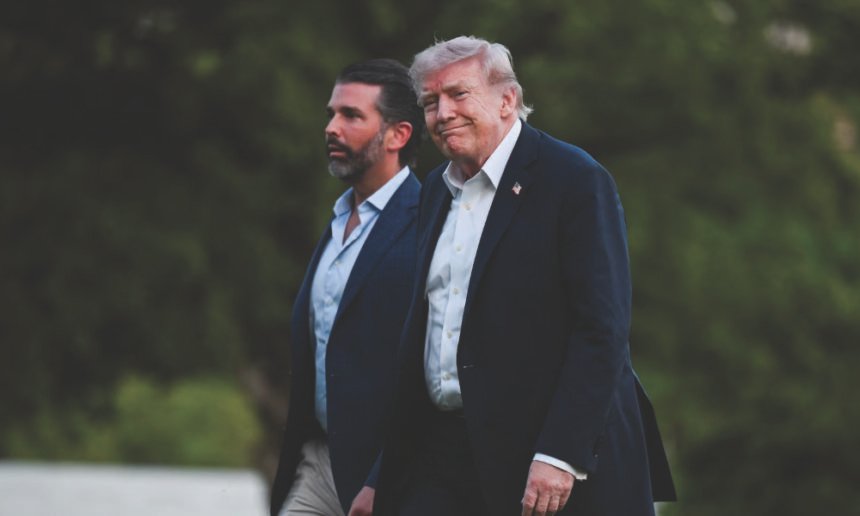
A startup backed by Donald Trump Jr. is reportedly in line for a whopping $15 billion Pentagon loan, an extraordinary government financing package that could turn the relatively young company into one of the biggest beneficiaries of Trump’s defense spending spree. And the more you look at the details, the more troubling this gets.
The company, Hadrian Automation, could receive one of the largest government loans in U.S. history to build a dozen automated factories producing military equipment, drones, munitions and precision components, according to an investigation by ProPublica.
The proposed funding would be almost twice the estimated value of the entire company and roughly 10 times larger than the biggest loan previously made through the Pentagon’s Office of Strategic Capital under the Trump administration.
And there’s another detail that makes the potential deal particularly significant: Donald Trump Jr.’s investment firm, 1789 Capital, holds a financial stake in Hadrian.
The firm participated in the company’s latest major funding round in August and previously invested in it in 2025. A spokesperson for 1789 Capital confirmed that the firm holds a minority stake, although the size of its investment has not been disclosed.
In other words, a massive infusion of taxpayer-backed financing could help dramatically expand a company in which the president’s son has a direct financial interest.
The proposed arrangement also raises questions about how much risk taxpayers could ultimately assume.
According to Pentagon documents reviewed by ProPublica, the funding would help Hadrian establish 12 automated factories in partnership with other defense and potentially commercial companies. The facilities would use artificial intelligence and robotics to increase domestic production of military equipment and other components.
The Pentagon has been seeking to expand domestic manufacturing capacity, particularly as the military faces shortages of certain munitions amid the wars in Ukraine and Iran.
But former Defense Department officials raised concerns about the structure of the proposed deal, warning that it could create an unusual financial dependency between the government and a relatively young private company.
Essentially, taxpayers could finance a massive expansion of Hadrian’s manufacturing operations, after which the federal government would presumably award contracts to the company. Those contracts could then generate revenue that Hadrian could use to repay its government loan.
That arrangement could leave taxpayers exposed if the company fails to deliver on its ambitious expansion plans.
And Pentagon staff reportedly have their own concerns.
Documents reviewed by ProPublica show that department personnel questioned whether Hadrian could scale its operations quickly enough, recruit sufficient workers and successfully execute a project of such enormous proportions.
Hadrian has attracted more than $1 billion in private investment and counts prominent Silicon Valley firms among its backers. But its ability to operate at the scale envisioned in the proposed Pentagon arrangement remains a significant question.
The company has pitched automation as a way to address longstanding manufacturing bottlenecks in the defense industry. Hadrian says its technology can help produce components for missile systems, fighter jets, spacecraft and naval vessels.
The company has already secured significant government business. In March, the Navy committed up to $900 million to a project involving submarine components and manufacturing.
The Pentagon is disputing the characterization of the proposed arrangement and insists political connections have nothing to do with its funding decisions.
A department spokesperson told ProPublica that discussions with Hadrian remain in their early stages and disputed the reported $15 billion figure.
“Outside affiliations, investors, or political connections play absolutely no role in the Department’s funding decisions,” the spokesperson said.
The White House also pushed back on suggestions that the administration was steering the deal toward a Trump-connected company. An administration official told ProPublica that Hadrian itself approached the Pentagon with the loan proposal and described the discussions as being at an extremely early stage.
Trump Jr.’s lawyer, Alan Garten, likewise denied that his client had any involvement in the company’s pursuit of government financing.
He said Trump Jr. played no role in Hadrian being considered for government funding and has no involvement in the company’s operations.
1789 Capital also said it does not get involved in government contracts sought by the companies in which it invests.
The potential deal is also raising questions about whether the Pentagon’s Office of Strategic Capital is being pushed beyond the mission Congress originally authorized.
The development is emerging just weeks before Democrats are expected to take control of both chambers of Congress, where party leaders have promised closer scrutiny of federal contracts, loans and other financial arrangements involving companies connected to the Trump family.
The proposed Hadrian financing is also not the first time a company backed by Trump Jr.’s investment firm has attracted attention over Pentagon funding.
ProPublica previously reported that a White House aide intervened in securing a $620 million Pentagon loan for Vulcan Elements, a rare-earth magnet startup that received investment from 1789 Capital just months earlier. The Pentagon and Trump Jr. denied that the company received preferential treatment.
The Hadrian proposal could raise even bigger questions.
Beyond the extraordinary size of the potential loan, former defense officials have questioned whether such a massive government-backed expansion of a private company could give it an unfair advantage over competitors.
There are also questions about whether the Pentagon’s lending program is being stretched beyond its original purpose. Congress established the Office of Strategic Capital to address gaps in the country’s industrial base, including technologies with both commercial and military applications.
Some former officials have questioned whether a project of Hadrian’s proposed scale fits comfortably within that mission.
For now, no $15 billion loan has been finalized, and the Pentagon insists the discussions are preliminary.
But the prospect of an unprecedented government financing package for a company backed by the president’s son’s investment firm is already raising questions about taxpayer exposure, government oversight and the increasingly intertwined worlds of Trump’s family business interests and federal spending.