








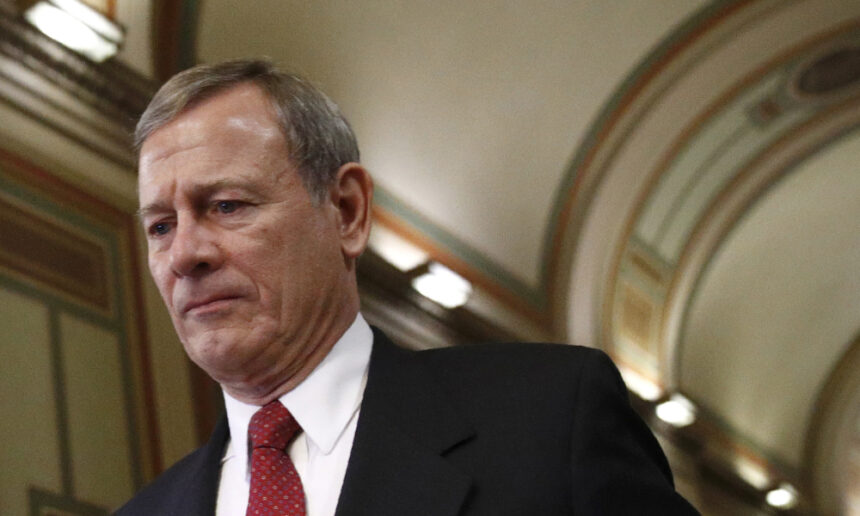
A complaint accusing Chief Justice John Roberts of potential misconduct is now before the body that oversees attorney discipline in Washington, D.C., and on September 10, that body will have to decide what happens next.
The complaint, docketed as No. 2026-U795, centers on millions of dollars reportedly received by Roberts’ wife, Jane Roberts, from law firms involved in cases before the Supreme Court.
The question now isn’t whether Roberts violated professional ethics. That hasn’t been determined. The immediate question is much narrower, and potentially more explosive:
According to journalist and political strategist Christopher Armitage, the D.C. Bar’s Board on Professional Responsibility is scheduled to consider the matter at its September 10 meeting.
And that puts the nation’s Chief Justice in an unusual position. Roberts has been a member of the D.C. Bar since 1981, meaning he is subject to the organization’s professional rules like other bar members.
The complaint’s author argues that the rules contain no blanket exemption for federal judges or Supreme Court justices.
The complaint was filed in April and raised questions about more than $10 million in commissions Jane Roberts reportedly received during her time at the legal recruiting firm Major, Lindsey & Africa.
The complaint alleges that the income was reported as salary on federal financial disclosure forms and argues that the characterization deserves scrutiny.
But according to the complaint’s author, the D.C. Office of Disciplinary Counsel never investigated the allegations, never asked Roberts for a response and never formally assessed whether the allegations, if true, could constitute an ethics violation.
Instead, the office closed the matter.
The explanation cited 28 U.S.C. § 351, a federal law governing complaints concerning the conduct of federal judges in their judicial capacity.
That’s where the dispute gets interesting.
The complaint wasn’t about a Supreme Court ruling or something Roberts allegedly did from the bench. It concerned financial disclosures and whether Roberts complied with professional obligations applicable to him as a member of the D.C. Bar.
The complaint’s author argues that the disciplinary office therefore relied on the wrong legal authority to shut the matter down.
D.C. Bar Rule XI, Section 2 allows discipline for misconduct “whether or not the act or omission occurred in the course of an attorney-client relationship.”
The money at the center of the complaint
The financial allegations are the reason this fight exists in the first place.
According to an internal spreadsheet attached to a 2022 whistleblower complaint sent to Congress, Jane Roberts received approximately $10.3 million in commissions between 2007 and 2014.
The payments reportedly came from placement fees involving major law firms including WilmerHale, Hogan Lovells and Davis Polk.
Those firms have appeared before the Supreme Court.
The complaint argues that calling the payments “salary” rather than commissions warrants investigation.
Several prominent legal figures have previously questioned the characterization of the income.
Law professor and former prosecutor Bennett Gershman has argued that describing the payments as salary was legally incorrect. Richard Painter, who served as chief ethics lawyer in the George W. Bush White House, has described the characterization as misleading.
And Kendal Price, an attorney who worked alongside Jane Roberts, has alleged under oath that her earnings were connected to her husband’s position.
Those allegations remain allegations. But the complaint’s central argument is that they should at least have been examined before the case was closed.
Instead, the disciplinary office declined to docket the complaint.
And here’s where the D.C. Bar’s own rules become a problem
The complaint’s author argues that the disciplinary system has built itself an unusually powerful escape hatch.
Under D.C. Bar Rule 2.4, the Disciplinary Counsel’s decision about whether to docket a complaint is not subject to review.
In practical terms, that means a complainant does not have a traditional appeal if disciplinary officials decide not to open a case.
The American Bar Association’s model disciplinary rules recommend giving complainants a mechanism to appeal dismissals to a supervising body.
D.C. does not provide that same avenue.
That matters here because the complaint is now asking the Board on Professional Responsibility to look at the disciplinary office’s decision even though the normal rules don’t provide an ordinary appeal.
And there is another precedent hanging over the dispute.
The William Barr precedent
In 2020, 27 lawyers—including four former presidents of the D.C. Bar—filed a disciplinary complaint against then-Attorney General William Barr.
The Office of Disciplinary Counsel declined to docket that complaint.
Among the reasons cited was the office’s position that it would not intervene in matters that were being publicly discussed in the national political arena.
The complaint’s author argues that this creates a troubling principle: The more politically prominent a case becomes, the easier it could be for disciplinary officials to decline to act.
And if the subject is an extraordinarily powerful government official, that raises an even bigger question about whether the rules are being applied equally.
The Jeffrey Clark precedent could be even more important
The Roberts complaint also points to a previous case involving Jeffrey Clark, a former senior Justice Department official.
When Clark argued that his federal position placed him beyond the reach of D.C. Bar discipline, the same disciplinary office took the opposite position.
It argued that holding federal office did not exempt a D.C. Bar member from professional discipline—and prevailed.
That creates an obvious question for the Board now:
If federal office didn’t shield Clark from the D.C. Bar, why should it shield Roberts?
That put pressure on the disciplinary system to explain why the same rules would be interpreted differently.
The Board has another option
On July 18, the complaint’s author asked the Board on Professional Responsibility to review the disciplinary office’s decision to close the matter.
On August 17, the Board’s Executive Attorney, James Phalen, responded that the request had been docketed and that the Board would meet on September 10.
The Board will then have an option that could change the trajectory of the case.
Under Rule XI, Section 4(e)(1), the Board has authority to consider and investigate alleged grounds for discipline **on its own motion**.
In other words, even if the disciplinary office doesn’t want to reopen the complaint, the Board has independent authority to investigate.
That is the power now sitting on the table.
September 10 could be the moment of truth
Nobody knows yet what the Board will do.
The complaint’s author acknowledges that the Board could still close the matter even if the legal arguments are persuasive. The rules give disciplinary officials substantial discretion over which complaints they pursue.
But the decision will be watched closely because of who is at the center of it.
This isn’t an ordinary lawyer.
It’s the Chief Justice of the United States.
If the Board agrees to investigate, Roberts would face scrutiny through the same professional disciplinary system that governs other D.C. Bar members.
If it refuses, the decision will raise a different question: Why?
The Board will have before it the closure letter, the D.C. Bar’s rules and the precedent established in the Clark proceedings.
And on September 10, it will have to decide whether those rules apply when the lawyer in question occupies the most powerful judicial position in the country.
That’s the real story here.
Not whether Roberts has been found guilty of misconduct—he hasn’t.
Not whether the allegations have been proven—they haven’t.
The immediate issue is whether the D.C. Bar will look at the allegations at all.
And whatever the Board decides, the answer will say something about how far the rules of professional accountability actually reach in Washington.
Because if the rules apply to everyone except the people at the top, then the question isn’t really whether there are rules.
It’s whether anyone powerful enough actually has to follow them.