






A federal appeals court has just put a stop to Donald Trump’s latest attempt to permanently plaster his name onto another building in Washington, D.C.
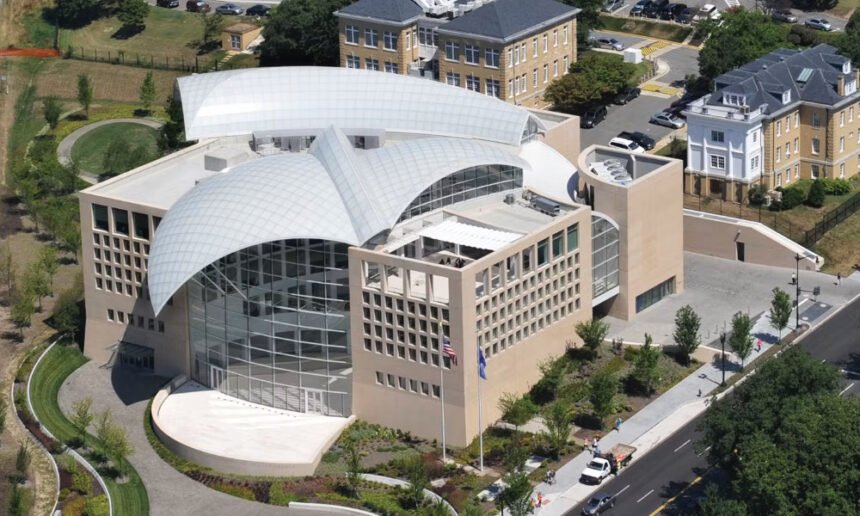
A divided three-judge panel of the D.C. Circuit Court of Appeals blocked the Trump administration from carving the president’s name into the headquarters of the U.S. Institute of Peace, an independent nonprofit created by Congress in 1984 to help prevent and resolve violent conflicts around the world.
Yep. Trump’s name can apparently be put on the building in giant letters — but carving it into the facade is a bridge the courts weren’t willing to let him cross.
The ruling came after attorneys for the Institute of Peace asked the appeals court for emergency relief, arguing that the administration could use a temporary court order in the broader case to literally set its position in stone.
The court agreed to block the carving.
Two judges on the three-member panel, Cornelia Pillard and Senior Judge Harry Edwards, voted to grant the institute’s request. Judge Karen Henderson, a George H.W. Bush appointee, would have rejected it.
The dispute is part of a much larger legal battle over the Trump administration’s effort to dismantle the Institute of Peace.
Trump announced plans in February 2025 to eliminate the institute as part of his push to shrink the federal government. The following month, members of the administration’s government-efficiency operation, then led by Elon Musk, forcibly entered the institute’s headquarters in an attempt to access its computer systems, according to the organization.
The administration also removed the institute’s president and Senate-confirmed board members.
And then Trump’s name was affixed to the outside of the building, prompting another round of litigation.
A federal judge previously ruled that Trump lacked the legal authority to remove the institute’s board members. The D.C. Circuit later put that ruling on hold while the administration’s appeal moves forward.
While that appeal was pending, the institute asked the appeals court to go one step further and prevent the administration from carving Trump’s name into the building itself.
The institute’s lawyers argued that allowing the administration to do so would amount to taking advantage of the court’s temporary order to “literally set things in stone” before the underlying legal dispute had been resolved.
The administration pushed back, telling the court that although the State Department had researched the possibility of engraving Trump’s name into the building, there were “no current plans” to do it.
The appeals court wasn’t taking any chances.
For Trump, it’s the latest setback in his increasingly aggressive effort to leave a physical imprint on Washington.
And there’s no shortage of examples.
The administration is already fighting a separate legal battle over the Trump-controlled Kennedy Center board’s effort to rename the performing arts complex for the president or otherwise place his name on its facade. A federal judge has blocked that effort, and the case is now before the D.C. Circuit.
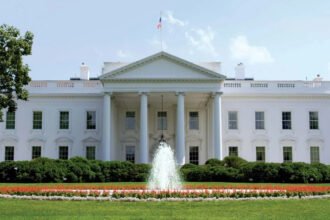
There are also lawsuits surrounding Trump’s proposed triumphal arch at Washington’s Memorial Circle, the controversial demolition the White House’s East Wing for a new ballroom and his proposal to paint the granite exterior of a 19th-century White House office building.
And now, when it comes to carving his name into yet another building, the answer from the federal appeals court is pretty simple: Not so fast.