








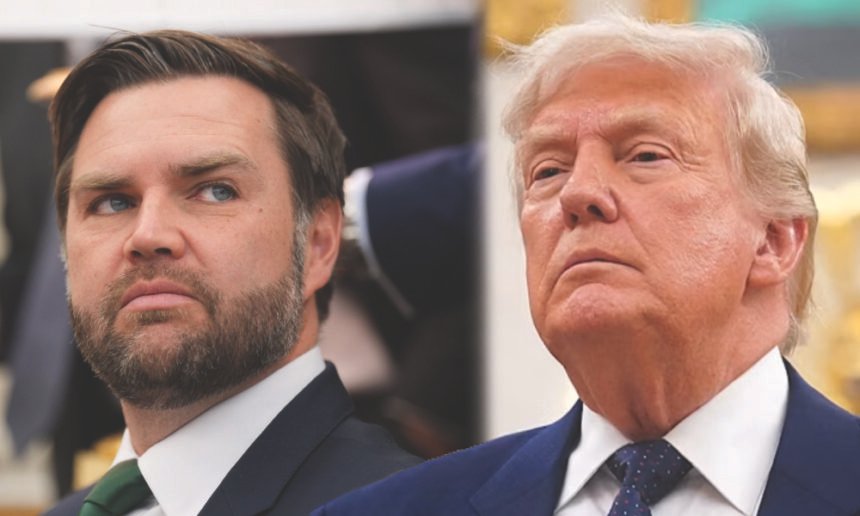
The Republican Party’s disastrous midterm performance is now fueling an increasingly uncomfortable showdown inside Donald Trump’s White House. Vice President JD Vance has publicly blamed Trump’s war with Iran for the GOP’s crushing losses, and the president is pushing back, insisting that the war was the right decision and that Republicans aren’t happy with the vice president pointing fingers at his commander in chief.
Trump has reportedly been fuming behind closed doors over Vance’s remarks. But in public, Trump tried to brush off questions about whether Vance’s comments had damaged their relationship. His response, however, quickly turned into a defense of the very war his vice president had identified as a major reason Republicans lost.
“No, not at all,” Trump said when asked whether the remarks had affected their relationship.
“A lot of people didn’t like his comments,” Trump added, before making clear that he wasn’t about to back away from the decision to attack Iran.
Trump said Vance should have made one additional point: that he would make the same decision all over again.
“If you had it to do again? Would you do it again? The answer is yes,” Trump declared, insisting the military campaign would go down as “one of the best things we ever did.”
And that’s where the tension gets interesting.
Vance didn’t simply offer a vague explanation for the Republican defeat. He directly blamed the president’s war with Iran in a lengthy social media post, writing: “The reason we lost is the war. The president himself said so last night.”
He then challenged Republicans defending the conflict to explain whether losing control of the Senate for the next six years was worth the price.
“If you’d like to argue it was worth it, that losing the Senate for the next 6 years was worth it, then do so,” Vance wrote. “Argue it was a worthwhile cost to pay. Agree or disagree, that’s at least honest.”
That’s a remarkable public rebuke from a sitting vice president — particularly one widely viewed as Trump’s likely successor.
Vance was pointing to Trump’s own acknowledgment that the Iran war contributed to the Republican losses. In an interview with The Wall Street Journal, Trump admitted the conflict “was a piece of it.”
But Trump continues to argue that preventing Iran from obtaining a nuclear weapon justified the military campaign. He has also left the door open to renewed military action, although he said that was unlikely if peace negotiations progress.
The problem for Republicans is that the war has become a political liability, and the president and vice president are now publicly emphasizing different sides of the fallout.
The timing couldn’t be worse for Vance. Before the midterms, he was widely viewed as the natural heir to Trump’s political movement and the early favorite for the 2028 Republican presidential nomination.
Now he’s facing a difficult balancing act: acknowledge the political damage caused by Trump’s decisions without appearing to turn against the president whose support helped put him in the White House.
Vance, 42, remains closely connected to the MAGA base. But he also has to own the administration’s record, including its increasingly unpopular policies and the Iran war.
“He also has to own every decision that is made the past two years and the next year,” Arizona-based Republican strategist Barrett Marson said.
Vance has reinvented himself before. He was once a sharp critic of Trump before becoming one of his most loyal allies. His decision to blame the Iran war for the midterm losses may be an attempt to show Republican voters that he can acknowledge the party’s mistakes.
But criticizing the president’s biggest foreign policy decision while serving as his vice president is a risky position — especially when Trump is publicly defending that decision and refusing to give Vance a clear endorsement for 2028.
Asked about the possibility of Vance succeeding him, Trump offered no commitment.
“Maybe you have a lot of people running. Maybe nobody’s going to run. Maybe he won’t run. I don’t know who’s going to run,” Trump said.
That hardly sounds like a president clearing the runway for his vice president.
One political consultant suggested Vance may even be questioning whether a presidential campaign is worth the effort.
“He’s probably asking, ‘Am I going to commit the next two years of this when the odds of success are pretty slim?’” the consultant said.
And Vance has another problem: he’s no longer the only Republican preparing for life after Trump.
Secretary of State Marco Rubio is emerging as a potential alternative. The State Department denied reports that he was considering stepping down to prepare for a presidential campaign, but he has several advantages, including national name recognition, foreign policy experience and an ability to build coalitions within the party.
Unlike Vance, Rubio largely kept his distance from Trump’s midterm campaign. He appeared onstage during the final stretch and spoke for just 11 seconds. That distance could give him room to present himself as a different kind of Republican candidate.
Former Florida Gov. Ron DeSantis is also blaming Trump for the midterm disaster, calling the results an “extinction-level event” for Republicans and a rebuke of the president and Congress.
DeSantis may also point to Florida’s performance as evidence of his political strength. While Texas and Kansas flipped blue, Florida remained firmly Republican.
Then there’s Texas Sen. Ted Cruz, who has not ruled out another presidential campaign. Cruz described the midterm results as a “blue tsunami” and an “a– kicking,” while noting that Republicans lost every statewide election in Texas.
Former Virginia Gov. Glenn Youngkin is another potential contender. He has repeatedly played down the possibility of running, but his more moderate image could offer Republicans a different path. Whether that approach can attract the party’s primary voters remains an open question.
The battle for Trump’s succession is getting messier
The midterm losses have done more than weaken Republicans politically. They’ve opened the door to a fight over the party’s future — and who gets to lead it after Trump.
Vance is still closely connected to the MAGA movement, but that connection also ties him to an administration facing voter backlash, a controversial war and a bruising election defeat.
His attempt to pin the Republican losses on the Iran war has put him in a politically awkward position. He’s effectively telling voters that the president’s decision helped cost Republicans their congressional majority, while Trump is insisting that the same decision was necessary and absolutely worth repeating.