








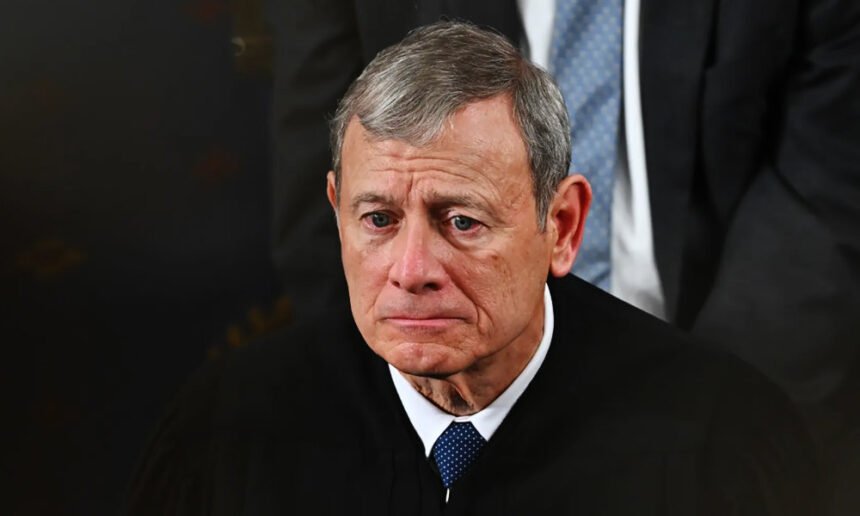
Chief Justice John Roberts is facing a very public impeachment push.
Rep. Steve Cohen, a senior member of the House Judiciary Committee, has introduced six Articles of Impeachment against Roberts, accusing the chief justice of violating the Constitution, disregarding his legal obligations and breaching his judicial oath.
And now an online petition demanding congressional action has reportedly passed 34,000 signatures.
The impeachment effort isn’t coming from some obscure corner of the internet.
It comes from a sitting member of Congress who has spent years working on the Judiciary Committee.
Cohen, a Tennessee Democrat, introduced the six articles. The resolution, H.Res. 1309, was referred to the House Judiciary Committee and has not been approved by the full House.
But Cohen isn’t exactly being subtle about what he thinks is wrong with the Roberts Court.
“The Supreme Court was once a proud and credible institution,” Cohen said when announcing the articles.
He argued that under Roberts’ leadership, the Court has come to be viewed as politically biased, with decisions that Cohen says benefit Republicans and the wealthy while undermining public confidence in the judiciary. Those are Cohen’s allegations and political assessment, not findings by a court or Congress.
And Cohen has put six separate accusations on the table.
Article One: A partisan Supreme Court
Cohen’s first article accuses Roberts of allowing the Supreme Court to become a partisan political force.
His argument centers heavily on the Court’s handling of election and redistricting cases.
Cohen points to the Court’s decision in Louisiana v. Callais and what followed in several states, including Tennessee, Louisiana, Alabama and Virginia.
In Tennessee, lawmakers subsequently redrew congressional districts, splitting the Memphis-based district Cohen had represented for nearly two decades.
Cohen argues that the Court’s handling of redistricting cases has been inconsistent and disproportionately benefited Republicans.
He has repeatedly criticized the timing of the Callais decision, arguing that the Court could have waited until later in its term but instead released the ruling in April, allowing states to act before the 2026 elections.
That’s the foundation of Cohen’s first impeachment article: that Roberts either failed to administer the Court impartially or allowed the Court’s actions to create the appearance that it was acting politically.
Article Two: The rich and powerful
The second article goes after what Cohen sees as a broader problem with the Roberts Court.
He accuses Roberts of leading a Court that systematically favors powerful interests over ordinary Americans.
Cohen argues that the Court’s decisions have weakened popular sovereignty and democratic representation and could help entrench political power that doesn’t reflect the will of voters.
Cohen isn’t arguing about one controversial ruling. He’s arguing that there is a pattern.
Article Three: Money and politics
Then there’s campaign finance.
Cohen’s third article accuses Roberts of violating his judicial oath to “do equal right to the poor and the rich” by helping create a campaign-finance system that gives wealthy interests greater political influence.
That argument goes directly at some of the Court’s major campaign-finance precedents.
Cohen’s position is that the Court’s approach has effectively tilted the political system toward those with the deepest pockets.
Article Four: Presidential immunity
This one is probably the most politically explosive.
Cohen accuses Roberts of usurping Congress’s authority and placing the president beyond criminal accountability for certain official conduct.
The accusation centers on the Supreme Court’s 2024 presidential-immunity ruling.
In Cohen’s view, the decision effectively put one person above the law and violated Roberts’ obligation to administer justice “without respect to persons.”
That’s not a minor disagreement over constitutional interpretation. It’s an accusation that the chief justice himself violated his oath.
Article Five: The Court’s unexplained rulings
Cohen’s fifth article targets what he describes as arbitrary, unexplained and inconsistent decisions by the Supreme Court.
Much of that criticism focuses on the Court’s emergency docket, where major cases can sometimes be resolved through short orders without the kind of detailed reasoning found in full opinions.
Cohen argues that this approach undermines constitutional protections and makes it difficult for the public to understand why the Court is making decisions that can have enormous consequences.
Article Six: Ethics and financial disclosures
And then there’s the ethics issue.
Cohen’s sixth article accuses Roberts of failing to fully disclose assets on financial forms and failing to recuse himself from cases involving potential conflicts of interest.
The article also raises questions about Roberts’ wife, Jane Sullivan Roberts, who has worked as a legal recruiter and whose clients have included major law firms.
Cohen alleges that firms litigating before the Supreme Court paid her millions of dollars while Roberts was sitting on cases involving those firms.
He argues that this created at least the appearance of a conflict and says Roberts’ conduct violated federal recusal law, including 28 U.S.C. § 455.
In June, he called for Roberts’ impeachment during a Judiciary Committee markup, saying the chief justice had failed to protect the integrity and independence of the Court.
Now the impeachment push has picked up another element: an online petition demanding congressional action.
The petition’s organizers say more than 34,000 letters have been sent to Congress calling for Roberts’ impeachment.
There is no indication that Roberts is about to be removed from the Court. But the charges are now officially sitting in Congress.
Six of them.
And thousands of people are asking Congress to do something about them.
For Roberts, that’s a pretty remarkable place to be.
The chief justice of the United States is supposed to be one of the most insulated figures in American government.
Instead, he now has a member of Congress formally accusing him of violating his oath, abusing his authority and failing to administer justice impartially.