









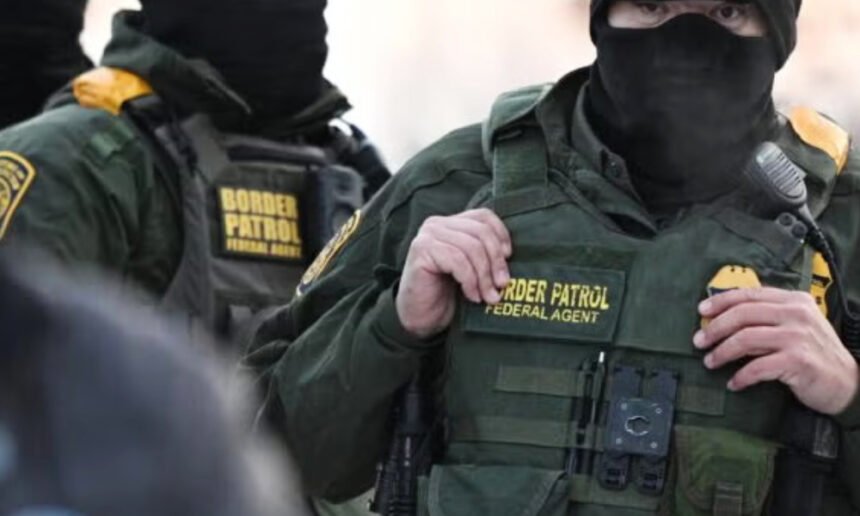
A longtime ICE official who helped evaluate job applicants is warning that the agency’s rapid hiring push has created what he describes as “grave national security risks”—and a separate federal records request is raising new questions about misconduct inside the agency.
The whistleblower, a 17-year ICE veteran who oversaw more than 100 employees responsible for evaluating thousands of applicants, filed a complaint with the Department of Homeland Security’s inspector general.
His complaint, first reported by The New York Times, alleges that ICE lowered its hiring standards and moved applicants through the process before completing critical background checks.
“We chose as an agency to be more convenient rather than thorough,” the official wrote, warning that the approach has the “potential to put lives at risk and jeopardize national security.”
That warning comes as ICE has expanded at a breathtaking pace under the Trump administration.
The agency brought in roughly 12,000 new hires last year, lowered the minimum hiring age from 21 to 18, removed its college-degree requirement and accelerated the hiring process.
The workforce has more than doubled. And according to the whistleblower, speed came at a price.
The ICE official alleges that some applicants received job offers before their background investigations were complete.
He says incomplete fingerprints and other required information meant officials sometimes had to make hiring decisions without having the full picture of an applicant’s history.
The complaint also alleges that employees were instructed to make decisions without complete security forms, fingerprints or polygraph examinations.
That is particularly concerning for an agency whose officers carry weapons and have broad authority to arrest and detain people.
Another former ICE official, attorney Ryan Schwank, has separately described the agency’s training system as “deficient, defective and broken.”
Schwank also alleged that recruits were given what he called a “blatantly unlawful order” to forcibly enter homes without a warrant.
“The academy is teaching cadets to violate the Constitution,” he said, while alleging that the practice was being kept secret.
The hiring surge came as misconduct allegations mounted
Against that backdrop, federal records obtained through a Freedom of Information Act request show that ICE’s Office of Professional Responsibility had 148 open allegations of misconduct or criminal wrongdoing.
The allegations include sexual assault, bribery, drug smuggling, domestic violence, drunk driving and misuse of government computers.
The records also include 10 incidents involving the discharge of service weapons, Newsweek revealed in a bombshell report.
Those incidents resulted in five deaths or serious injuries, three cases involving no injury or damage, one involving property damage and one involving a minor injury.
The records break down the allegations further. There were five bribery cases, two allegations of adult sexual assault, two drug-smuggling cases, three domestic-violence cases and two sexual-harassment cases.
There were also 10 DUI or DWI allegations, six involving misuse of government vehicles and 15 involving government computers, email or phones.
Another 12 allegations involved misuse of position or conflicts of interest, while 12 involved hostile work environments.
The report does not identify the individuals involved, establish whether the allegations were substantiated or say what discipline, if any, resulted.
Still, the whistleblower complaints and misconduct records raise a common question: what happens when an agency responsible for some of the government’s most powerful law-enforcement functions grows faster than its systems for vetting, training and supervising the people carrying out that mission?
‘The risk is obvious’
John Sandweg, who served as acting ICE director under President Barack Obama, said the sheer number of unresolved cases raises questions about whether the agency has enough capacity to investigate allegations promptly.
He also warned that rapidly expanding an agency can create its own problems if hiring speed takes priority over finding and properly training qualified personnel.
That concern is especially significant given the circumstances surrounding ICE’s expansion.
The agency has become the centerpiece of Trump’s mass-deportation campaign, with agents conducting tens of thousands of arrests as the administration pushes to dramatically increase immigration enforcement.
At the same time, ICE has faced mounting scrutiny over the conduct of individual agents and the circumstances surrounding several shootings.
One particularly contentious case involves ICE agent David Brouillette, who fatally shot Johan Sebastián Durán Guerrero in Maine.
Two of Brouillette’s former wives have alleged that he had a history of violence and abuse and questioned whether ICE properly investigated that history before hiring him. Those allegations have not been established as findings of misconduct.
The cases have intensified calls from lawmakers for greater oversight of the agency.
Rep. Bennie Thompson and Rep. Seth Magaziner have criticized what they describe as inadequate accountability and transparency within ICE.
The latest whistleblower complaint adds another layer to those concerns.
It isn’t simply alleging that individual ICE officers may have committed misconduct. It is alleging that the system responsible for deciding who gets to become an ICE officer in the first place was compromised by the rush to hire.
If the agency is putting speed ahead of those safeguards, the question isn’t just how many people ICE can put on the streets. It’s who, exactly, the agency is putting there.
Meanwhile, the Department of Homeland Security said it does not comment on personnel, but defended its vetting process. The agency said applicants receive tentative selection letters after completing the application and interview process, while some can begin training under temporary status before their full background investigation is completed.