







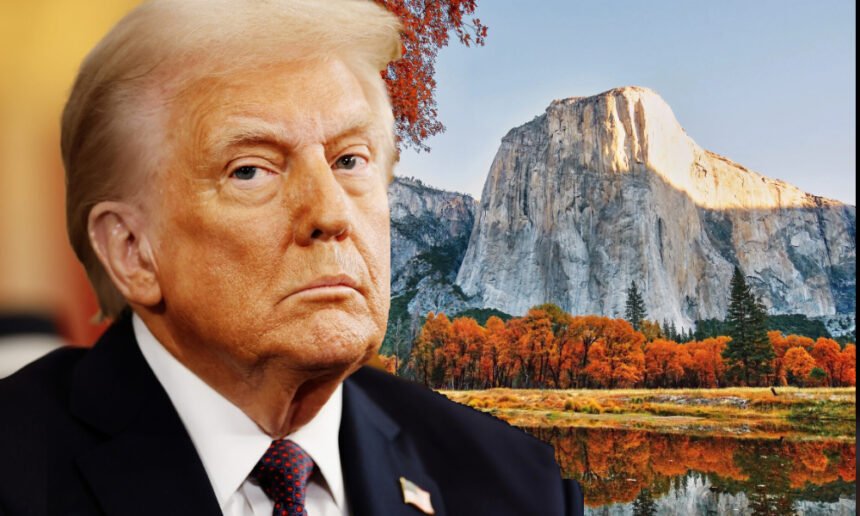
Yosemite National Park belongs to the American public.
However, the Trump administration is reportedly pushing a controversial proposal that could give part of the national park to a private developer, allowing the company to build a road connecting its property to an existing park road. The new access would make the developer’s property considerably more valuable.
And here’s the part that makes the whole thing particularly interesting: Previous administrations said no.
According to NOTUS, the Bush, Obama and Biden administrations all rejected similar proposals involving the property.
Now the proposal is back under President Donald Trump, and sources familiar with the discussions say political appointees at the Department of the Interior are pressuring the National Park Service to move it forward.
The Interior Department strongly denies that characterization. But the circumstances are raising eyebrows.
The property at the center of the dispute is an 83-acre parcel owned by Kingsbarn Realty Capital, a real estate investment and development company.
Its CEO, Jeff Pori, has public business ties to people in Trump’s orbit, according to NOTUS.
The property sits near one of Yosemite’s most famous attractions: the Mariposa Grove of Giant Sequoias.
And the developer wants a road.
Not just any road. The proposed private road would cross National Park Service land and connect the 83-acre property to an existing road inside Yosemite, providing much easier access toward Yosemite Valley.
Right now, getting from the property to the valley requires a roughly 90-minute, winding drive.
With the proposed road, the trip would become dramatically easier. That could also make the private property considerably more valuable.
According to NOTUS, the land could potentially be developed into a hotel, resort or private residence.
One person familiar with the situation told NOTUS that the arrangement looks particularly questionable because of the potential impact on the property’s value.
“Obviously this looks kind of unseemly, with the value of this property potentially exploding with the deal,” the source said.
Another source offered an even less diplomatic assessment: “It kind of smells, you know. It’s not quite right.”
And then there’s the reported pressure inside the Park Service.
Four people familiar with the discussions told NOTUS that Kingsbarn’s proposal has the backing of Interior Secretary Doug Burgum’s political leadership.
Those sources said Trump administration officials are pressuring National Park Service employees to approve the proposal despite the fact that similar proposals were rejected under three previous administrations.
NOTUS reported that Park Service staff have been required to provide regular updates on the proposal to political appointees inside Burgum’s office.
Sources also told the outlet that political staff have occasionally berated Park Service employees for failing to move quickly enough.
“They want us to be responsive to the property owner and their lobbyists or people, and they want us to work with these folks,” one anonymous source told NOTUS.
Another source described the political pressure as “very unusual.”
If that’s what is happening, it would certainly be an unusual way to handle a private developer’s request for access through one of America’s most treasured national parks.
The Interior Department says that’s not what’s happening.
“This story relies on anonymous allegations to manufacture a political narrative that simply is not true,” the department said in a statement. “There has been no political pressure to reach a predetermined outcome, and claims suggesting the Department is secretly working to hand over National Park Service land to a private developer are false.”
Interior also stressed that no final decision has been made.
The federal government can’t simply decide to give away a piece of a national park because a developer wants it.
Under public-land rules, if the National Park Service gives up park land, it must replace it with land of equivalent value.
The Interior Department says it will comply with that requirement if a deal ultimately moves forward.
So, technically, nobody is handing Yosemite over to a developer.
At least not yet. But the bigger question isn’t simply whether the government can legally exchange land.
It’s why this particular proposal is suddenly receiving so much attention.
The property owner wants a private road through federal land.
The road could substantially improve access to an 83-acre property that could potentially be developed into a lucrative resort, hotel or private residence.
Three previous administrations rejected similar proposals.
Now, sources say political appointees under Trump are pushing Park Service employees to move the proposal along.
And the developer’s CEO has public connections to people in Trump’s political orbit.
The administration says the allegations are false.
That leaves the public with a fairly straightforward question:
What changed?
Because Yosemite hasn’t changed.
The developer’s property hasn’t suddenly moved closer to Yosemite Valley.
And the rules governing federal land haven’t disappeared.
The biggest difference is who’s sitting in the White House.
For now, the Interior Department says no final decision has been made. That’s precisely why this is worth watching.
Once a road is built, a land exchange is completed and private development begins, the debate over whether the deal was a good idea becomes considerably harder to undo.