








A federal judge has blown up what she described as an extraordinary legal arrangement between Donald Trump and his own administration, tossing out the settlement that created what critics called a nearly $1.8 billion January 6 slush fund and referring multiple attorneys for possible disciplinary action.
In a scathing 56-page ruling, U.S. District Judge Kathleen Williams concluded that the entire agreement was fundamentally illegitimate because, in her view, there was never an actual legal dispute between the two sides. Instead, she found that Trump’s Justice Department was effectively negotiating with Trump’s own legal team to produce a settlement that would funnel billions of taxpayer dollars toward grievances not recognized under federal law.
“The nature of the suit itself and the conduct of the Parties and counsel from its filing make plain that this was an attempt to use the Court to provide some legitimacy to an agreement to confer immunity to people and entities affiliated with the President and to earmark billions of dollars from American taxpayers to redress grievances not defined in the law,” Williams wrote.
The judge’s ruling wipes out the settlement that had formed the legal foundation of the fund.
Williams also ordered that parties connected to the agreement—including Trump, the Treasury Department and the IRS—are prohibited from relying on the settlement in any official capacity moving forward.
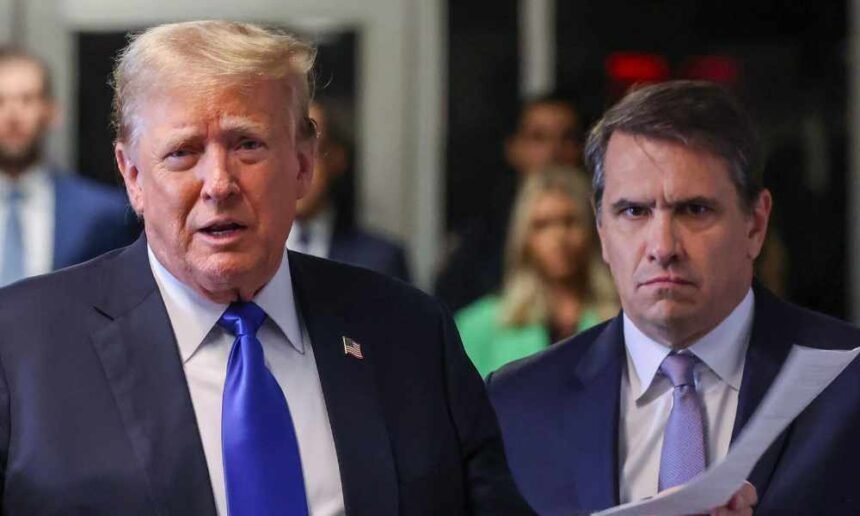
Perhaps even more remarkable, the judge referred Trump attorney Alejandro Brito to the Florida Bar for possible professional discipline and referred former Trump attorney and current Deputy Attorney General Todd Blanche, along with Justice Department attorneys involved in the case, for possible sanctions over their conduct.
At the heart of Williams’ decision was a simple conclusion: this was never a genuine lawsuit.
Trump originally sued over the unauthorized disclosure of his tax returns. But Williams noted that he waited until after returning to the White House—when his own appointees controlled the Justice Department—to pursue the litigation.
Those same administration officials then negotiated directly with Trump’s private attorneys.
“These officials then negotiated on behalf of the United States, with his current lawyers, including his former White House Counsel, to reach a ‘settlement,'” Williams wrote. “It is risible to suggest that there was ever adverseness between the Parties.”
According to the ruling, the settlement contained provisions that went far beyond resolving Trump’s tax-return claims.
Among them was language drafted by Blanche that purported to permanently shield Trump, his family and his business interests from future federal claims by declaring the United States would be “forever barred and precluded” from pursuing them.
Williams said those extraordinary provisions—and the proposal to distribute billions in taxpayer funds for vaguely defined grievances—were never meaningfully presented to the court.
Instead, she concluded, the entire proceeding was built on the fiction that two opposing parties were litigating against each other when, in reality, they shared the same interests all along.
“The answer is a resounding ‘no’: the Lead Plaintiff and the Government are one, a fully realized unitary interest,” Williams wrote.
The judge also pointed to Blanche’s congressional testimony earlier this year, in which he spoke confidently about the future of the proposed fund, as further evidence that the government and Trump’s legal team were acting as one.
Williams ultimately concluded there was never a legitimate controversy for a federal court to resolve.
“In sum,” she wrote, “the facts before this Court demonstrate there was never adverseness between the Parties; there was never a case or controversy; and there was never a question as to who would prevail.”
The ruling represents one of the sharpest judicial rebukes yet of the Trump administration’s handling of a case involving the federal government, with a judge concluding that the court itself had been used to legitimize an agreement that never should have existed in the first place.