








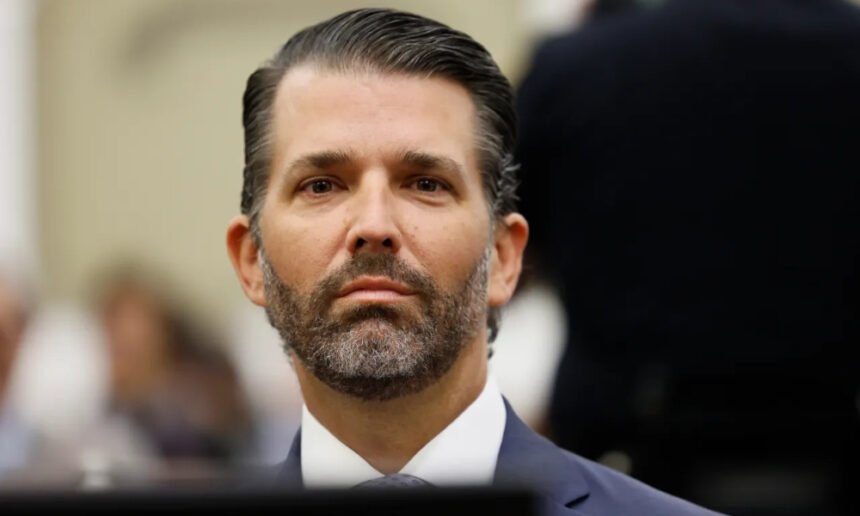
Donald Trump Jr. has found himself at the center of a new congressional investigation into a string of remarkably lucrative investments made by his venture capital firm since his father returned to the White House.
The investigation seeks to determine whether the unusual pattern of investments and subsequent government actions that benefited those companies warrants a closer look.
House Democrats want to know whether 1789 Capital is simply extraordinarily good at picking winners, or whether being closely connected to the Trump administration has given the firm an advantage other investors don’t have.
Rep. Jamie Raskin, the top Democrat on the House Judiciary Committee, is demanding answers from 1789 Capital, the venture capital firm Trump Jr. joined shortly after Donald Trump returned to the presidency.
In a letter obtained by MS NOW, Raskin points to a series of investments he says were made with “almost clairvoyant accuracy.”
The timing of some of those bets, he argues, is difficult to ignore.
When Trump Jr. joined 1789 Capital, the firm was reportedly worth only a few million dollars.
It is now estimated to be worth roughly $3 billion.
That’s a staggering jump—and Raskin wants to know exactly how it happened.
The $620 million Vulcan windfall
One investment in particular is drawing scrutiny: Vulcan Elements, a rare-earth magnet producer.
1789 Capital bought an undisclosed stake in the company in 2025.
About three months later, the Pentagon announced a $620 million loan to Vulcan.
The timing was remarkable. Bloomberg valued the two-year-old startup at roughly $200 million around the time 1789 Capital invested.
After news of the government deal broke, Vulcan’s estimated value soared to nearly $2 billion.
Raskin called it an “amazing turn of events” that the Trump administration decided to put more than half a billion dollars into what was then an unproven startup.
Trump Jr. has denied having inside information.
He previously told The New York Times that he and 1789 Capital president Omeed Malik simply made a reasonable assumption that Vulcan would succeed.
“It’s not like it takes a genius to figure this out,” Trump Jr. said.
Perhaps not. But Raskin isn’t convinced the timing can simply be waved away.
Then there’s Juul
Vulcan isn’t the only investment attracting attention.
Raskin is also seeking information about 1789 Capital’s investments in Juul, Polymarket and defense contractor Anduril Industries.
Reuters reported that 1789 invested in e-cigarette company Juul in March 2025.
Later, the Food and Drug Administration reversed a ban involving certain e-cigarette products.
Once again, the question is whether 1789 was simply making smart bets—or whether the firm had unusually good insight into where federal policy was heading.
Raskin sees a pattern.
“With Don Jr.’s new leadership role, 1789 Capital has developed an uncanny ability to identify companies that are about to receive massive influxes of cash from the Trump Administration or to benefit from significant changes in federal policies and regulations,” he wrote.
“They say there is no such thing as a sure thing in investing, but this is about as close as you can get.”
Democrats want the receipts
Raskin isn’t just asking for explanations. He’s demanding records.
His letter seeks communications involving 1789 Capital and federal officials, elected representatives and other government figures, along with a complete list of the firm’s investments.
The purpose is to determine whether Trump’s return to power created investment opportunities that 1789 Capital was uniquely positioned to exploit.
Raskin went even further, arguing that it is “impossible to believe that your firm’s astonishing growth and success are due to anything other than insider political influence and thoroughgoing corruption.”
That’s a serious accusation.
Trump Jr.’s firm calls it political harassment
1789 Capital isn’t taking the allegations quietly.
AJ Merton, counsel for the firm, dismissed Raskin’s claims as “unsubstantiated talking points.”
“Repackaging press clippings on congressional letterhead does not turn news headlines into evidence,” Merton told MS NOW, calling the investigation a partisan stunt and politically motivated harassment.
Trump Jr. has likewise denied having inside information about the investments.
So far, Republicans in Congress have resisted Democratic efforts to subpoena Trump Jr. over the firm’s investments.
But that could change dramatically depending on the outcome of November’s elections.
A $3 billion question
The investigation comes at an awkward time for the Trump family.
Since Donald Trump returned to the White House, his administration has made major financial and regulatory decisions affecting industries in which Trump’s allies and associates have invested.
At the same time, Trump Jr.’s venture capital firm has gone from reportedly being worth only a few million dollars to an estimated $3 billion.
That doesn’t prove wrongdoing. But it does raise a question that isn’t going away:
How did Trump Jr.’s firm manage to repeatedly position itself so close to major government decisions—and profit so handsomely when those decisions arrived?
Raskin believes the timing is too extraordinary to ignore.
If Democrats regain control of the House after the November elections, they could have substantially more power to obtain the records and testimony they are currently seeking.
The biggest question surrounding 1789 Capital isn’t whether its investments were profitable. It’s whether someone knew where the government was heading before everyone else did.