







For years, MAGA influencers spent their time insisting every election they lost was somehow “rigged.” Now one of their own is leveling eyebrow-raising claims against Elon Musk that sound less like normal campaign strategy and more like something pulled from a Silicon Valley political thriller.
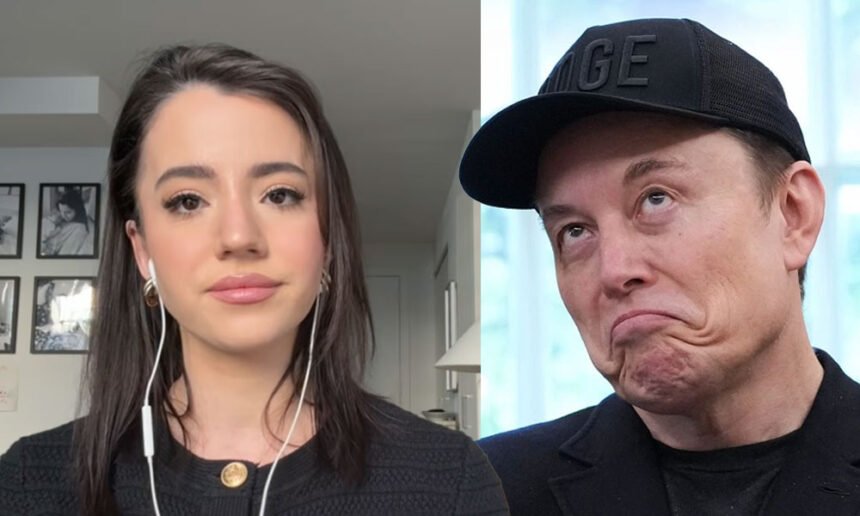
Ashley St. Clair, the conservative influencer who has publicly claimed Elon Musk fathered one of her children, posted a TikTok detailing what she says were private conversations with Musk during the 2024 election cycle. And according to her, those conversations left her deeply unsettled.
The story she’s telling is absolutely explosive.
St. Clair claims that in October 2024, Musk told her he was preparing to unveil what he allegedly described as an “anomaly in the matrix.” According to her, Musk referenced having “10,000 lasers in space,” which she interpreted as a reference to Starlink satellites.
“And he says, you know, this is not a piece they’ll see on the chessboard,” St. Clair recalled in the video.
Because apparently billionaires now talk like rejected Bond villains.
St. Clair says the conversation immediately made her uncomfortable. According to her, she responded by saying she didn’t want to ask further questions because she didn’t want to be “deposed.”
Musk’s alleged response?
“Very wise.”
Which, to put it mildly, is not exactly the kind of sentence that makes people feel reassured about democracy.
The influencer also claimed Musk later sent her internal America PAC data showing what she described as “real-time delta vote metrics” during the election. St. Clair said the data allegedly seemed far beyond the kind of voter information campaigns typically get from door-knocking operations.
“And I am just like, how the f*ck do you have this sort of data?” she said in the video.
She went on to mock the quality of campaign field operations, saying many political canvassing vendors are chaotic and unreliable, making the sophistication of the alleged data even more surprising to her.
Then came election night.
St. Clair claims Musk already knew Donald Trump would win hours before major networks officially called the race because his operation supposedly had unusually advanced real-time analytics.
Naturally, the internet immediately exploded.
Because when Americans hear phrases like: “private satellite network”, “real-time election data”, “secret chessboard strategy”, and “10,000 lasers in space”, all attached to one of the richest men on Earth, people tend to have a few questions.
Especially when that billionaire also owns a major social media platform, operates a global communications network, holds massive government contracts, and spends enormous amounts of money influencing elections.
The wildest part may be St. Clair claiming she was disturbed enough by these conversations that she began documenting communications and sending records to third parties “in case anything happened” to her.
Again, not exactly calming language.
She also compared the situation to the Cambridge Analytica scandal — except “a million times worse.”
That comparison alone was enough to send social media spiraling into conspiracy theories, memes, panic, and partisan warfare.
Now, to be absolutely clear: St. Clair has not publicly produced evidence proving these allegations, and there is currently no verified evidence that Musk, Starlink, or America PAC manipulated voting systems or altered vote counts in the 2024 election.
But the reason this story is blowing up online isn’t hard to understand.
Americans are already deeply uneasy about the growing power of billionaire tech moguls who control communications infrastructure, social media algorithms, political messaging pipelines, surveillance-scale data systems, and massive campaign financing operations all at the same time.
At this point, Elon Musk isn’t just a businessman. He’s become an unelected power center with influence touching media, politics, communications, AI, national security, elections, and public discourse simultaneously.
That concentration of power makes people nervous. And honestly, it probably should.
And somehow, after spending years screaming about “election interference,” many of the same political figures who demanded investigations into Facebook memes and voting machines are suddenly a lot less interested in asking questions when one of their own billionaire allies ends up at the center of controversy.
Because apparently “protecting democracy” depends entirely on whose billionaire is involved.
Meanwhile, ordinary Americans are left watching billionaires, PACs, influencers, private tech systems, political propaganda machines, and social media empires merge together into something that increasingly feels less like a functioning democracy and more like a cyberpunk reality show nobody remembers signing up for.
And maybe the most disturbing part of all is this: Stories like this don’t even sound impossible anymore.