








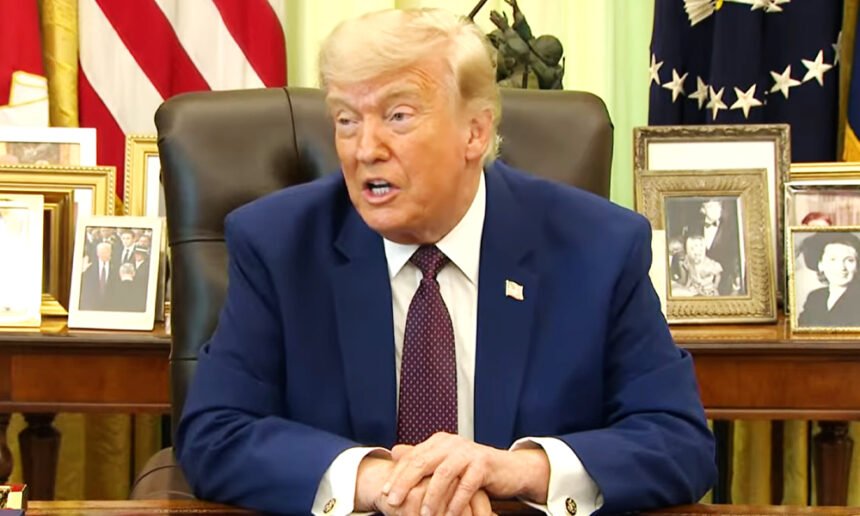
Donald Trump tried to explain his collapsing ceasefire with Iran on Wednesday, and somehow ended up talking about how “very easy” it would be to “wipe everybody out.”
It was that kind of press conference.
Asked whether the shaky ceasefire in the Middle East was still holding after Iran launched missile strikes targeting Kuwait, Trump didn’t exactly offer a clean yes-or-no answer. Instead, he suggested that ceasefires in that part of the world don’t really mean what people think they mean.
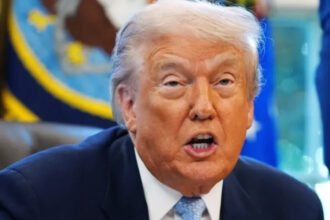
“It’s a different part of the world,” Trump said. “I’d say in that part a ceasefire is when you’re shooting in a more moderate manner.”
That definition will probably surprise anyone who assumed a ceasefire involved less shooting, not more politely calibrated violence.
Trump also appeared to downplay the seriousness of the exchange of fire, suggesting Iran’s missile attack came in response to earlier U.S. military action.
“We’ve been hitting them pretty hard,” he said, adding that there was “a reason” for the escalation and describing the situation as something that was “nipped in the bud.”
But the “bud” in question included a missile strike on Kuwait’s main airport that reportedly killed one person and injured more than 60 others, according to local officials. Kuwaiti defenses intercepted some of the incoming missiles and drones, but not all of them.
Still, Trump framed the situation less as a crisis and more as a kind of regional misunderstanding with occasional explosions.
Then came the moment that turned heads.
“There’s never been a military like what we have,” Trump said. “We could go another two, three weeks and just wipe everybody out. Very easy to do.”
It wasn’t entirely clear who “everybody” referred to, but the scale of the statement stood out even in a region already on edge.
Trump added that he would prefer a written agreement that could “accomplish the same thing without killing everybody,” though he insisted the U.S. military was fully capable of doing exactly that if ordered.
As he spoke, Iranian officials defended their missile and drone attacks as acts of self-defense, arguing that U.S. forces operating from regional bases were contributing to ongoing hostilities.
“What sanctions and war failed to achieve won’t be won with more war,” Iranian Foreign Minister Abbas Araghchi said.
Meanwhile, the conflict continues to escalate in real time. U.S. Central Command confirmed strikes on Iranian-linked targets near the Strait of Hormuz, including facilities on Qeshm Island, which American officials say were used in recent attacks on Gulf states.
The Pentagon condemned Iran’s strike on Kuwait as “deliberate, calculated, and unjustified,” rejecting Tehran’s claim that U.S. forces were responsible for the damage.
So on one side, you’ve got missile strikes, counterstrikes, and rising regional instability. On the other, a ceasefire that apparently involves “moderate shooting” and a U.S. president casually floating the idea that wiping out an entire adversary is just a matter of timing.
If this is the diplomatic phase of the conflict, it’s worth asking what escalation is supposed to look like.