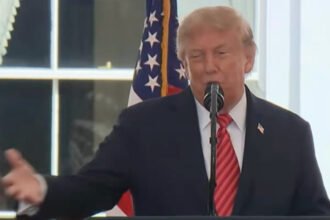







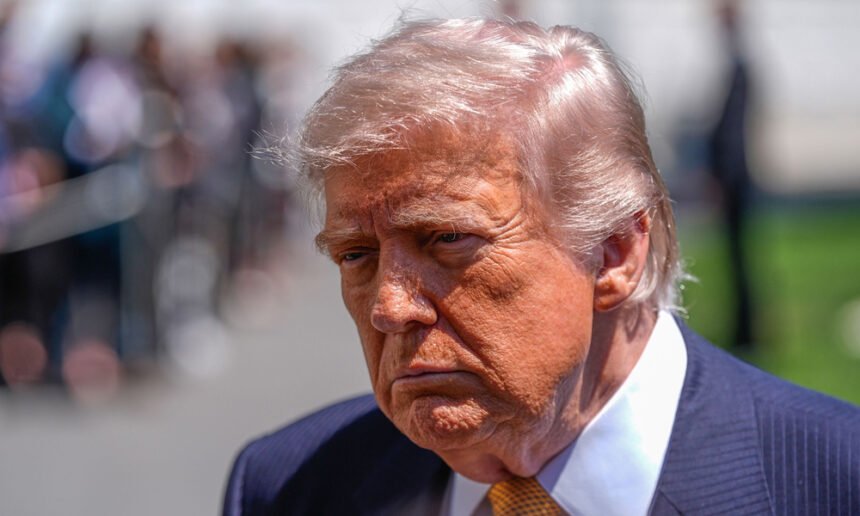
Just weeks ago, Donald Trump was demanding Iran’s “UNCONDITIONAL SURRENDER” and openly talking about reshaping the country’s leadership after a war he insisted America would decisively win.
Now, emerging details from ongoing negotiations suggest Trump may instead be preparing to accept a deal that falls dramatically short of the sweeping victory he promised, leaving major pieces of Iran’s nuclear program intact — a humiliating retreat that is triggering backlash from Republicans and Democrats alike.
According to multiple reports, negotiations between Washington and Tehran are moving toward a framework agreement aimed at reopening the Strait of Hormuz and easing parts of the U.S. blockade that crippled Iranian shipping during the war.
That alone represents a stunning reversal.
Trump originally framed the war as a mission to break Iran’s power, eliminate its nuclear threat, and force Tehran into submission. Instead, the administration now appears to be negotiating around the very leverage Iran gained during the conflict.
And the proposed terms are already triggering backlash.
Reports indicate the emerging framework could involve sanctions waivers, the gradual reopening of Iranian oil exports, and even the possible unfreezing of some Iranian assets while negotiations continue over unresolved nuclear issues.
That is a long way from “unconditional surrender.”
Even more awkward for the White House, Iran itself does not appear to be behaving like a defeated adversary. Iranian officials have openly stated that discussions remain unresolved and that no final agreement is imminent.
Meanwhile, Tehran reportedly still wants to retain control over the Strait of Hormuz, the strategic waterway whose closure sent global energy markets into chaos and helped trigger rising gas prices across the United States.
Trump’s political problem is obvious.
If he escalates the war again, he risks worsening economic pain, higher fuel costs, more instability in the Middle East, and growing public opposition at home.
But ending the conflict on terms that appear far weaker than the administration’s original demands carries a different danger: looking like he blinked.
And even some Republicans are beginning to sound alarmed.
Sen. Thom Tillis questioned why the administration now seems willing to tolerate Iran retaining nuclear material after officials previously claimed Iran’s capabilities had been effectively destroyed.
Sen. Roger Wicker warned publicly that striking a deal now could create “a perception of weakness.”
And Trump ally Lindsey Graham reportedly expressed concern that allowing Iran continued leverage over the strait could shift the regional balance of power in Tehran’s favor.
Democrats are attacking Trump from a different angle, accusing him of launching a reckless war without a coherent endgame and now scrambling for an exit ramp.
Sen. Cory Booker blasted reports that the administration may prioritize reopening the strait before resolving Iran’s nuclear program.
“What I’m seeing that has me so outraged right now,” Booker said, “is the president said he went into this to deal with their nuclear program. This does not deal with that.”
He added: “Donald Trump is being played as a fool.”
That line may end up haunting the administration because the broader optics are becoming increasingly difficult to ignore.
Back in March, Trump insisted there would be “no deal with Iran except UNCONDITIONAL SURRENDER.”
Now the White House appears to be discussing phased negotiations, sanctions relief, shipping access, and prolonged diplomacy — the very kind of negotiated compromise Trump once mocked as weakness.
The comparison to former President Barack Obama is becoming unavoidable.
Trump famously tore up Obama’s Iran nuclear deal in 2018, calling it disastrous and weak despite international inspectors repeatedly verifying Iranian compliance.
Years later, after war, economic disruption, global oil shocks, and American casualties, critics are asking a devastating question:
Did Trump blow up a functioning agreement only to end up pursuing a weaker one after a catastrophic conflict?
That question is becoming harder to dismiss as details continue to emerge.
And it underscores the political trap now closing around Trump.
Continuing the war risks deeper economic and military disaster. Ending it on compromised terms risks looking like a humiliating retreat dressed up as diplomacy.
Either way, the president who demanded “unconditional surrender” now appears to be searching for a deal he can survive politically.