








The conservative majority on the Supreme Court of the United States delivered a sweeping decision Wednesday that critics say effectively guts one of the nation’s most important civil rights laws — the Voting Rights Act of 1965.
In a 6–3 ruling in Louisiana v. Callais, the court struck down a Black-majority congressional district in Louisiana, dramatically raising the bar for future voting rights challenges.
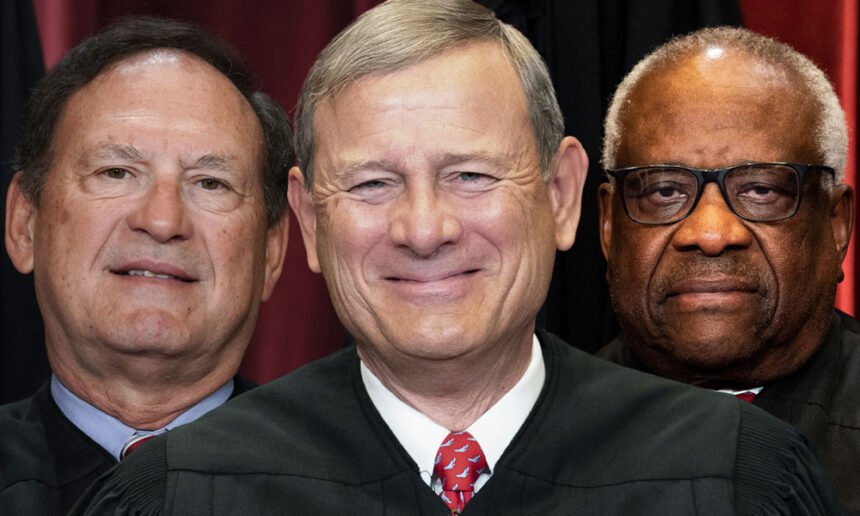
Writing for the majority, Justice Samuel Alito said plaintiffs must now prove “intentional discrimination” when challenging electoral maps — a major shift that legal experts say will make such cases far harder to win.
“When [Section 2] of the Act is properly interpreted, it imposes liability only when circumstances give rise to a strong inference that intentional discrimination occurred,” Alito wrote.
That standard effectively rolls back decades of precedent, under which courts could block maps based on discriminatory effects — not just explicit intent.
In a blistering dissent, Justice Elena Kagan warned the ruling leaves the Voting Rights Act “all but a dead letter.”
She argued the decision could open the door for states to dismantle minority voting districts nationwide, sharply reducing representation for Black and Latino communities.
“After today, those districts exist only on sufferance, and probably not for long,” Kagan wrote.
The case stems from Louisiana’s 2021 redistricting battle, where lawmakers initially drew just one majority-Black district despite the state’s significant Black population. After a lower court ordered a second district, a separate group of plaintiffs challenged that map — ultimately bringing the issue before the Supreme Court.
The ruling marks the latest in a series of decisions narrowing the Voting Rights Act’s reach. In Shelby County v. Holder, the court struck down key federal oversight provisions. Later, in Brnovich v. Democratic National Committee, it limited challenges to voting restrictions.
Now, with this latest decision, critics say the court has gone even further — undercutting the core mechanism used to challenge racially discriminatory district maps.
The law itself dates back to the height of the civil rights movement, following the Selma marches led by Martin Luther King Jr.. It was designed to dismantle Jim Crow-era barriers and expand political representation for marginalized communities.
For decades, it succeeded in dramatically increasing minority representation across all levels of government.
But with this ruling, legal observers say that legacy is now under serious threat.
The immediate impact remains unclear, but experts warn the decision could trigger a wave of new legal challenges to existing majority-minority districts — potentially reshaping political power from Congress to local governments.
While the court stopped short of formally overturning the Voting Rights Act, the practical effect, critics argue, is unmistakable: one of the country’s most powerful civil rights protections has been severely weakened.