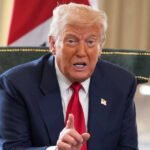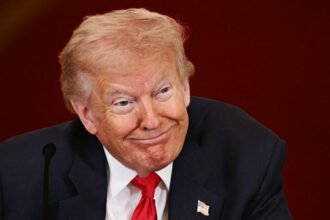






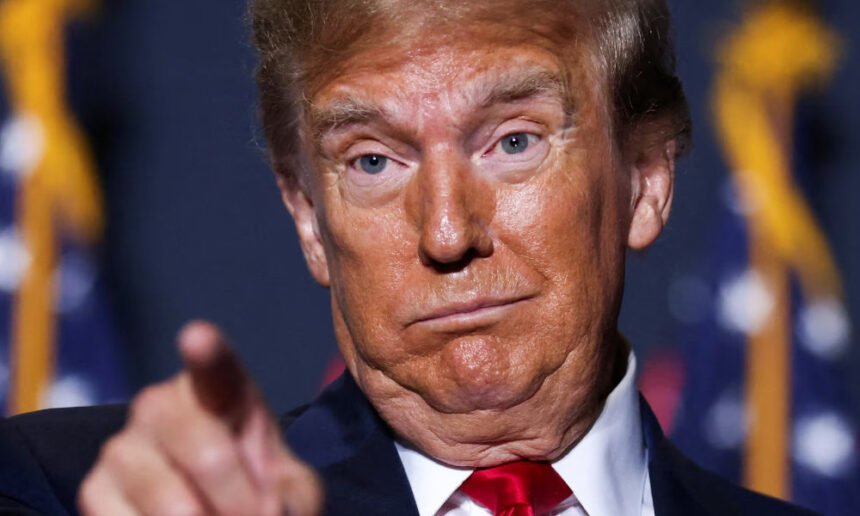
Donald Trump is making an extraordinarily explicit promise to voters: Keep Republicans in control of Congress, and he says he’ll give you $5,000.
There is a federal law that says you cannot offer money to influence someone’s vote.
The law is not particularly complicated.
Under 18 U.S.C. § 597, anyone who “makes or offers to make an expenditure” to a person to vote, withhold a vote, or vote for or against a candidate can face criminal penalties. A willful violation can carry up to two years in prison.
So here’s the obvious question: What exactly is Trump doing?
At his Republican midterm convention in Dallas, Trump made his $5,000 promise about as plainly as a politician possibly could.
“If the Republicans win the House of Representatives and the United States Senate, both of them, I will issue a dividend to every adult citizen in the United States of America for $5,000,” Trump said.
The White House then doubled down, describing the “Trump Dividend” as a $5,000 cash payment that would happen if Republicans win both chambers of Congress.
And Trump has repeated the pitch: Republicans win. You get $5,000.
That sounds an awful lot like a bribe.
And that is where the law comes in.
Federal law doesn’t say a politician can offer voters money as long as he gives the scheme a cute name like “dividend.”
It doesn’t say it’s okay if the politician calls the money a reward for “economic success.”
And it doesn’t create an exception simply because the payment would theoretically go to everyone.
The statute focuses on whether money is being offered to influence voting.
That’s why the language Trump is using is extraordinary.
He isn’t merely promising a tax cut someday.
He isn’t saying Republicans have a better economic plan.
He’s personally tying a massive cash payment to one specific election result: Republicans retaining control of the House and Senate.
And the proposed payment isn’t small.
There are roughly 240 million adult U.S. citizens. At $5,000 apiece, the price tag would be around $1.2 trillion.
Trump has not explained how the government would actually finance it.
Vice President JD Vance has suggested tariff revenue could be used, but current tariff collections are nowhere close to enough to cover the proposed payment. The plan would also require Congress to approve the spending.
So we’re talking about a president promising a trillion-dollar-plus government payout while explicitly tying it to the outcome of a congressional election.
And then things get even more interesting.
Because the $5,000 promise isn’t the only money going out the door.
The administration has begun sending $500 payments to nearly 1 million Americans who purchased health coverage through the Affordable Care Act marketplace. The White House says the payments are refunds for excessive fees, while Reuters reported that the checks are landing disproportionately in states that could help determine whether Republicans retain control of Congress.
Then came another payment.
Trump announced that more than 20 million Medicare recipients would receive a one-time $90 payment toward their Part B premiums. The money is coming from the Medicare Improvement Fund.
Again, those payments are not automatically illegal simply because they are happening before an election.
But the timing matters. And so does the broader pattern.
The administration is simultaneously promising voters a $5,000 payment if Republicans win, sending hundreds of dollars to some Americans, sending $90 payments to millions of seniors and spending taxpayer money on television advertising featuring Trump.
That last part has already triggered another legal controversy.
The White House has spent nearly $1.5 million in taxpayer money on three television and streaming campaigns featuring Trump. The administration calls them public service announcements, but legal experts have questioned whether the ads are actually political messages designed to influence the midterms.
And unlike the $5,000 proposal, where the legal question centers on whether the payment is sufficiently tied to an individual’s vote, the taxpayer-funded advertising raises a separate question about whether federal money is being used for partisan political purposes.
And that question is serious enough that it shouldn’t be brushed aside simply because Trump calls the payment a “dividend.”
Because the statute doesn’t say, “Don’t bribe voters unless you have a nicer name for it.”
It says you cannot offer an expenditure to influence voting.
Trump’s defenders have a straightforward argument: He isn’t telling individual Americans, “Vote Republican and I’ll personally pay you $5,000.” He’s promising the same payment to all eligible adults if Republicans win, regardless of how any particular person voted.
But Trump’s critics have an equally obvious response: The president himself is making the payment conditional on a Republican victory.
And he is making that promise during the campaign for the very election that determines whether Republicans keep Congress.
That’s precisely why the legal issue deserves scrutiny.
At the very least, Trump has pushed the line between campaigning and governing into territory where the federal vote-buying statute becomes impossible to ignore.
And he’s doing it in public. No secret recording. No hidden promise. No backroom deal.
Just the president standing on a stage and telling Americans that if Republicans win the House and Senate, he’ll give them $5,000.
Whether that ultimately constitutes a criminal violation of federal election law is a question for prosecutors and the courts.
But the underlying issue is remarkably clear:
Federal law prohibits offering money to influence how Americans vote.
And Trump has put an extraordinarily large dollar figure — potentially more than $1 trillion in taxpayer money — directly into the middle of a congressional election.
That’s not a minor legal footnote.
That’s the story.