









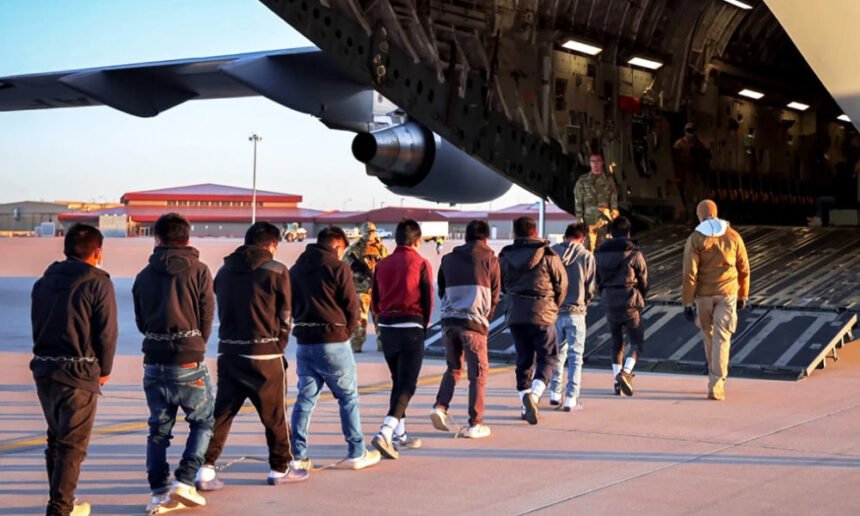
The Supreme Court has cleared the way for the Trump administration to resume rapidly deporting migrants to countries other than their own — even as the justices prepare to decide whether the policy is legal.
The Tuesday order puts a lower-court ruling on hold while the Supreme Court considers a central question: Do migrants have to be given a meaningful chance to object before the government sends them to a country where they have no ties?
The so-called third-country deportation policy has become a key part of the administration’s broader immigration enforcement effort. Under agreements with dozens of countries, the government has sent more than 25,000 migrants to countries other than their homelands, with the vast majority going to Mexico, the Associated Press reports.
The policy had hit a major roadblock in the lower courts.
A federal judge ruled that migrants must have an opportunity to raise concerns that they could face persecution or torture in the country where the administration wants to send them. The 1st U.S. Circuit Court of Appeals largely upheld that ruling, saying migrants were not being given sufficient notice or a meaningful opportunity to challenge their removal.
Now the Supreme Court has stepped in.
The Trump administration argues that third-country removals are necessary when migrants cannot quickly be returned to their home countries, including situations in which their countries refuse to accept them.
Federal attorneys have also argued that the governments receiving the deportees provide assurances that they will not be persecuted or tortured.
But immigrant attorneys say those assurances do not resolve the central problem.
They argue that people can be sent to countries they have never lived in, have no connections to and sometimes barely knew existed before they arrived.
Some deportees have subsequently faced imprisonment or serious safety concerns, according to attorneys representing migrants. They also say the policy has affected people who have no criminal convictions and people who had previously been found to face a risk of persecution or torture.
And that’s exactly why the legal fight over due process matters.
Government attorneys told the Supreme Court that the lower-court ruling forced officials to cancel a deportation flight carrying roughly 70 people who were scheduled to be sent to three different countries.
The administration argues that requiring individualized opportunities to challenge third-country removals creates logistical and diplomatic problems and interferes with its ability to carry out deportations quickly.
Immigrant advocates see the same requirement very differently.
They argue that giving someone a meaningful opportunity to explain why they could face persecution or torture isn’t an unnecessary delay — it’s a basic safeguard against sending people into potentially dangerous situations.
The Supreme Court previously allowed the Trump administration to continue third-country deportations on an emergency basis while the earlier litigation proceeded. Now the justices are preparing to consider the underlying legal dispute.