








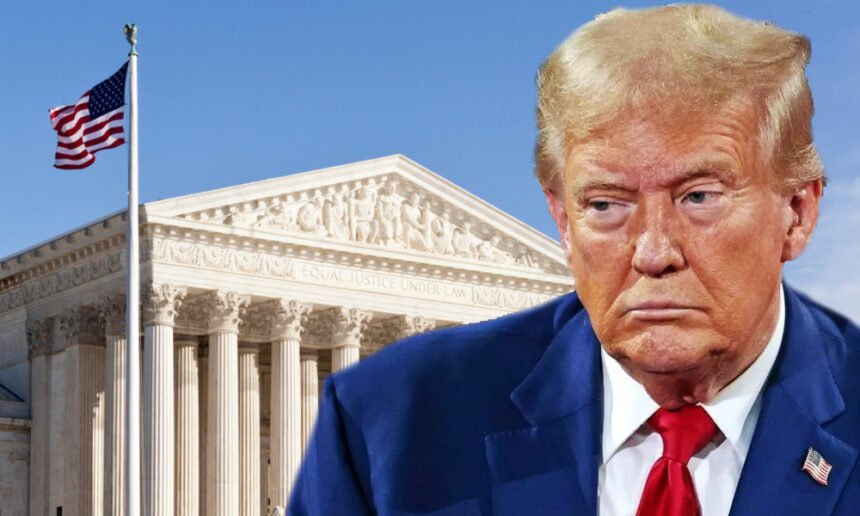
The Supreme Court has rejected Missouri Republicans’ latest attempt to use a congressional map designed to give the GOP an advantage in the November midterms—a major setback for President Donald Trump’s push to redraw congressional districts in Republican-led states.
The justices on Thursday declined to revive the Trump-backed Missouri map, leaving in place the Missouri Supreme Court’s ruling that the new districts cannot be used unless voters approve them. For now, Missouri will return to the congressional districts drawn after the 2020 census for the November election.
That means the Republican effort to redraw Missouri’s political map—and potentially eliminate the Democratic seat held by longtime Rep. Emanuel Cleaver of Kansas City—has hit a wall just weeks before voters head to the polls.
And it is a particularly awkward result for Republicans because they already used the new map in the August primary.
The whole mess began last year, when Trump urged Republican-led states to redraw congressional districts in an effort to strengthen the party’s position in the House.
Missouri Republicans answered the call.
Gov. Mike Kehoe called a special legislative session, and lawmakers approved a new congressional map that was designed to make Cleaver’s Kansas City-based 5th District significantly more Republican-friendly.
The map moved portions of Kansas City into neighboring Republican-held districts and stretched the remainder of Cleaver’s district eastward into more heavily Republican rural territory.
State Sen. Rick Brattin won the Republican primary in the reshaped district. Cleaver was unopposed in the Democratic primary.
The new map looked like exactly what Republicans wanted.
Then Missouri voters got involved.
Opponents of the redistricting effort gathered more than 300,000 signatures on a petition seeking a statewide referendum on the new districts. Republican Secretary of State Denny Hoskins initially rejected the petition, arguing that Missouri’s Constitution did not allow voters to challenge congressional redistricting through a referendum.
That position ultimately collapsed in court.
The Missouri Supreme Court ruled unanimously that the state Constitution allows voters to approve or reject “any act” of the Legislature through a referendum, including congressional redistricting. The court ordered the referendum to appear on the November ballot and barred officials from using the new map unless voters approve it.
But instead of ending the fight, the ruling kicked off a new round of legal chaos.
A federal judge later ordered Missouri to use the new Republican-backed map for the November election, creating a direct conflict between the state and federal courts. Republican officials argued that switching maps after the primary would create confusion and potentially violate federal election law.
The dispute eventually reached the U.S. Supreme Court.
And the justices declined to rescue the Republican map.
The result is that the older, 2022 congressional districts remain in effect for the November election, while Missouri voters will still get a chance to decide whether to approve the new map through Proposition A.
That is a significant blow to Republicans’ broader redistricting strategy.
Missouri was the second Republican-led state, after Texas, to respond to Trump’s call for mid-decade congressional redistricting. Republicans have pursued new maps in several states in hopes of gaining additional seats in the closely divided House.
The Missouri map was particularly important because Republicans currently hold six of the state’s eight House seats, while Democrats hold two. The new boundaries were specifically designed to make the Kansas City-based Democratic seat more competitive for Republicans.
But for the November election, that plan is now on hold.
There is also an extraordinary wrinkle in all of this: Missouri voters already cast their primary ballots under the new map.
That means candidates who ran in August did so under district boundaries that the state Supreme Court ultimately determined had never legally taken effect.
The court was blunt about that point, saying the new map “is not the law and has never been the law” because the referendum petition was properly filed. The court determined that the 2022 map therefore remains the valid congressional map for the 2026 general election unless voters approve the replacement.
The Republican effort has now produced exactly the kind of election-year confusion that GOP officials warned would result from changing the maps after the primary.
But the Supreme Court has made its position clear for now: Missouri cannot simply use the new Republican-favored districts because Republican officials want them in place.
The voters get a say. And that is where Proposition A comes in.
If voters approve it, the new map will eventually take effect. If they reject it, Missouri will keep the existing districts.
Either way, the Trump-backed redistricting effort has suffered a major legal setback just as the midterm campaign enters its final stretch.