









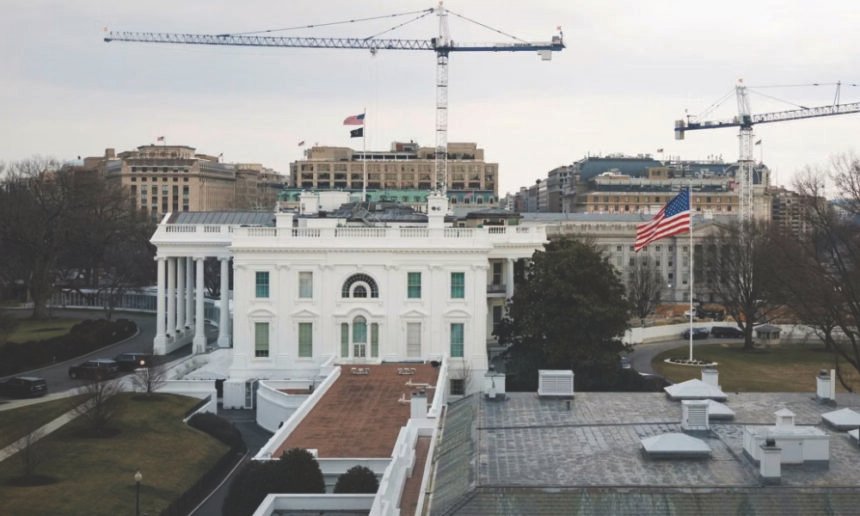
With Democrats preparing to take control of the House in January, the Trump administration appears to be racing to push through the president’s controversial construction projects. Now, congressional whistleblowers are raising an even more serious concern: key government records related to those projects are already disappearing ahead of investigations.
According to sources cited by CNN, multiple whistleblowers have approached House Democrats in recent weeks, warning that the Interior Department is getting rid of records in anticipation of congressional scrutiny once Democrats take control.
The warnings have prompted Rep. Jared Huffman (D-Calif.), the incoming chairman of the House Natural Resources Committee, to move quickly to protect potentially critical evidence.
On Tuesday, Huffman plans to send letters to the Interior Department, other federal agencies, and private companies demanding that they preserve documents and data connected to the committee’s oversight responsibilities.
The letters, first obtained by CNN, offer an early glimpse of what could become a major investigative target when Democrats take over the committee in January.
The Interior Department oversees much of the federal land involved in Trump’s construction plans, including national parkland the president wants to use for several projects. The agency has also played a major role in fast-tracking parts of the administration’s plans.
The Trump administration has flatly rejected the whistleblower allegations.
“The claims made by these so-called whistleblowers are 100% false,” an Interior Department spokesperson told CNN, adding that the agency follows federal records-management requirements.
But Democrats aren’t taking any chances.
The preservation letters are also being sent to the National Park Service and Bureau of Land Management, both part of the Interior Department, as well as the Agriculture Department and private companies including Lockheed Martin and John Deere.
Recipients will be required to certify their compliance, including taking steps to preserve existing records, identify and recover deleted information, and suspend any practices that could result in further destruction or deletion.
And Democrats are making clear that this is only the beginning.
The Natural Resources Committee may not attract the same attention as the House Judiciary or Oversight committees, but its authority over national parks and federal lands puts it directly in the middle of Trump’s ambitious construction plans.
Among the projects likely to face scrutiny are the proposed triumphal arch, the East Potomac golf course, fencing around Lafayette Square near the White House, and the Tidal Basin development plan.
Huffman told CNN that his committee is preparing an aggressive oversight effort and signaled that the administration should expect a very different Congress in January.
“Everything is coming; it’s all coming,” he said.
“It’s just going to be an entirely new day,” Huffman added, arguing that Democrats’ sweeping midterm victories have given the incoming majority a mandate to investigate an administration that voters believe has been focused on the wrong priorities.
Committee aides are already preparing for high-profile hearings on one or more of the construction projects early in the new Congress. And if the administration refuses to cooperate, Democrats are prepared to issue subpoenas.
Huffman also believes the committee could potentially stop some of Trump’s projects from moving forward.
“Especially because we have standing to go to court if we have to,” he told CNN. “We’ll have tools to be able to stop a lot of it.”
The committee is also coordinating with House Oversight and Judiciary Democrats, who are preparing their own investigations into other parts of the Trump administration.
Meanwhile, sources familiar with the approval process for Trump’s construction projects told CNN they are seeing a growing urgency inside the administration to get as much done as possible before the end of the year.
That urgency is raising alarms among historic preservationists and others who have been fighting the projects.
Over the next 60 days, several major initiatives are expected to move forward simultaneously, with some heading before federal agencies for approval and others advancing through historic-preservation reviews.
Charles Birnbaum of the Cultural Landscape Foundation described the coming weeks as a potential political storm.
“We’re going to start seeing all of these things happening simultaneously,” he told CNN. “It is going to be like a storm where it plays out until the new Congress is seated.”
The administration’s push is already visible. The day after the midterm elections, Trump appeared at the White House ballroom construction site to sign the final steel beam before it was lifted into place.
White House spokesperson Davis Ingle defended the accelerated pace, saying Trump was moving “at lightning speed” because the administration had no time to waste.
But with whistleblowers raising concerns about disappearing records, Democrats preparing subpoenas and hearings, and the administration rushing to advance projects before January, the coming weeks could become a critical fight over who controls the future of some of Washington’s most prominent public spaces — and whether the incoming Congress will have access to the records needed to investigate how those decisions were made.