






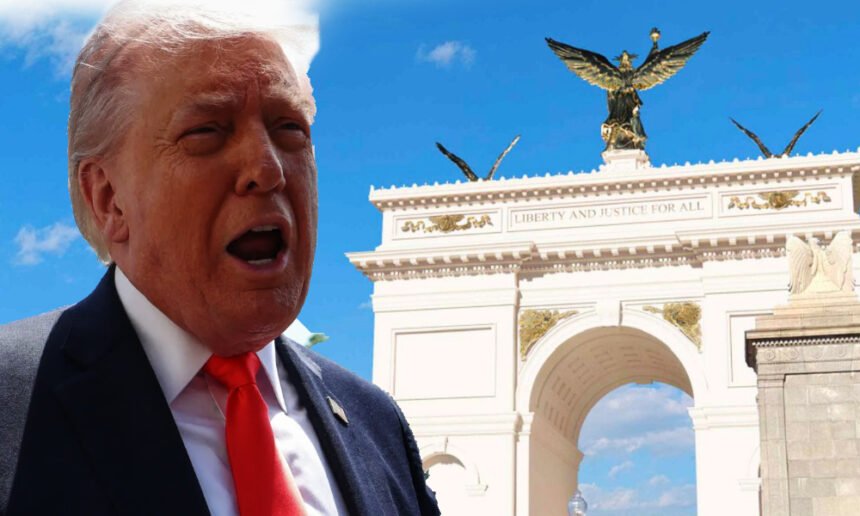
The Justice Department went to court hoping to clear the way for Donald Trump’s planned “Great Triumphal Arch.”
Instead, it got a very simple answer from the judge: No.
U.S. District Judge Tanya Chutkan on Thursday refused the DOJ’s request to dissolve an order requiring the Trump administration to give her 48 hours’ notice before taking most activity at Memorial Circle, where the administration plans to build the massive arch near Arlington National Cemetery.
The DOJ had argued that Chutkan’s order was getting in the way of public safety, park maintenance and other routine government operations. Prosecutors asked her either to eliminate the requirement or clarify exactly what she meant.
Chutkan chose the second option — while making clear that the first option was going nowhere.
“To remove what little doubt may exist,” Chutkan wrote, she was clarifying that the phrase “any activity” applied only to work “related to or in preparation for the construction of an arch on Memorial Circle.”
Emergency response and routine park maintenance unrelated to the arch are not covered.
And then came the part the DOJ presumably wasn’t hoping to read:
“Defendants’ alternative request to dissolve the Order is DENIED.”
In other words, the judge wasn’t throwing out her order. She was simply making sure there was no confusion about what it covered.
The ruling came one day after The Washington Post reported that the Trump administration’s own preservation review had identified potential “adverse effects” from construction of the 250-foot arch on nearby historic properties. The National Park Service has identified dozens of potentially affected historic sites, including the Lincoln Memorial and the National Mall.
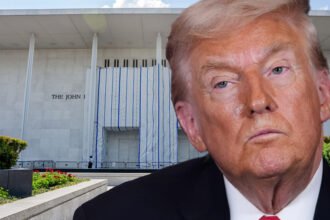
It also came the same day another federal judge ordered the administration to provide 30 days’ notice before taking steps toward demolishing the main building of the Kennedy Center.
Chutkan’s order dates back to the administration’s September push to begin work at Memorial Circle. Interior Secretary Doug Burgum announced that the government was preparing to begin excavation for the proposed arch and military observation deck within two weeks.
That announcement immediately collided with the ongoing lawsuit brought by three Vietnam War veterans and architectural historian Calder Loth, who are challenging the project.
The administration subsequently told the court that the initial work would be archaeological information gathering rather than construction. Chutkan’s order allows that limited activity while requiring advance notice for other work at the site.
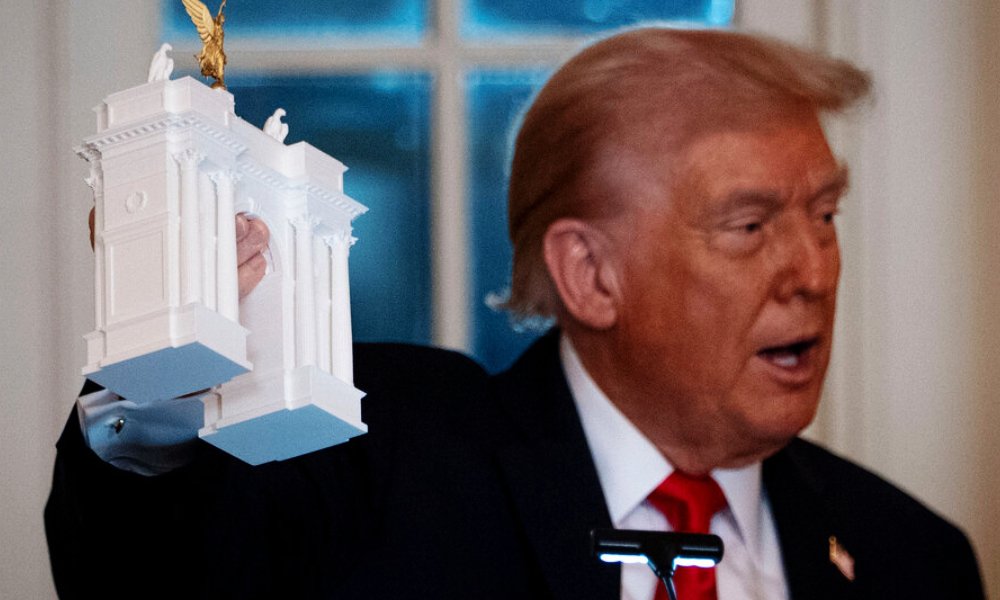
The proposed structure is no small monument.
Trump has described the planned arch as a centerpiece for the nation’s 250th anniversary. At roughly 250 feet tall, it would be about 86 feet taller than Paris’s Arc de Triomphe. The administration plans to build it at Memorial Circle, near Arlington National Cemetery and along the symbolic corridor connecting the cemetery, Arlington House, the Arlington Memorial Bridge and the Lincoln Memorial.
That location is a major part of the dispute.
The veterans and Loth say they regularly visit the area to honor fellow service members buried at Arlington. Their lawsuit argues that the enormous structure would interfere with a historic sight line representing national reunification following the Civil War.
The administration, meanwhile, has continued moving the project through the federal approval process. Officials have said they expect to submit final plans to the National Capital Planning Commission this fall, with November identified as a possible target for final consideration.
For now, though, the administration has another hurdle to deal with.
And it comes in the form of a judge who has made her position pretty clear: If you’re going to start work on Trump’s giant arch, the court wants to know about it first.