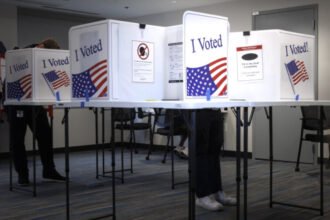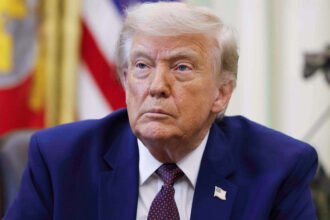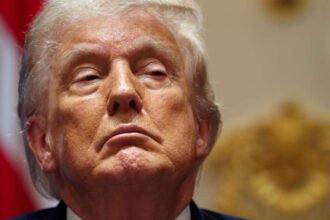









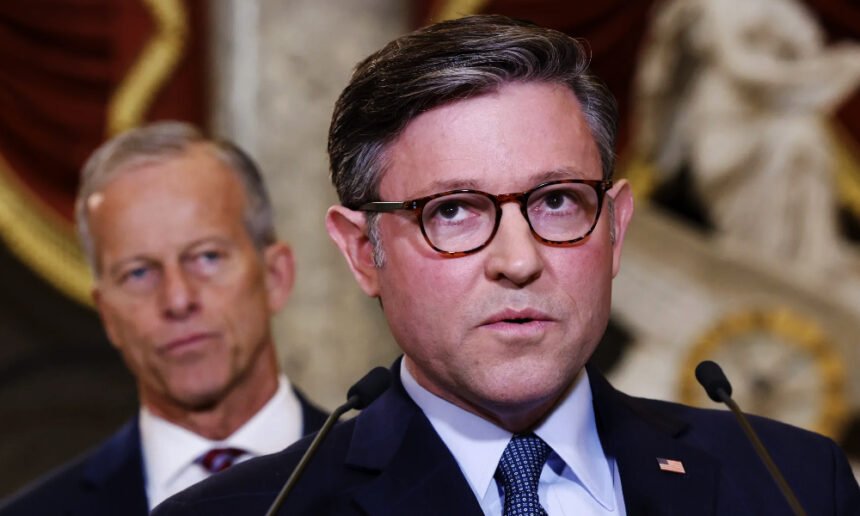
Republicans are increasingly nervous about November.
With the midterm elections just weeks away, GOP candidates are scrambling to reinvent themselves, Republican super PACs are throwing huge amounts of money into races that were once considered safely red, and party operatives are openly worrying that all that cash may not be enough to overcome voter anger over President Donald Trump’s handling of the economy and the war in Iran.
In other words: The Republican panic button has officially been pressed.
“You’ve got real momentum on the Democrat side,” Sen. Jim Justice, R-W.Va., told HuffPost. “If we don’t watch out, you know, everybody all of a sudden now is just awakened to the fact that we may lose in the midterm.”
That concern is spreading into territory Republicans once considered safely theirs.
Operatives in both parties now see Senate races in Iowa and Kansas as competitive, while the head of a major Republican polling firm warned that even lawmakers representing districts Trump carried by as much as 15 points should check whether their seats are actually safe.
And then there’s the money.
Trump’s super PAC has spent $138 million trying to boost vulnerable Republican candidates. But some Republicans are beginning to wonder whether the party’s messaging is connecting with voters.
“If money can’t turn some of these races around, things are going to get ugly,” one Republican consultant told HuffPost.
Republicans are already spending heavily in places where the results aren’t matching the size of the checks.
In Texas, Gov. Greg Abbott has outspent Democrat Gina Hinojosa by roughly 10-to-1 over the past month, according to the source material, yet polling has moved toward Hinojosa even though Abbott remains ahead.
In Nevada, roughly $40 million in Republican spending has produced a toss-up governor’s race. In Ohio, Republican Vivek Ramaswamy has spent about $70 million while Democrat Amy Acton holds a narrow lead, according to the report.
The party’s own allies are now questioning the strategy.
The American Principles Project, a conservative group that has previously encouraged Republicans to emphasize anti-transgender messaging, recently warned that such advertising “may not be sufficient” and argued Republicans need to explain more clearly how they plan to improve Americans’ economic situation.
“The Republican sales pitch to voters on the economy is at best unclear,” the group wrote.
That may be the biggest problem Republicans are facing.
A New York Times/Siena University poll released this week found Democrats leading Republicans 51% to 43% among likely voters on the generic congressional ballot. The poll also found Trump’s approval rating at 38%, while Democrats held advantages over Republicans on several major issues, including the economy and cost of living.
The economy is particularly bad news for the GOP.
Only 14% of voters in the Times/Siena poll said the economy was better than it was a year ago, down from 31% in January. And 71% disapproved of Trump’s handling of the cost of living, compared with just 28% who approved.
That brings us to Trump’s favorite explanation for the economic pain: Joe Biden.
Trump has repeatedly blamed his predecessor for high prices and other economic problems.
“I hope everyone realizes that price increases throughout America were caused by Sleepy Joe Biden and the Biden Administration, not by ‘TRUMP,’” Trump wrote on Truth Social this week.
Vice President JD Vance has made essentially the same argument, asking voters to give the administration “another chance” to continue its work.
But at least according to another poll cited in the report, that explanation isn’t landing particularly well.
A Politico poll found that 43% of Americans considered Trump fully responsible for the current state of the economy, compared with 28% who blamed Biden. Even among Trump voters, 21% said Trump was responsible. The rising cost of living was also identified as the top issue facing Americans.
And Republican candidates appear to be responding accordingly.
Rep. Ashley Hinson, the GOP Senate candidate in Iowa, once promised to be Trump’s “strongest ally in the Senate.” Her latest campaign ad, however, emphasizes her willingness to work across party lines.
In South Florida, Republican Rep. Maria Elvira Salazar has gone even further, publicly criticizing some of Trump’s immigration enforcement policies.
“Mr. President, some of your immigration enforcement efforts have gone too far,” Salazar says in her ad. She also argues that Hispanic voters who helped Trump win in 2024 “feel betrayed today.”
Republican strategists are even discussing where to pull resources.
According to a Republican source cited by HuffPost, party operatives have discussed cutting off support for Rep. Mike Collins, who is trailing Democratic Sen. Jon Ossoff in Georgia’s Senate race. Other GOP officials are still reluctant to abandon races such as North Carolina, where Democrat Roy Cooper is leading Republican Michael Whatley.
Democrats, meanwhile, are moving money into states Republicans have traditionally been comfortable winning.
Democratic-aligned super PACs have begun advertising in Senate races in Kansas and South Carolina, while party officials are also targeting Iowa and other traditionally Republican territory.
Even Sen. John Kennedy, R-La., acknowledged that Republicans are suddenly spending time in states that normally wouldn’t require much attention.
“If you told me six months ago I was gonna be having to spend my time in those three states, I wouldn’t have believed you,” Kennedy said of Iowa, Nebraska and Kansas. “Those ought to be fat guy layups for us. We’re going to win there, but the races are close.”
Meanwhile, Trump continues putting himself at the center of the midterm conversation.
He held an unusual “midterm convention” last week, using prime-time speeches to urge voters to treat the election as a referendum on his administration. This week, he also dismissed record gas prices as “a very inexpensive price to pay” for the war in Iran.
Republicans are trying to answer the economic backlash by attacking Democrats as socialists and communists.
Sen. Rick Scott, R-Fla., argued that Republicans could have a strong midterm showing by highlighting what he described as Democrats’ “crazy” views.
But other Republicans are acknowledging the more immediate problem: Their voters are hurting.
Justice said Republicans have done a “horrible” job communicating their accomplishments, while warning that frustrated voters don’t necessarily have to switch parties to hurt Republicans.
“They can’t hold their nose and go vote for the Democrats, but they can stay home,” Justice said. “And that will be the big challenge.”
That may be the central problem for Republicans heading into November.
The latest polling shows Democrats with an advantage nationally, but polling is not a guarantee of the eventual result. The Times/Siena survey itself notes that the electoral map, relatively few competitive House seats and the structure of Senate races could produce a different outcome from the national numbers.
Still, Republicans clearly aren’t waiting around to find out.
They’re changing their ads. They’re moving money. They’re reconsidering which races are worth fighting. And some of their own senators are openly admitting that races they expected to coast through are suddenly competitive.
As one Republican consultant put it: “If money can’t turn some of these races around, things are going to get ugly.”