



Donald Trump just suffered another major setback in his effort to rewrite the rules for voting by mail, and the two Supreme Court justices most closely aligned with his administration’s election agenda were not happy about it.
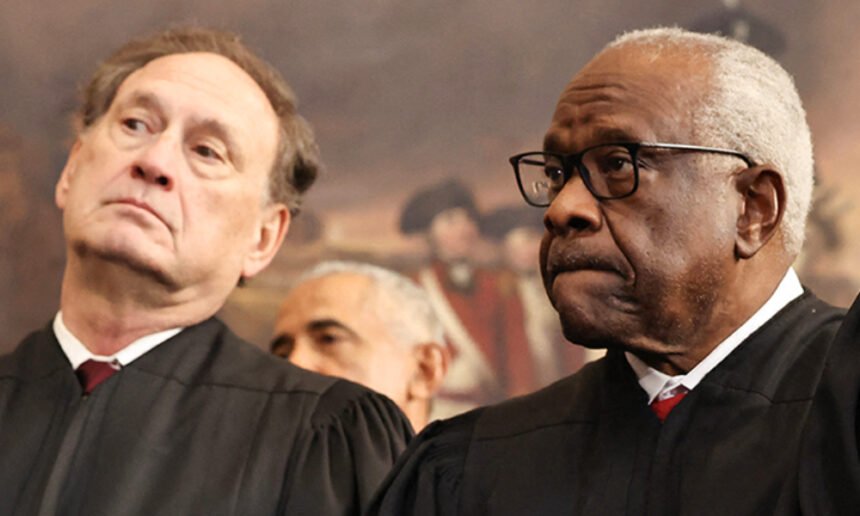
Justices Samuel Alito and Clarence Thomas dissented Monday after the Supreme Court refused to let Trump’s administration put new restrictions on mail-in voting into effect ahead of the 2026 midterm elections.
The unsigned ruling was only one paragraph long.
But it delivered a serious blow to Trump’s attempt to impose a new federal system on mail ballots.
“The government is unlikely to succeed on the merits of its challenge,” the Court concluded, refusing to lift a lower-court injunction blocking the U.S. Postal Service from implementing the rule.
Alito and Thomas disagreed.
And Alito’s dissent was anything but subtle.
“The Court incorrectly denies the Government’s application for a stay,” he wrote.
The dispute stems from an executive order Trump issued in March directing the Postal Service to create new requirements for election mail.
The resulting rule would require states to submit basic voter information to a federal USPS portal and redesign ballot envelopes to include specific features, including a specialized barcode tied to each voter.
The Postal Service would review the mail for compliance, and ballots that failed to meet the requirements could be rejected and returned to the state.
That may sound like bureaucratic paperwork.
But the consequences could be much bigger.
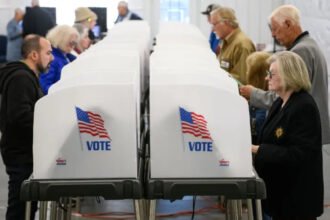
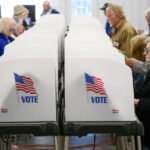
Critics warned that the rule could disrupt legitimate ballots and potentially prevent eligible voters from casting their ballots by mail. Reuters reported that voting-rights groups and state officials argued the changes could disproportionately affect Democratic voters, who have historically been more likely to use mail voting.
And Reuters has now placed the fight within a much broader context.
In a report published Tuesday, Reuters said election officials around the country are preparing for potential federal efforts by the Trump administration to “tilt the midterms to Republicans.”
More than 50 election officials interviewed by Reuters described concerns about federal interference, ballot access and other disruptions as the November elections approach.
The mail-ballot fight is one of the most consequential pieces of that larger battle.
And on Monday, the Supreme Court stopped Trump’s administration from putting the new USPS restrictions into effect for the 2026 election.
Alito wasn’t persuaded by concerns about the timing.
He acknowledged that implementing the rule so close to the midterms presented practical problems, but said those concerns weren’t enough to justify blocking the administration.
“The government has a strong interest in enforcing the rule,” Alito wrote, pointing to the administration’s argument that the changes would help detect election fraud.
Then he turned his criticism toward the states challenging the rule.
Alito argued that the states couldn’t complain about the timing because litigation had contributed to the delay.
And he went even further.
He blamed the courts — including the Supreme Court itself — for holding up the administration.
The government, Alito wrote, had been subjected to months of litigation and injunctions and then had to wait “nearly another full month” for the Supreme Court to issue its decision in an earlier phase of the case.
So, in Alito’s view, the administration shouldn’t be blamed for the fact that the rule was arriving so close to Election Day.
The majority saw the situation very differently.
Justice Brett Kavanaugh agreed that the rule might ultimately fall within the Postal Service’s legal authority.
But he concluded that implementing it for the 2026 elections would be unlawful because state and local election officials simply did not have enough time to reasonably put the new system into place.
And notably, none of Trump’s three Supreme Court appointees joined Alito and Thomas in dissent.
Neil Gorsuch and Amy Coney Barrett remained with the majority.
Kavanaugh concurred with the decision.
That left Alito and Thomas as the only two justices arguing that Trump’s mail-ballot system should be allowed to proceed for this year’s election.
The stakes are difficult to miss.
Trump’s administration has repeatedly argued that tighter control over mail voting is necessary to protect election integrity.
Opponents say the new requirements could instead create confusion, delay ballots and prevent eligible voters from successfully voting by mail.
And because millions of Americans use mail ballots, even relatively small administrative problems could have consequences at the ballot box.
A federal whistleblower had previously warned that the proposed USPS system could lead to thousands of valid ballots being rejected. The Postal Service’s inspector general subsequently announced an investigation into those claims.
Now the Supreme Court has said the administration cannot put the rule into effect for the 2026 midterms while the legal fight continues.
That means voters will not suddenly be facing a new federal USPS system weeks before Election Day.
The existing state-based mail-voting systems remain in place.
For Trump, it’s another court-imposed roadblock to an effort that could have fundamentally changed how millions of Americans cast ballots.
For Alito and Thomas, however, the Supreme Court got it wrong. They wanted the administration to get its rule back on track.
The other seven justices did not.