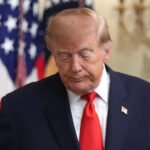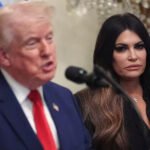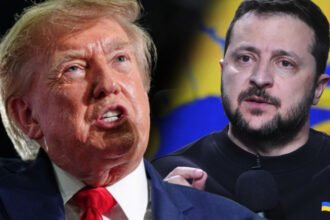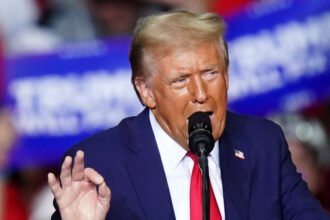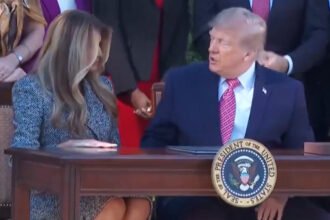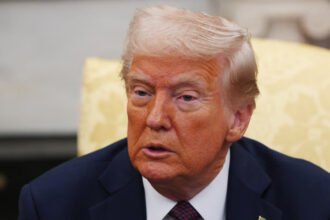







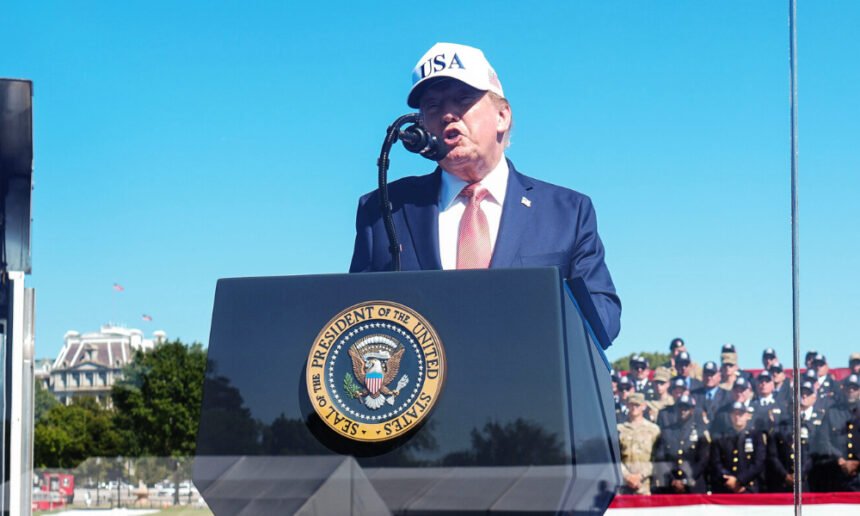
President Donald Trump stood Tuesday in front of first responders, 9/11 families and a massive steel beam pulled from the wreckage of the World Trade Center to commemorate one of the darkest days in American history.
And then, in classic Trump fashion, he started talking about himself.
The ceremony on the White House Ellipse was organized by the Tunnel to Towers Foundation as part of its “Steel Across America” tour. A 21-foot beam recovered from the South Tower stood behind Trump as he honored the firefighters, police officers and other first responders who ran toward the destruction on September 11, 2001. About 150 first responders attended.
Trump honored FDNY firefighter Jeffrey Palazzo and announced that a new Coast Guard cutter would bear his name. He also posthumously awarded the Presidential Medal of Freedom to Welles Crowther, the equities trader and volunteer firefighter who became known as the “man in the red bandana” after helping save people trapped in the South Tower.
But as the speech unfolded, the focus repeatedly shifted back to Trump.
He talked about his own experience after the attacks, once again recounting a story about supposedly being near Ground Zero and being carried to safety by firefighters who feared a nearby building was about to collapse.
“I had two firemen actually lift me up and started running with me,” Trump said.
The account is disputed and has never been independently substantiated. Trump has repeatedly claimed that he was involved in the recovery effort around Ground Zero, but there is no evidence establishing that he participated in rescue or recovery operations as he has described.
Then Trump turned to Howard Lutnick, his commerce secretary and former head of Cantor Fitzgerald.
Lutnick’s company occupied several floors of the World Trade Center’s North Tower and lost more than 650 employees in the attacks. Lutnick survived because he had taken his son to school that morning, while his brother Gary was killed. Trump praised Lutnick for rebuilding the company and making it “bigger, stronger, better.”
Trump’s telling of the story focused heavily on the remarkable survival of one man and the rebuilding of his company.
Then came the moment that most starkly captured the strange self-focus of the speech.
Trump introduced Welles Crowther, whose mother, Alison, and sister, Paige, were there to accept his Presidential Medal of Freedom.
Crowther was 24 when he died in the South Tower after repeatedly helping people escape the building. Survivors later identified him as the man wearing a red bandana over his face as he moved through the smoke and chaos, helping lead people to safety.
Trump praised Crowther’s courage. But he also couldn’t resist comparing the 9/11 hero’s fame with his own.
“The man in the red bandana has become more famous than me,” Trump said, adding: “I don’t like it.”
It was delivered as a joke. But the setting made the joke particularly jarring: the president was standing before first responders and families honoring people who died saving others, while speaking about whether one of those fallen heroes had become more famous than the president himself.
Alison Crowther then spoke about her son’s legacy in very different terms.
She emphasized courage, compassion and service—the qualities that defined her son’s actions that morning.
Trump eventually returned to the broader themes of sacrifice and national resilience. But the most memorable moments of the ceremony weren’t simply about the steel, the fallen firefighters or the victims.
They were about Trump himself.
At a ceremony built around remembering the people who gave everything on September 11, Trump once again found a way to put himself in the middle of the story.