







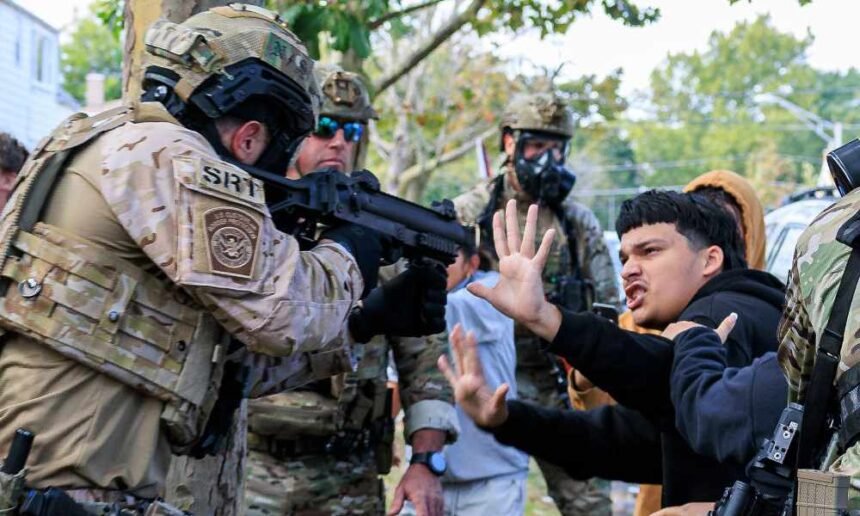
As public outrage grows over a string of fatal encounters involving Immigration and Customs Enforcement agents, the Trump administration is reportedly moving to make it even harder to hold those agents accountable.
According to a report by The New York Times, FBI officials around the country have been told that the bureau will no longer investigate confrontations involving ICE agents, a dramatic shift that would effectively leave the agency policing itself.
If the guidance is ultimately implemented, one of the few independent checks on ICE’s use of force would largely disappear.
The reported change comes after two fatal shootings by ICE agents in just the past two weeks—one in Texas and another in Maine—renewed scrutiny of the agency’s increasingly aggressive tactics. Those incidents are only the latest in a series of deadly encounters that have drawn growing criticism from civil rights advocates and fueled calls for greater oversight.
Citing people familiar with internal communications, the Times reported that FBI managers received written guidance on Thursday notifying them of the policy change. Some ICE agents were reportedly informed by their FBI counterparts the same day.
The guidance instructed the bureau to stop investigating allegations involving assaults on Department of Homeland Security agents.
On paper, those investigations are meant to determine whether federal officers were assaulted. In practice, however, they often uncover evidence that can later be used to investigate or prosecute ICE agents accused of misconduct or excessive force.
Eliminating those investigations would remove one of the government’s primary avenues for gathering independent evidence against immigration officers.
The Justice Department and the Department of Homeland Security insist nothing has changed.
In a joint statement, the agencies denied the report, saying, “The relationship between D.H.S. and D.O.J. in investigating assault on federal officer cases has not changed, and F.B.I. will continue to investigate in accordance with agency policy.”
The statement added that anyone who assaults law enforcement “will be prosecuted to the fullest extent of the law.”
But the reported guidance tells a very different story.
If the FBI steps aside, responsibility for investigating incidents involving ICE agents would largely fall to Homeland Security Investigations—an investigative arm within the same department as ICE.
In other words, ICE would be investigating itself.
That raises another major concern. Homeland Security Investigations does not have authority to investigate federal civil rights violations. As a result, cases involving the shootings of unarmed civilians or allegations that ICE agents violated constitutional rights would be far less likely to receive an independent federal review.
The timing is difficult to ignore.
The administration has aggressively prosecuted protesters and bystanders accused of assaulting federal officers, sometimes over brief or incidental physical contact. Yet according to The New York Times, nearly half of those felony assault cases ultimately collapse—either ending in acquittals, dismissals, or prosecutors quietly dropping the charges altogether.
Even when those cases fail, the FBI’s investigations often produce evidence documenting what officers themselves did during the encounters.
If those investigations disappear, so could one of the strongest tools for uncovering misconduct by federal immigration agents.
The move represents a significant reduction in independent oversight of an agency already facing intense criticism over its use of force, and would make it even more difficult to determine whether ICE agents who kill or injure civilians violated federal law.