








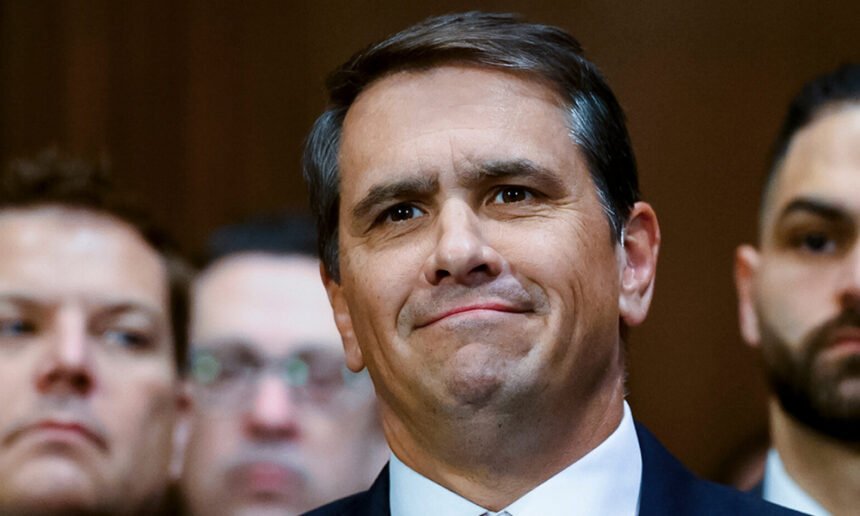
Acting Attorney General Todd Blanche is now openly bragging about putting “roadblocks” inside the Department of Justice to make sure Democrats can’t prosecute President Donald Trump after his term ends.
Yes, the top federal law enforcement official is describing structural interference designed around one political figure, intensifying fears that the Justice Department is being reshaped into a political shield rather than an independent law enforcement body.
And he’s not being subtle about it.
“We can just keep on exposing it and putting roadblocks in place so it never happens again,” Blanche told NewsNation host Katie Pavlich in an interview posted on X by journalist Aaron Rupar. He also warned about “some Democrats coming out and actually already forecasting what they’re gonna try to do if they get leadership again.”
So the framing is clear: this isn’t just about current legal fights — it’s about preemptively hardening the Justice Department against future administrations that might investigate Trump.
And that’s where the power story really sharpens. Because what Blanche is describing isn’t standard prosecutorial discretion. It’s institutional design aimed at constraining what future governments are allowed to do. In plain terms: building political immunity into the machinery of federal law enforcement.
Meanwhile, critics are pointing to a pattern that stretches beyond a single interview.
Blanche previously signed a one-page addendum declaring the federal government “FOREVER BARRED” from pursuing any IRS audit or tax claim against Trump, his family, or his businesses. That agreement, according to reporting, stemmed from a settlement tied to Trump’s $10 billion lawsuit over the leak of his tax records. Critics dispute the administration’s interpretation that it only applies to existing audits and not future ones, a distinction that matters a lot more when you’re talking about permanent financial protection for a president and his circle.
And that’s not even the only institutional fight he’s been involved in.
Blanche also spent weeks defending a nearly $1.8 billion taxpayer-funded “anti-weaponization” fund before it was ultimately scrapped after Senate Republicans revolted. On top of that, he previously urged young lawyers at a Federalist Society conference to join what he called a “war” against “rogue activist judges” blocking Trump’s agenda, language that drew a sharp rebuke from a coalition of 50 former federal judges.
The throughline is hard to miss: legal institutions aren’t being treated as neutral systems. They’re being treated as terrain in an ongoing political conflict, one where the goal is not just to win cases, but to reshape what future cases can even be brought.
And here’s the hypocrisy contrast that practically writes itself.
For years, Trump officials have warned about “weaponized” justice systems, “rogue prosecutors,” and politically motivated investigations. That rhetoric has been central to justifying sweeping institutional changes.
But now the head of the DOJ is openly describing mechanisms to preemptively block investigations into Trump himself, effectively creating a one-directional shield inside the very system that’s supposed to enforce accountability evenly.
And the wild part is how normalized this is becoming in public discourse: not hidden maneuvering, but openly framed “roadblocks” as strategy.
At some point, the question stops being what individual officials are doing, and becomes what version of the Justice Department is even left when every administration treats it like a prize to lock down for the next fight.