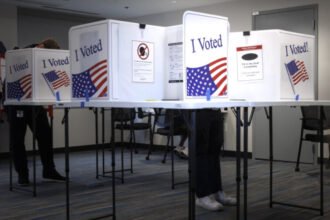







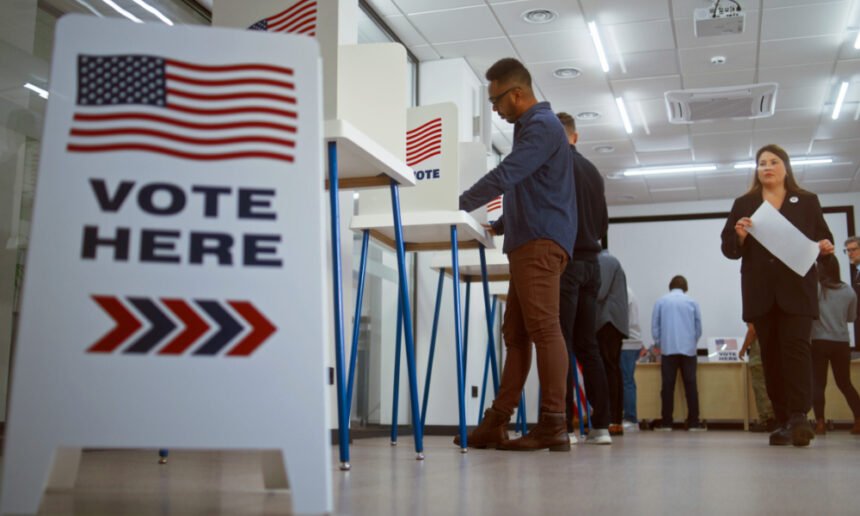
Texas election officials are asking the state’s highest court to bless something that could have major consequences far beyond one county: changing voting maps after the primary election has already happened.
Local officials are defending their decision to adopt new precinct boundaries months after voters had already cast their ballots in the March primary and use those new maps for the November general election.
And they aren’t exactly hiding their partisan motivation.
In a filing with the Texas Supreme Court, Galveston County acknowledged that one reason for changing the maps is to “increase partisan performance.” In other words, to improve Republicans’ chances of winning, Democracy Docket reports.
Voting-rights plaintiffs are urging the court to stop the change, warning that allowing it could open the door for other Texas jurisdictions to redraw election maps after seeing the results of a primary and then use those new boundaries in the general election.
That would create a remarkable scenario: voters cast their primary ballots under one set of district lines, only to discover that those lines had been changed before the general election.
The plaintiffs filed an emergency petition last week, arguing that the Texas Election Code requires a political party’s nominees for the general election to be chosen through the primary election process.
Galveston County officials disagree.
“Practically, there are many reasons why a county’s commissioners may adopt changed precinct boundaries between a primary and general election,” the county argued in a filing Monday. Those reasons, it said, could include responding to new laws, complying with population requirements, or simply “increase partisan performance (as here).”
That last part is hard to miss. The dispute is the latest chapter in a long-running redistricting battle in Galveston County.
Voting-rights plaintiffs are already challenging a Republican-backed redistricting plan that was struck down in 2023 by U.S. District Judge Jeffrey Brown, a Trump appointee. The ruling was later reversed by the conservative Fifth Circuit, while some related claims remain alive in district court.
Now Galveston County has adopted another set of changes—and insists it can use them in the November election despite the fact that the 2026 primary has already taken place.
That’s where things get particularly unusual.
Other states confronted with similar redistricting pressure this year have taken a different approach. Mississippi Republicans, for example, declined to redraw their congressional maps after the state’s March primaries had already been held.
Texas election officials are taking the opposite position: the primary happened, but the maps can still change.
And if the Texas Supreme Court agrees, voting-rights advocates fear the precedent could extend well beyond Galveston County.
The county’s argument is essentially that state law doesn’t explicitly say officials can’t change the boundaries between the primary and general election.
But notably, the county did not point to a comparable case in which a court had approved such a post-primary map switch.
Instead, Galveston County is also arguing that the plaintiffs went to the wrong court, saying they should have first sought an injunction in district court rather than taking the dispute directly to the Texas Supreme Court.
For voting-rights advocates, however, the stakes are bigger than a procedural fight over which court should hear the case.
The question is whether election officials can change the political playing field after voters have already participated in the primary.
If the answer is yes, critics warn that election maps could become something of a moving target, one set of boundaries for the primary, another for November, potentially adjusted after officials have already seen which candidates and political coalitions performed well.
And Galveston County has already acknowledged that partisan advantage is one of the reasons for its change.
That makes this much more than a routine map update.
The Texas Supreme Court now has to decide whether county officials can rewrite the boundaries between two elections, or whether the voters who already cast their primary ballots get to keep the map they voted under.