








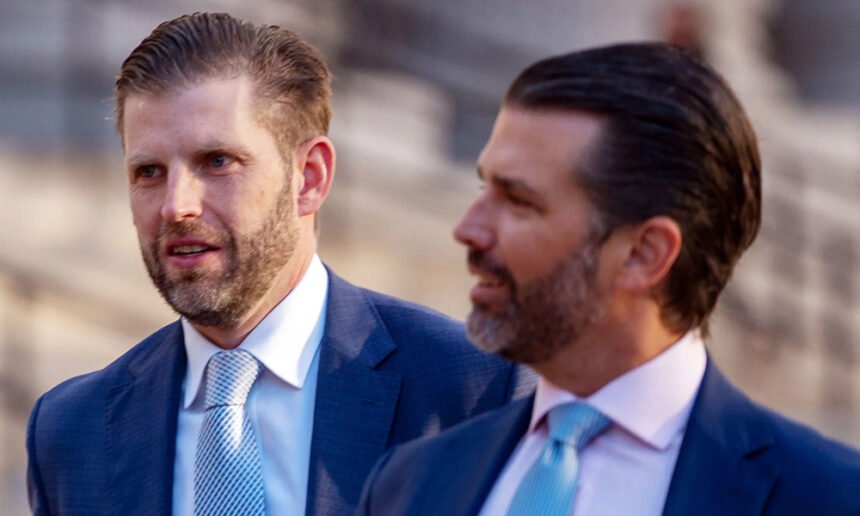
A new bombshell report is drawing direct comparisons between Donald Trump Jr. and Eric Trump and some of the most infamous convicted cryptocurrency fraudsters in modern history, flagging publicly available evidence that would ordinarily trigger criminal prosecution.
The report, published by Christopher Armitage on The Existentialist Republic Substack, alleges that the Trump sons’ crypto venture, World Liberty Financial, engaged in the same core behavior that sent other crypto founders to federal prison for years.
The report’s argument is brutally simple: Other crypto executives accused of misleading investors about insider control, hidden financial mechanisms, and self-dealing are already sitting in prison cells. Donald Trump Jr. and Eric Trump are not.
At the center of the controversy is World Liberty Financial, a cryptocurrency venture launched by the Trump sons in late 2024.
According to the report, the company generated at least $1.2 billion in revenue connected to the Trump family in roughly sixteen months — an astonishing amount that reportedly eclipsed what parts of the Trump real estate empire generated over several previous years combined.
The report alleges the project marketed itself as “decentralized” while secretly maintaining centralized insider control over users’ assets and governance.
That distinction matters enormously in the crypto world.
“Decentralized” is not just a buzzword. It is one of the central promises many crypto investors rely upon when deciding whether to put money into a project. The term suggests that no single insider or company can unilaterally freeze accounts, manipulate the system, or dominate governance decisions.
But according to documents flagged by Armitage, World Liberty functioned in the exact opposite manner.
The report points to smart contract code that allegedly allowed insiders to freeze customer wallets and block token holders from transferring or selling their assets — authority critics say directly contradicted the project’s marketing claims.
The allegations became public in part through a dispute involving crypto entrepreneur Justin Sun, who reportedly invested tens of millions of dollars into World Liberty before later accusing the company of concealing the freeze mechanism.
According to Armitage, Sun described the function as a hidden “trap door” that gave insiders sweeping control despite promises of decentralization.
The report further alleges that Trump family insiders controlled overwhelming voting power inside the project while ordinary investors possessed little meaningful influence over governance decisions.
Then came the financial collapse.
The token ultimately lost roughly 80 percent of its value, wiping out massive amounts of investor wealth while Trump-linked entities allegedly continued receiving substantial revenue from token sales.
The comparison to previous crypto prosecutions is where the report becomes especially explosive.
It points to the case of SafeMoon founder Braden Karony, who was sentenced to more than eight years in prison after prosecutors alleged he falsely told investors that key liquidity mechanisms protecting their investments were locked and secure when insiders allegedly retained hidden access.
The report also compares the conduct to former Celsius CEO Alex Mashinsky, who received a lengthy prison sentence after prosecutors alleged he misled customers about the safety and financial condition of the platform while enriching himself.
And it invokes convicted crypto figures like Sam Bankman-Fried and Do Kwon — both prosecuted after accusations they misrepresented how their crypto operations actually functioned while insiders retained hidden control.
Legal experts argues the same underlying legal principles could apply to World Liberty Financial.
Specifically, it points to New York’s “scheme to defraud” statute, which criminalizes systematic fraudulent conduct directed at multiple victims through false representations.
Marketing a crypto project as decentralized while allegedly concealing insider freeze controls and centralized governance mechanisms could potentially fit squarely within that law’s framework.
The report also notes that the scale of the alleged conduct could raise broader financial fraud questions if prosecutors ever obtained internal communications, investor records, or company documents through subpoena power.
No criminal charges have been filed against Donald Trump Jr., Eric Trump, or World Liberty Financial.
And no court has ruled that the allegations outlined in the report are true.
Still, the report argues the public evidence already raises questions that would likely trigger aggressive scrutiny if the people involved did not carry the Trump name.
Again and again, the report returns to the same uncomfortable comparison:
Other crypto founders accused of misleading investors about hidden insider controls and self-dealing were investigated, prosecuted, convicted, and imprisoned.
The Trump sons, despite allegations critics say resemble those same schemes, continue operating freely while overseeing a billion-dollar crypto empire connected to the sitting president’s family.
That discrepancy, the report argues, is becoming harder to ignore.
If ordinary crypto founders can go to prison for misleading investors about hidden insider control, why are the president’s sons being treated differently?