









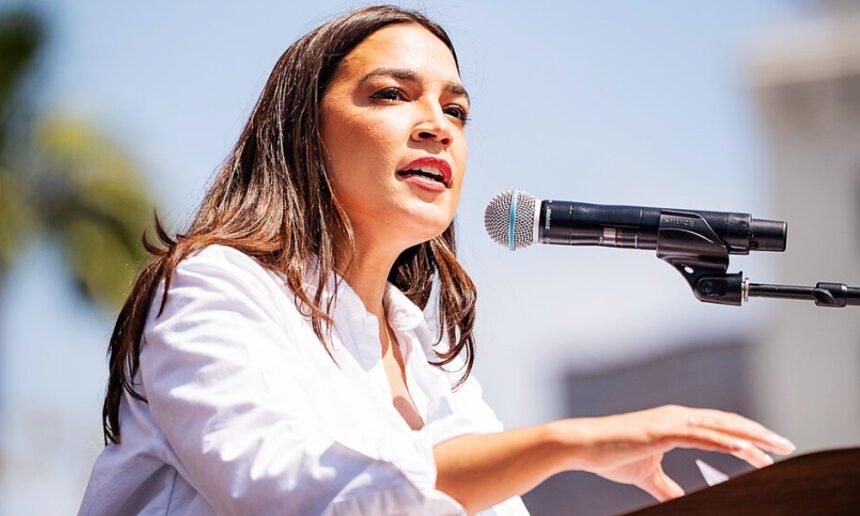
Alexandria Ocasio-Cortez didn’t have to announce a presidential campaign to set off a political firestorm.
She didn’t have to declare that she was running in 2028. She didn’t even have to say she wanted to be president.
All she had to do was make a deeply personal decision about her own life—and then talk openly about it.
And suddenly, the MAGA world lost its mind.
But AOC knew exactly how they would react.
“Don’t be weird about this, even though I know all of you will be.”
That’s how AOC opened her Instagram announcement.
She was right.
The 36-year-old congresswoman, one of the most social-media-savvy politicians in America, documented her egg-freezing process online, including videos of herself injecting medication while talking about politics and policy.
Almost immediately, the conversation moved beyond fertility.
One right-wing commentator attacked the idea that women can “have it all.”
AOC’s response was characteristically blunt.
Maybe you can’t have everything, she argued, but you can have “a hell of a lot.”
And perhaps “a lot” includes the presidency.
That’s the tell.
AOC has now made public something that conservatives would probably rather not confront: the possibility of an America in which someone who doesn’t fit their traditional template of what a woman, a mother, or a political leader is “supposed” to look like could someday occupy the Oval Office.
A young woman.
A single woman.
A child-free woman.
A Latina woman.
And, perhaps most threatening of all to MAGA’s cultural worldview, a woman who doesn’t appear particularly interested in asking permission.
AOC recently went public with her decision to freeze her eggs, documenting parts of the process and explaining why fertility preservation matters to her as she thinks about her future. She has also confirmed that she and longtime fiancé Riley Roberts have split. At the same time, speculation surrounding a possible 2028 presidential campaign has intensified, although she has not announced a run.
Put those facts together, and something interesting happens.
AOC’s personal life suddenly becomes political.
Not because she made it political.
Because MAGA did.
For years, American women have been told that marriage and motherhood are somehow prerequisites for being taken seriously. Women who prioritize careers are accused of being selfish. Women who don’t have children are treated as incomplete. Single women in politics are subjected to endless questions about their relationships and their “family plans”—questions male politicians rarely face with anything approaching the same intensity.
AOC’s situation exposes just how deeply those expectations remain embedded in American political culture.
She is not saying marriage is bad.
She is not saying motherhood is bad.
She is not saying women shouldn’t have children.
She’s saying something far less comfortable for people who want women to follow a prescribed life script:
A woman gets to decide for herself.
That’s apparently still a radical proposition. And AOC represents an especially potent version of it.
She is young enough to represent a generation that has watched traditional institutions become less stable and less affordable. She is a Latina who rose from working-class roots in the Bronx to become one of the most recognizable politicians in the country. She built a national political following without coming from the traditional Democratic establishment.
And she has never been particularly interested in behaving the way the political class thinks she should.
That matters because the presidency has historically been surrounded by an extraordinarily narrow image of leadership.
Presidents are supposed to look presidential.
They are supposed to have the right pedigree.
The right résumé.
The right family.
The right biography.
The right kind of spouse.
And increasingly, MAGA politics has wrapped that traditional image of American leadership in an even more rigid cultural package—one that places enormous emphasis on marriage, children, traditional gender roles and what it considers “family values.”
AOC blows a hole right through that picture.
Imagine the cultural shock if the country eventually elected a president who was a 30-something Latina woman who had never been married and had no children.
For some Americans, that would simply be history.
For others, it would represent a profound cultural shift.
And that’s precisely why the reaction to AOC’s personal choices is so revealing.
The question isn’t really whether AOC froze her eggs.
The question is why so many people feel entitled to judge what that decision says about her worth, her femininity, her priorities or her fitness for public office.
Nobody asks male politicians whether they are fathers before deciding whether they are qualified to lead the country.
Nobody demands that a male candidate prove he has successfully constructed the “right” family before taking his political ambitions seriously.
But when a woman steps outside the traditional script, the script suddenly becomes the story.
AOC’s critics may think they’re attacking her.
What they’re actually doing is advertising the boundaries they want women to stay inside.
And AOC has spent her career stepping outside those boundaries.
She was too young.
Then she was too inexperienced.
Then she was too progressive.
Then she was too outspoken.
Then she was told she couldn’t possibly understand working-class Americans despite having worked as a waitress and bartender before entering Congress.
Now the argument is increasingly about something much more personal: whether a woman without a husband or children can represent the country.
That’s a revealing evolution.
Because it suggests that the policy arguments aren’t always enough.
When critics can’t stop AOC’s political rise by attacking what she believes, they can always attack who she is.
But that’s also where the politics can backfire.
There is an enormous difference between telling voters that you oppose AOC’s policies and telling millions of women that someone like AOC is fundamentally unfit because she doesn’t live her life the way you think a woman should.
The first is politics.
The second is cultural policing.
And cultural policing has a funny way of creating sympathy for the person being targeted.
AOC may or may not run for president in 2028. She has not made that decision publicly, and recent reporting indicates she is weighing a presidential campaign against a possible Senate bid.
But the mere possibility is enough to force a question that American politics has largely avoided:
What if the next generation of political leadership doesn’t look like the generations that came before it?
What if the future president is young?
What if she’s single?
What if she doesn’t have children?
What if she’s Latina?
What if she doesn’t apologize for any of it?
That’s the possibility AOC embodies.
And maybe that’s why MAGA’s reaction to her personal life has become so intense.
Because the most disruptive thing about AOC isn’t that she’s a socialist, a progressive or a congressional firebrand.
It’s that she represents a version of American womanhood that refuses to wait for society to decide when she is allowed to lead.
She doesn’t need a husband to validate her.
She doesn’t need children to prove her femininity.
She doesn’t need permission to preserve her fertility.
And she certainly doesn’t need anyone’s approval to imagine herself at the highest level of American politics.
AOC didn’t have to announce that she was running for president to expose this.
Her MAGA critics did it for her.
All she had to do was live her life.
And for a movement built around traditional ideas of family, gender and American identity, that may be the part that’s hardest to swallow.