









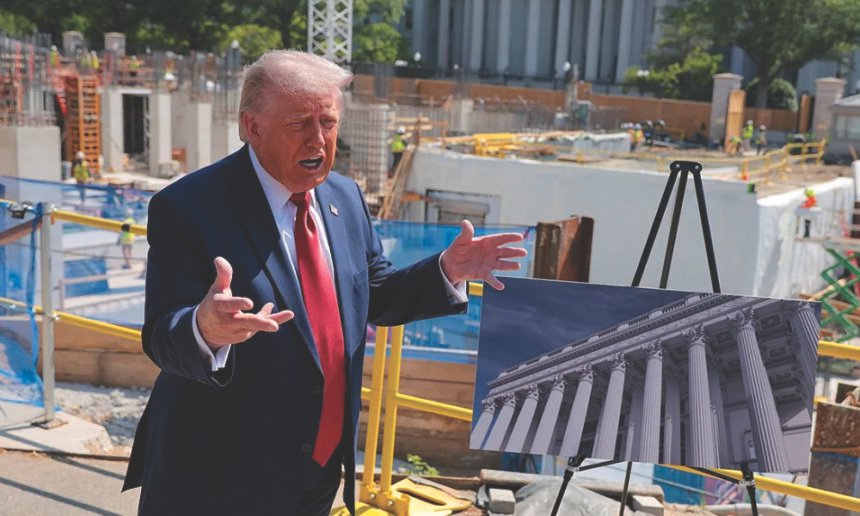
Donald Trump is taking extraordinary steps to keep congressional Democrats from investigating his administration’s activities. And he’s putting a financial threat on the table for any government contractor that dares to help them.
With Democrats set to take control of the House in January, the White House is moving to restrict their access to information about controversial administration projects, including several high-profile undertakings personally championed by Trump.
In an executive order issued late Friday, Trump directed federal contractors to notify the White House and obtain its approval before complying with congressional investigative demands, according to The Hill.
The message to businesses that depend on federal contracts is clear: Cooperating with Congress could put your government business at risk.
Trump has also threatened to pull funding from contractors who cooperate with congressional investigations, potentially making companies think twice before handing over records or answering lawmakers’ questions.
And Democrats have plenty of projects they want to examine.
Among them are the renovation of the White House reflecting pool, Trump’s massive new ballroom replacing the East Wing, work involving the Kennedy Center, and other controversial projects that have drawn scrutiny.
Rep. Dan Goldman (D-N.Y.), a former federal prosecutor, called the premise of the executive order “comical.” But he warned that the financial threat could have a very real chilling effect on businesses.
A pledge to cancel contracts, he said, “will make any business pause.”
“The extent of obstruction and stonewalling that the [White House] is foreshadowing is almost unimaginable,” Goldman wrote on X. “An obvious violation of the most fundamental principles of separation of powers. Judges must recognize this and move quickly.”
The order is also part of a broader effort by the administration to get ahead of Democratic oversight before it even begins.
White House counsel Will Scharf has already sent two letters to congressional Democrats signaling that the administration intends to resist their investigations.
In one letter, Scharf suggested the probes could be criminal in nature, alleging they were launched to harass administration officials. In another, he argued that the White House had no obligation to respond to Democratic inquiries until lawmakers officially take control of the House.
Legal experts, however, say the administration is stretching executive privilege far beyond its intended purpose.
Joyce Vance, a former U.S. attorney during the Obama administration, explained that executive privilege is designed to protect confidential internal government deliberations — not shield ordinary commercial dealings from congressional scrutiny.
“The title of this one is interesting. Trump says the quiet part out loud; it’s about ‘Protecting The Executive’s Privileges,’ in other words, it’s about protecting Donald Trump as Democrats gear up to investigate the corruption that appears to be rife in his administration,” Vance wrote on her blog.
She also described the order as relying on “the full weight of economic blackmail.”
“The order is a thinly veiled, perhaps not veiled at all, attempt to prevent businesses the administration has worked with on matters like The Reflecting Pool, The Kennedy Center, The Ballroom, The Arch, and on and on, from providing Congress with information about those dealings,” she added.
For contractors, the consequences could be serious. Companies now risk being caught between congressional demands for information and a White House that controls the federal contracts their businesses depend on.
Susanne Sachsman Grooms, a former attorney for Democrats on the House Oversight and Government Reform Committee who now leads congressional investigations at law firm Cooley, told *The Hill* that contractors could find themselves in the middle of a fight that has little to do with their own business.
“From our perspective, representing people who are federal contractors and subcontractors, it puts them in the middle of a complicated fight that isn’t really their fight,” she said.
Many contractors are simply trying to fulfill their obligations. Some may even be required to comply with congressional subpoenas as a condition of their federal contracts.
But refusing to cooperate with Congress can create problems, just as angering the White House officials responsible for awarding contracts could threaten their business.
“Upsetting Congress is not an ideal scenario, and similarly upsetting the executive branch officials who give you your contracts is also not an ideal scenario,” Sachsman Grooms explained.
Democrats leading the House’s major investigative committees aren’t backing down.
Rep. Jamie Raskin (D-Md.), who is expected to chair the House Judiciary Committee, accused Trump of trying to prevent Congress from investigating potential corruption involving his administration.
During an appearance on CNN’s State of the Union on Sunday, Raskin said both individuals and companies have an obligation to provide truthful testimony to Congress.
“Trump is scrambling to cover up all of the corruption, the kickbacks, the bribery, the insider influence, and they’ve issued a totally unprecedented and lawless royal edict,” Raskin told Dana Bash.
He dismissed the executive order as having little legal force, comparing it to an internal office memo rather than a legitimate restriction on congressional authority.
“We’ve got the Constitution on our side,” Raskin said. “We are charged by the Constitution to conduct oversight in order to ferret out all of the corruption and the bribery and the sweetheart contracts, and we’re going to do that.”
Rep. Robert Garcia (D-Calif.), the top Democrat on the House Oversight Committee, also condemned the order as a “blatant attack” on Congress’s constitutional oversight powers.
“This EO desperately orders contractors to get White House permission before complying with congressional oversight. What is the White House trying to hide?” Garcia said in a statement.
“Donald Trump wants to stop us from exposing the rampant waste, fraud, and corruption by his Administration, but we’re just getting started.”
There is also a precedent for contractors becoming trapped in a prolonged legal battle between Trump and Congress.
Sachsman Grooms pointed to the experience of Mazars USA, the accounting firm that handled Trump’s and the Trump Organization’s financial records.
In 2019, House Democrats subpoenaed the firm for Trump’s financial documents, triggering a lengthy legal battle between Congress and the White House. The House ultimately obtained the records in 2022.
She warned that the latest executive order could produce a similar standoff, with contractors reluctant to turn over documents until a court settles the dispute.
“One way it may play out in practice is just that it might stymie and slow the course of being able to produce documents,” she told The Hill.
And that delay could be exactly what the administration is counting on.
Vance argued that Trump has repeatedly relied on delaying tactics when confronted with investigations, while Goldman warned that contractors are likely to be extremely cautious about risking their federal business.
“The [White House] knows this is a ridiculous reading of executive privilege, but they also know a court will need to issue such an order before a contractor will comply with a Congressional subpoena,” Goldman wrote.
“And if the speed of the judiciary is anything like 2019-20, that will take way too long.”
That’s the larger concern as Democrats prepare to take control of the House: Even if courts ultimately reject the administration’s position, the White House could slow investigations simply by making companies afraid to cooperate.
The contractors holding the records may have information lawmakers need to examine Trump’s projects. But when those same companies depend on the federal government for their next paycheck, a threat from the White House could be enough to make them think twice.