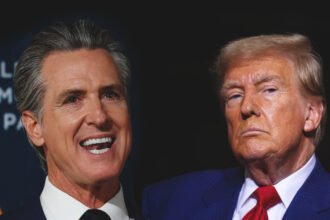








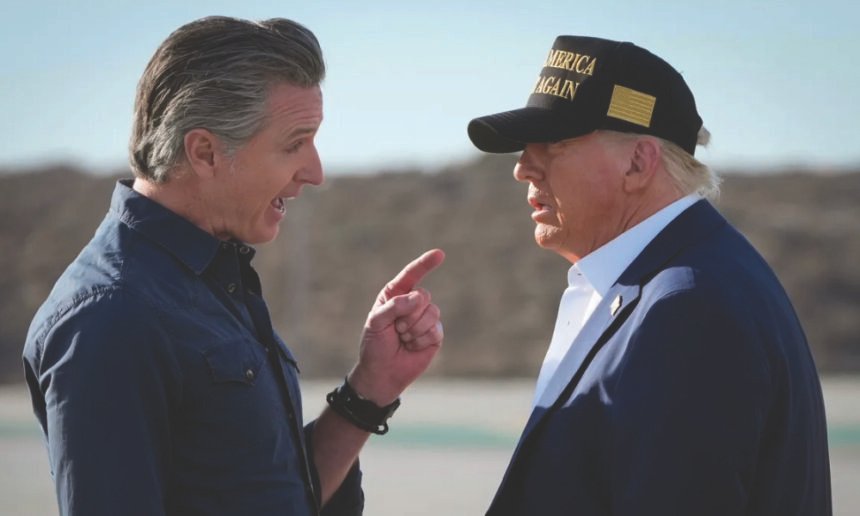
The political battle between President Donald Trump and California Gov. Gavin Newsom escalated Monday after Trump used a Justice Department appearance to attack Newsom’s decision to commute the death sentences of 548 inmates—and Newsom responded by accusing the president of turning presidential mercy into a business.
Speaking alongside Attorney General Todd Blanche and relatives of murder victims, Trump called Newsom’s decision one of the most shocking acts of injustice in American history. He accused the California governor of putting convicted killers ahead of victims’ families and promised his administration would fight the move.
Trump also used the event to announce a tougher federal death penalty policy, directing the Justice Department to pursue capital punishment for certain crimes involving the murder of children, as well as rapists and human traffickers who kill their victims. He called for federal executions to be expedited and announced nearly $150 million in public safety grants.
But Newsom wasn’t backing down.
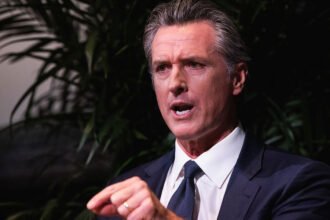
In a video response, the governor acknowledged the pain of the families who appeared alongside Trump, while defending his decision and emphasizing that none of the affected inmates would be released.
“To the families standing with him today, your grief is real,” Newsom said. “That’s why every person, every person on California’s former death row will die in prison. No one walks out.”
Then he turned his attention directly to Trump.
“Donald Trump’s criminals, they walk out,” Newsom said.
The governor’s argument was that Trump was attacking California’s use of clemency while using his own presidential pardon power to benefit political allies and wealthy associates.
“Donald Trump doesn’t oppose mercy, he sells it,” Newsom said.
He went further, calling for reforms to prevent future presidents from using pardons to benefit people with money or political connections.
“No president can ever again turn the power of mercy into a business. No president and no one should be able to sell a pardon,” he said. “The Justice Department is not Donald Trump’s law firm. Justice is not for sale. Not in California, and not in America.”
Newsom announced his decision on November 5, proposing to change all 548 California death sentences to life in prison without the possibility of parole. The move does not erase the convictions, release anyone from prison, or make the inmates eligible for parole. Some of the proposed commutations still require review by the California Supreme Court.
The governor has opposed capital punishment for years, issuing a moratorium on executions in 2019. California has not carried out an execution since 2006.
Trump, however, made the decision a centerpiece of his Justice Department appearance, inviting relatives of murder victims to describe the impact of the crimes and their anger over the proposed commutations.
Among those who spoke was Mark Klaas, whose 12-year-old daughter Polly was abducted and murdered in 1993. He criticized Newsom for changing the sentences of 548 inmates without the consent of victims’ families or California voters.
Sandy Fern, the mother of eight-year-old Michael Lyons, who was abducted, tortured and murdered in 1996, also condemned the decision. She directly challenged Newsom to face the families and explain why her son’s killer would no longer face execution.
Their grief and anger were central to Trump’s argument that Newsom had denied victims’ families the justice they were promised.
But the dispute also raises a broader question about the use of executive clemency—and whether the same standard should apply when presidents grant mercy to their own political allies.
Trump pardoned more than 1,000 people convicted in connection with the January 6, 2021, attack on the Capitol. He also pardoned former Honduran President Juan Orlando Hernández, who had been convicted in the United States of drug-trafficking offenses.
More recently, Trump said he would consider pardoning billionaire Elon Musk as Musk faces the prospect of congressional investigations under Democratic control.
Newsom has seized on those decisions to challenge Trump’s criticism, arguing that the president cannot condemn one governor’s use of clemency while defending his own use of the pardon power.
The clash comes as Newsom is widely viewed as a potential Democratic presidential contender in 2028, giving the confrontation an unmistakable national political dimension.
And while Trump has vowed to challenge California’s decision, the governor is making his own message clear: changing a death sentence to life without parole is not the same as setting a convicted murderer free.