






A proposal to livestream the execution of a convicted mass murderer has sparked a fierce religious debate, but one of Donald Trump’s longtime spiritual advisers isn’t just defending the idea. He says God commands it.
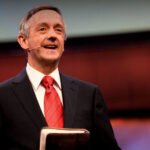
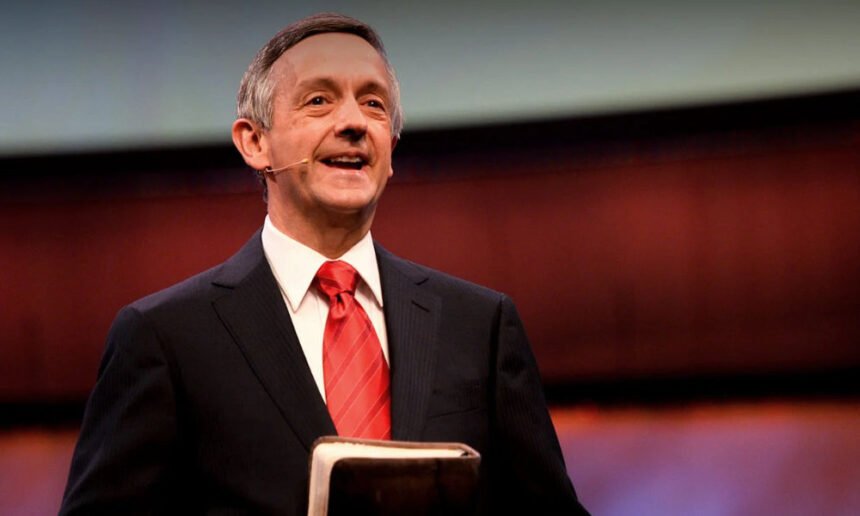
Rev. Robert Jeffress, senior pastor of First Baptist Church in Dallas and a longtime informal adviser to Trump, has thrown his support behind Defense Secretary Pete Hegseth’s push to let the public watch the planned firing-squad execution of Nidal Hasan.
And Jeffress isn’t treating it as a matter of personal opinion.
“I support the Pentagon’s decision to livestream the execution of mass-murderer Nidal Hasan,” Jeffress said.
“Capital punishment is commanded by God in Genesis 9:6 to remind people of the sanctity of human life,” he added. “The more people that can see that truth illustrated through a public execution, the better.”
Jeffress told The Dallas Morning News that he would watch the killing himself.
His argument is that a public execution would serve as a lesson about the value of human life. He cited the biblical account of God’s instructions to Noah, arguing that those who take another person’s life should face the ultimate penalty.
“Capital punishment for society isn’t God’s suggestion; it’s God’s command,” Jeffress told the newspaper.
He also argued that broadcasting the execution would be consistent with scripture because more viewers would see what he considers a divine lesson about the sanctity of life.
Trump subsequently shared Jeffress’s statements on Truth Social, and the pastor thanked the president for amplifying them.
The proposal has exposed a striking divide among religious leaders: Some are invoking scripture to defend turning a state execution into a public broadcast, while others warn that doing so would cross a dangerous moral line.
Jeffress isn’t the only prominent evangelical figure close to the administration weighing in on the proposal.
Rev. Franklin Graham, son of the late evangelist Billy Graham and a prominent Trump ally, also stopped short of condemning the idea. Instead, he questioned why people who consume violent entertainment would be appalled by the prospect of watching an actual execution.
“There are a lot of strong opinions,” Graham wrote on Facebook, adding that he didn’t know “where that debate will land.”
“I found it ironic that many who embrace Hollywood and its culture of death that is constantly depicting murders, rapes, and all kinds of violence — all in the name of entertainment — are saying they’re so appalled at this,” he wrote. “Have we become desensitized to death? What are your thoughts?”
Meanwhile, Catholic leaders call the proposal “barbaric.”
Archbishop Paul S. Coakley, president of the U.S. Conference of Catholic Bishops, described the announcement as a “barbaric promotion of a culture of death” and urged the administration to reconsider.
“Our God is the God of life. In no way can Hasan’s actions be condoned,” Coakley said. “But this decision is a barbaric promotion of a culture of death and must be reconsidered.”
He also invoked Romans 12:17, which instructs Christians not to repay evil for evil.
“The public execution even of one who has done grave harm will only further undermine the moral fabric of our nation and be a blight on the conscience of its people,” Coakley said.
Krisanne Vaillancourt Murphy, executive director of Catholic Mobilizing Network, which advocates for abolishing the death penalty, warned against turning an execution into something people can watch and celebrate.
“We undermine our own humanity when we treat another person’s death as something to watch, celebrate, or use for entertainment,” she said.
Murphy also compared the proposal to the horrors of lynching in America’s past and public executions carried out in authoritarian countries.
The competing religious arguments are particularly notable given the growing influence of Christian nationalism in American politics—a movement that seeks to embed Christianity more deeply into the country’s laws, institutions and public life.
Trump and his allies have helped make Christian nationalist voters a powerful political constituency, while Hegseth and other administration officials have regularly incorporated explicitly Christian messages into their public communications.
In this case, however, the debate is about more than religious messaging. It concerns whether the government should broadcast a state-sanctioned killing and present it as a public lesson.
Hasan is scheduled to be executed on December 3. If carried out as planned, it would be the U.S. military’s first firing-squad execution since 1945, when Army Private Eddie Slovik was executed by a firing squad from his own unit.
Hasan killed 13 people and wounded 32 others in the 2009 mass shooting at Fort Hood, Texas. His victims included fellow service members at the military installation.
The planned execution has already created unease among some military personnel who could be ordered to participate.
Mikey Weinstein, founder of the Military Religious Freedom Foundation, told *The Washington Sun* that he had spoken with six service members seeking religious exemptions to avoid being selected as members of the firing squad.
Weinstein said he expects as many as 180 service members could seek exemptions.
Vice President JD Vance, who converted to Catholicism in 2019, said Friday that he wasn’t sure whether the execution would actually be livestreamed. He also made clear that he wouldn’t watch it.
“I don’t know that that’s actually going to happen,” Vance said.
Vance described Hasan’s attack as exceptionally heinous, emphasizing that the victims were soldiers he was supposed to treat for mental health and other problems.
“Now that said, I mean, look, if it’s through livestream, I’m not going to be watching it,” he added.
The administration’s plans remain uncertain, but the debate is already raising difficult questions about justice, religion and the role of government in public life.
For Jeffress, livestreaming the execution would be a way to demonstrate what he sees as God’s command. For other faith leaders, turning a person’s death into a public spectacle risks undermining the very sanctity of life that religious teachings are supposed to defend.