










A major Texas swing county is preparing to close 92 Election Day polling places ahead of November’s midterm elections, and Democratic Senate nominee James Talarico is warning that the move could make it harder for thousands of voters to cast a ballot.
Tarrant County, which includes Fort Worth and sits just west of Dallas, is scheduled to vote Tuesday on whether to eliminate nearly one-third of its polling places ahead of the pivotal elections.
Many of the locations slated for closure are in areas with large Black and Latino populations.
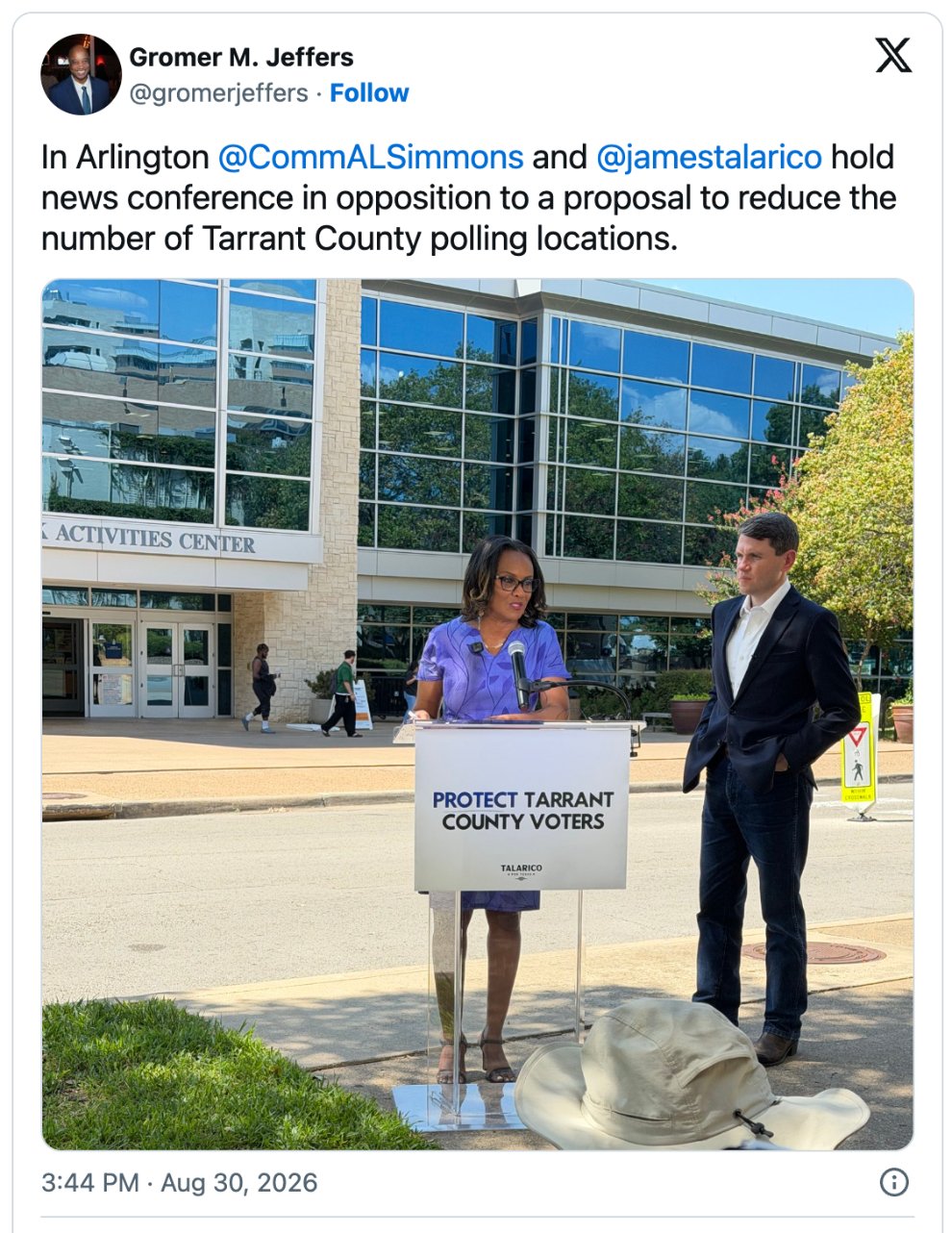
Talarico, who is running for the U.S. Senate, blasted the proposal Sunday, arguing that reducing the number of polling places would mean longer travel times for voters and could ultimately suppress turnout.
“The most powerful people in this county, the most powerful people in this country, don’t want us to be able to vote easily,” Talarico said at a news conference.
“We’re here fighting for the rights of everybody,” he added. “The problem is when we let voting rights become a partisan issue. That’s when we walk down a very dangerous path in this country.”
Republicans defending the proposal say it’s not about politics.
State Rep. Matt Shaheen, a Republican who chairs the Texas House Elections Committee, dismissed accusations that the closures are intended to suppress turnout.
“We’re clearly not trying to suppress the vote,” Shaheen told The Associated Press. “That’s a silly accusation.”
But critics aren’t making their argument based solely on Tuesday’s proposal.
They point to what has happened in Tarrant County before.
In 2024, Republican County Judge Tim O’Hare unsuccessfully tried to eliminate several early voting locations on college campuses. At the time, the county’s Republican chairman openly acknowledged that removing the sites would benefit the GOP, calling it “a serious win for Republicans in Tarrant County.”
Then, during the 2025 off-year elections, Republicans voted 3-2 to reduce the number of polling locations by more than a third and cut funding for free bus rides to the polls for low-income residents.
The previous year, county officials also introduced rules barring groups they described as “left-wing” from registering voters inside county buildings.
That history is why civil rights groups aren’t exactly reassured by the latest proposal.
A coalition including the ACLU, the Legal Defense Fund and the Texas Civil Rights Project sent a letter to the Commissioners Court on Friday warning that closing so many polling places could disproportionately affect Black, Latino and Asian American and Pacific Islander voters.
“Cutting the number of poll sites, especially at such a large scale, will harm Tarrant County voters and their right to participate in the democratic process,” the groups wrote.
They noted that many of the polling locations targeted for closure are concentrated in southern and southeastern Fort Worth and central and eastern Arlington—areas with predominantly nonwhite populations.
And there’s a reason Tarrant County is getting so much attention.
It’s a swing county in a state that Democrats desperately want to flip.
Tarrant County narrowly backed Democrat Collin Allred in his 2024 Senate challenge against Republican Sen. Ted Cruz.
At the same time, Talarico has emerged as a competitive Democratic candidate in this year’s Senate race, leading Republican Attorney General Ken Paxton in several polls.
If Democrats are serious about winning control of the Senate, Texas is one of the biggest prizes on the map.
That makes access to the ballot an especially consequential issue.
Tuesday’s vote comes after county commissioners already tabled an earlier proposal that would have closed nearly half of Tarrant County’s polling locations.
An analysis of that earlier plan found a striking disparity in its potential impact.
The lowest-income third of ZIP codes would have lost nearly 58 percent of their Election Day polling sites.
The highest-income third would have lost just under 22 percent.
Majority-minority ZIP codes would have lost nearly 52 percent of their polling places, compared with roughly one-third in majority-white ZIP codes.
No comparable analysis has yet been conducted on the new proposal.
But that hasn’t stopped civil rights groups from sounding the alarm.
And Tarrant County Commissioner Alisa Simmons, a Democrat running to unseat O’Hare as county judge, isn’t satisfied with the argument that the new proposal is better than the previous one.
Speaking alongside Talarico Sunday, Simmons acknowledged that the latest plan is an improvement over the earlier proposal.
But she wasn’t exactly celebrating.
“Dropping 92 Election Day polling places is crazy,” she said.
And then she made the point that may matter most: “We should not compare this proposal to the worst proposal. We should compare it to the access that Tarrant County voters actually had in 2022.”
That’s the heart of the dispute.
Republicans proposing the closures say the county is simply trying to save money.
Critics say the county is making it harder for people to vote, and that the burden won’t fall equally across the county.
Either way, 92 polling places is not a minor adjustment.
It’s a major change to how hundreds of thousands of Texans could cast their ballots.
And with a potentially decisive Senate race unfolding in one of the country’s most closely watched political battlegrounds, Tarrant County voters are about to find out exactly what that change means.