








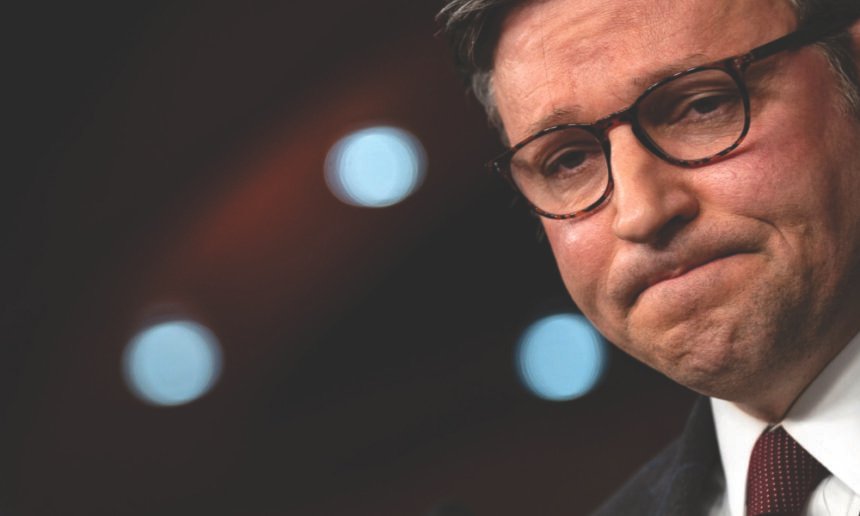
Republicans are getting increasingly nervous as Election Day approaches, and the private conversations inside the party are becoming considerably darker. What once looked like a difficult election is now shaping up to be a potential disaster, with GOP candidates suddenly fighting to hold onto seats in districts Donald Trump won comfortably just two years ago.
Behind the scenes, House Republicans are no longer just asking whether they’ll lose their majority. They’re discussing how many seats they could lose. Vulnerable incumbents have reportedly been scrambling to get emergency funding from party leaders as campaign money dries up and Democrats gain ground in districts Republicans once considered safe.
The Senate map is also becoming a source of concern, with Republicans increasingly worried about races in Ohio, Kansas and other traditionally red states.
“It could be quite a brutal evening,” one senior Republican involved in private party discussions told POLITICO. “Once the dominoes start falling it becomes hard to stop them.”
The panic has reportedly become so serious that some Republican incumbents have stopped paying for their own polling in recent weeks, choosing instead to save every available dollar for advertising while pleading for help from Trump’s political operation and the National Republican Congressional Committee.
One Republican strategist working on midterm races summed up the situation with a video of a dumpster on fire being swept away by floodwaters.
Not exactly a ringing endorsement of the party’s prospects.
Republicans have known for months that the political environment was deteriorating. Voters remain angry about the cost of living and Trump’s policy agenda, while the war with Iran and rising fuel prices have created additional problems for a party already struggling to maintain enthusiasm among parts of its 2024 coalition.
One particular concern is that younger men and working-class voters, including white and Hispanic voters who backed Trump in 2024, simply won’t show up this time.
And that could open the door for Democrats to make unexpected gains in places where Republicans thought they were safe.
In Wisconsin’s closely watched 3rd Congressional District, 20-year-old Trump voter Isaiah Romero offered a glimpse of that frustration. While filling up his truck at a gas station in Eau Claire, Romero complained about fuel prices, calling them “bull.”
Asked whether he planned to vote this time, his answer was blunt.
“No,” he said. “I didn’t vote for this.”
Meanwhile, Republicans are facing new problems across the country just as they thought they had contained others. Trump recently canceled planned in-person rallies in deep-red Kansas and Iowa, opting instead for tele-rallies to support GOP candidates during the final stretch.
In Ohio, Republicans are particularly worried. The Senate contest between Republican Sen. Jon Husted and former Democratic Sen. Sherrod Brown remains extremely close, while Republican gubernatorial nominee Vivek Ramaswamy has reportedly suffered a sharp decline in internal polling.
The backlash surrounding Ramaswamy’s controversial attack ad featuring the estranged mother of Democratic candidate Amy Acton has added to the party’s problems. The ad portrayed Acton as a liar about her childhood, but public records have supported key parts of her account.
Republicans are also concerned about Rep. Max Miller, who faces child and domestic abuse allegations that he denies. Party insiders reportedly believe he could lose despite Trump’s double-digit victory in the district in 2024.
And Ohio isn’t the only place causing headaches.
South Carolina has become unexpectedly competitive, with Republican Sen. Darline Graham facing a well-funded Democratic challenger. Republicans have gained some confidence after outside groups poured money into the race and Trump announced another rally to energize the party’s base.
But the anxiety is spreading into territory Republicans never expected to defend.
In Louisiana, Republican Senate nominee Julia Letlow is facing concerns about a surge in early voting among Black voters and other Democratic-leaning groups. Trump has scheduled an election-eve tele-rally for Letlow, with House Speaker Mike Johnson also expected to participate.
Republicans still expect Letlow to win, but some privately fear the race could be much closer than anticipated. One Louisiana Republican described the situation this way:
“The cakewalk turned into a knife fight.”
The same source predicted Letlow could win by just six points in a state Trump carried by 22 points in 2024.
Even a traditionally safe Republican House district in Louisiana has become a costly internal battle, with outside groups pouring money into a bitter Republican primary that could end in a December runoff.
On the House side, the situation may be even more troubling.
Republicans are scrambling to protect incumbents in districts Trump won by double digits, including races in Colorado, Michigan, Virginia, Ohio, Texas and Minnesota. The National Republican Congressional Committee says it began coordinating advertising in vulnerable districts months ago and conducted polling in more than 100 districts to assess the damage.
But privately, some Republicans believe several seats are already slipping away.
The party is reportedly particularly worried about North Carolina’s open 11th Congressional District, several other deep-red districts, and Kentucky’s 6th District, where the Republican incumbent is said to be barely holding on despite Trump’s 15-point victory there in 2024.
Republicans are also struggling in South Texas, where redrawn congressional districts were supposed to improve the party’s chances. One GOP official reportedly believes the damage has reached a point where additional campaign spending won’t be enough to turn things around.
Even Rep. Brad Finstad of Minnesota, who represents a district Trump won by 12 points, has been warning party leaders about Democratic spending and the growing threat to his reelection.
Senate Democrats are cautiously optimistic, although the races remain extremely tight, with polling across much of the battleground map falling within the margin of error.
One senior Democratic Senate operative summed up the uncertainty: “I would rather be us than them. But if anyone tells you they know what’s going to happen, they’re full of shit. Everything is close.”
Republican officials, meanwhile, are trying to manage expectations while hoping the final days produce a turnaround.
One GOP strategist working on a campaign that is trending toward Democrats offered perhaps the bleakest assessment of all:
“I can see the light at the end of the tunnel,” the strategist said. “It might be a semi-truck, but at least I can see it.”