








With less than 90 days until the midterm elections, Democrats are looking at something that seemed far less realistic just a few months ago: a potential path to taking back the Senate.
Republicans still hold the structural advantage. But President Donald Trump’s declining approval numbers, voter frustration over the war in Iran and continued concerns about inflation and affordability are putting a growing number of GOP-held seats on the defensive.
Democrats need to flip four seats while protecting the seats they already hold.
And right now, they’re looking at eight Republican-held seats that could potentially be in play.
That’s a pretty dramatic expansion of the battlefield. We’re talking about North Carolina and Maine, but also Ohio, Alaska, Iowa, Texas, Kansas and Nebraska.
Some of those races are genuine toss-ups. Others are long shots.
But the fact that Democrats are spending money, recruiting serious candidates and polling competitively in states like Kansas and Texas tells you something about the political environment heading into November.
And Republicans have another problem beyond the polling.
Their voters have to actually show up.
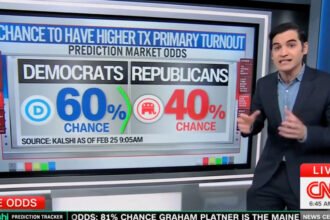
Jessica Taylor, Senate and governors editor at the nonpartisan Cook Political Report, told The Hill that Democratic voters have been turning out at higher rates than Republicans in primaries this spring and summer.
That’s potentially significant for a party trying to win control of Congress while its president’s approval rating continues to slide.
Republicans now have to defend their candidates from the political baggage coming out of Washington — while also making sure Republican voters don’t simply decide to stay home.
Here are the eight races Democrats believe could give them a path to four Senate pickups.
North Carolina: The Biggest Opportunity?
If Democrats are looking for one race that could make the Senate map very interesting, this is probably it.
Republican Sen. Thom Tillis is retiring, leaving former Republican National Committee chair Michael Whatley to face former North Carolina Gov. Roy Cooper.
And Cooper isn’t exactly introducing himself to voters.
He’s already won statewide in North Carolina — including in 2016 and 2020, both times with Trump at the top of the ticket.
Recent polling has shown Cooper with an advantage. A Fox News survey released in late July had him nine points ahead of Whatley.
Cook Political Report currently rates the race “likely Democratic.”
Taylor pointed to Trump’s approval rating in the state, which is hovering around 40%, along with Democrats’ decision to nominate a well-known former governor.
Republicans, however, aren’t treating this as a lost cause.
National GOP money is beginning to flow into the race, and there’s still plenty of time for the contest to tighten.
Maine: Susan Collins Is Finally Vulnerable?
Maine is another race that has changed quickly.
Democratic nominee Graham Platner dropped out in July after facing an accusation of sexual assault, which he denied. Democrats replaced him with Troy Jackson, a logger and former Maine Senate president.
That could ultimately help Democrats.
Jackson doesn’t carry the same baggage, although he has considerably less time to introduce himself to voters.
Standing in his way is Republican Sen. Susan Collins — one of the most durable political survivors in the country.
Collins has repeatedly won statewide in a state where Democrats have a significant advantage. This time, she’s emphasizing her seniority, her position as chair of the Appropriations Committee and her history of occasionally breaking with Trump.
Democrats are reminding voters about another vote: Collins’ 2018 decision to confirm Supreme Court Justice Brett Kavanaugh, a vote that helped pave the way for the Supreme Court’s eventual decision to overturn Roe v. Wade.
Recent polling has Jackson slightly ahead. A University of New Hampshire poll had him up three points.
But there’s a reason Republicans aren’t panicking.
Pollsters have underestimated Collins before.
“She’s been a survivor, but her numbers are the worst they’ve ever been in her career,” Taylor said.
That’s not exactly a comfortable position for an incumbent who has made a career out of defying political gravity.
Ohio: Sherrod Brown Wants His Seat Back
Ohio has moved sharply toward Republicans over the past decade.
That hasn’t stopped former Sen. Sherrod Brown from trying to reclaim the seat he lost in 2024.
Brown is running against Republican Sen. Jon Husted, and the race is essentially a toss-up.
One recent Democratic poll had Brown ahead by four points.
A New York Times/Siena poll from June had Husted ahead by three.
So, yes — basically a coin toss.
One surprisingly important issue could be data centers.
Husted has supported bringing data centers to Ohio. Brown has attacked him over tax incentives for developers and argued that companies should bear more of the electricity costs associated with their enormous facilities.
Taylor called the issue “incredibly salient” and said Brown has used it effectively.
There’s also a separate Republican headache involving Rep. Max Miller, who has been accused by his ex-wife of domestic abuse. Miller has denied the allegations and has refused to leave the race.
Husted has called on Miller to step down, potentially creating some separation between himself and the controversy.
Alaska: Democrats Are Actually Playing Here
Alaska is not exactly the state Democrats usually put at the top of their Senate pickup list. Trump won it by 13 points.
Yet Cook Political Report currently considers the race a toss-up.
The reason is former Rep. Mary Peltola.
Peltola made history as the first Alaska Native member of Congress and previously represented Alaska statewide in the House. She’s also built a reputation as a moderate Democrat.
Her campaign slogan — “Fish, Family, Freedom” — is about as Alaska as it gets.
Her campaign has leaned heavily into her Alaska roots and her experience working on commercial fishing boats.
Republican Sen. Dan Sullivan, meanwhile, has to deal with the political environment surrounding Trump.
“Alaska is a Trump +13 state. But you’ve seen Trump’s approval rating even go down there,” Taylor said.
Then there’s the cost of living. Peltola has attacked Sullivan over his support for the Iran war, arguing that the conflict has contributed to higher fuel costs in rural Alaska.
Republicans aren’t taking any chances. The Senate Leadership Fund recently added another $2 million to the race, bringing its total spending against Peltola to $17 million.
For a state Democrats normally wouldn’t expect to be competitive, that’s a lot of money.
Iowa: Farmers Are Feeling the Squeeze
Iowa has also become unexpectedly competitive.
Democratic nominee Josh Turek, a Paralympic gold medalist and state representative, isn’t running the traditional Democratic midterm campaign.
Instead of making the entire election about Trump, he’s emphasizing corruption and cleaning up Washington.
Turek also secured an important endorsement from former President Barack Obama, who has endorsed only one other Senate candidate this cycle: Texas Democrat James Talarico.
His Republican opponent is Rep. Ashley Hinson, a three-term congresswoman who has Trump’s endorsement.
An Emerson College poll conducted through Aug. 6 had Hinson ahead by three points.
But there’s a potentially serious problem for Republicans in Iowa:
The economy is hitting farmers.
Trump’s tariffs and the Iran war have pushed fertilizer and fuel prices higher, putting additional pressure on the state’s agricultural economy.
“There’s something unique happening in Iowa,” Taylor said. “The state has been hit hard by tariffs and agriculture prices.”
Republicans are responding with money.
The Senate Leadership Fund recently announced another $4 million in August spending in Iowa.
Apparently, Iowa is no longer being treated like a state Republicans can simply put on autopilot.
Texas: Wait… Is Texas Actually Competitive?
For decades, Republicans haven’t had to spend much time worrying about losing a Senate race in Texas. That may be changing.
Republican Sen. John Cornyn lost his primary in May to Trump-backed Attorney General Ken Paxton.
Paxton now faces Democratic state Rep. James Talarico — and this is where things get interesting.
Paxton comes into the general election carrying a considerable amount of political baggage.
Talarico has built his campaign around corruption and his Christian faith.
Taylor considers Paxton particularly vulnerable.
“I think Ken Paxton is a uniquely vulnerable Republican because of all of his baggage,” she said.
The polling isn’t exactly calming Republican nerves.
An Emerson College poll released Thursday showed Paxton leading Talarico by just one point, 47% to 46%.
Other polling, including a Fox News survey, has shown Talarico slightly ahead.
Then there’s the money.
Talarico has raised approximately $31.6 million compared with Paxton’s $9.3 million.
That’s a remarkable fundraising advantage in a race Republicans almost certainly didn’t expect to be this competitive.
Texas isn’t necessarily turning blue overnight.
But Republicans may have to spend real money defending a Senate seat they once would have considered virtually untouchable.
Kansas: Seriously, Kansas?
Yes. Kansas.
Democratic nominee Rev. Adam Hamilton is making Republicans pay attention to a race that normally wouldn’t be anywhere near the national conversation.
Hamilton, founder of a large United Methodist church in the Kansas City area, emerged from a field of 11 candidates and quickly demonstrated that he could raise money.
He’s collected nearly $3.1 million.
Republican Sen. Roger Marshall has raised about $611,000.
Cook Political Report recently moved the race from “safe Republican” to “likely Republican.”
That’s still a long way from calling Kansas a toss-up.
But the shift itself is notable.
Trump’s tariffs have contributed to some Kansas farms closing, creating another potential opening for Democrats.
Marshall has remained a strong Trump ally and has emphasized his background as a rural physician.
Hamilton, meanwhile, comes from the suburbs.
Another poll this month had Marshall ahead by just one point.
That’s not enough to declare Kansas a Democratic pickup.
But it’s enough to make Republicans pay attention.
Nebraska: The Independent Who Won’t Go Away
Republican Sen. Pete Ricketts is facing independent Dan Osborn, the Navy veteran and mechanic who nearly pulled off an upset against Republican Sen. Deb Fischer in 2024.
Osborn lost that race. But he received 47% of the vote.
That was enough to convince Democrats — and Republicans — that he could be a serious candidate again.
Republicans have once again tried to portray Osborn as a Democrat, despite his refusal to identify as one.
Osborn is instead running as a working-class outsider focused on issues including campaign finance reform.
Taylor believes the political environment could give him another opening.
“I think it’s another prairie state where you’ve seen Trump’s approval drop,” she said.
Recent polling has been encouraging.
A May poll showed Osborn ahead by five points, although earlier surveys had Ricketts narrowly leading.
Ricketts has a major financial advantage, outraising Osborn by nearly three-to-one.
But Osborn is doing something candidates have been doing since long before television commercials existed:
He’s showing up. His campaign is holding town halls in all 93 Nebraska counties, hoping to build name recognition one community at a time.
Ricketts has responded by calling Osborn “a fake” and arguing that he covered the state long before Osborn did.
The Bigger Picture
Let’s be clear: none of these races is guaranteed to flip.
Republicans still have major structural advantages in several of these states. National GOP groups are already spending millions to protect vulnerable incumbents, and there are still 85 days for the political environment to change.
But the map has undeniably expanded.
North Carolina currently looks like Democrats’ clearest opportunity. Maine and Ohio are highly competitive. Alaska, Iowa and Texas have moved into genuine battleground territory. Kansas and Nebraska remain longer shots, but they’re no longer being completely dismissed.
And that’s the part Republicans can’t particularly enjoy.
Democrats need four pickups. They now have eight Republican-held seats they can seriously target.
The common thread running through several of these races is the same political problem Republicans are facing nationally: Trump’s approval rating has plummeted, voters are frustrated about affordability, and the consequences of policies involving tariffs, Iran and the economy are becoming campaign issues far beyond Washington.
Republicans still control the Senate. But instead of spending the summer talking about how Democrats might survive the 2026 map, the political conversation has shifted to something very different: Can Democrats actually take four seats?
With 85 days left, that question is no longer hypothetical.