






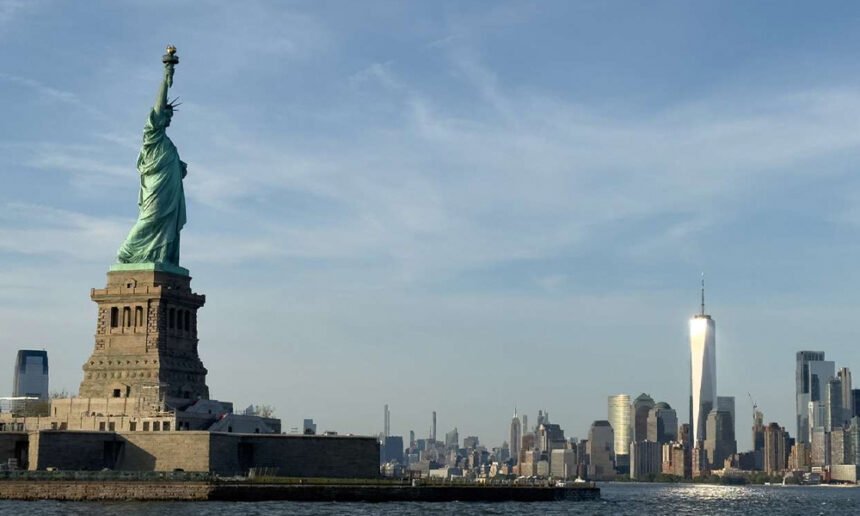
During oral arguments Friday before the U.S. Court of Appeals for the D.C. Circuit, the attorney suggested that Donald Trump could move so quickly that it could “bulldoze the Statue of Liberty” before anyone could stop it.
Yes. That Statue of Liberty.
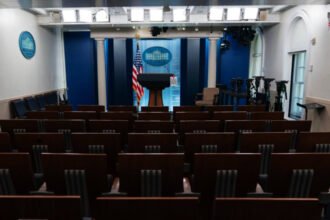
The exchange took place in a case involving President Donald Trump’s controversial White House ballroom project, a plan tied to construction activity on the White House campus that has already sparked legal and political challenges, including disputes over demolition and executive authority.
But the hearing didn’t stay in that lane for long. Judge Patricia Millett pressed the DOJ lawyer on how far executive power could go before courts are able to intervene in urgent situations.
“If the government decides very quickly to bulldoze the Statue of Liberty… nothing can be done?” she asked, according to Politico’s Kyle Cheney, who was in the courtroom.
The attorney’s answer landed like a ton of bricks in a marble hallway.
“I think that’s right, yes,” the lawyer responded.
And just like that, a technical legal argument about timing and judicial review turned into one of the most emotionally charged hypotheticals imaginable.
Because it’s one thing to debate administrative law in abstract terms.
It’s another to casually invoke the destruction of the Statue of Liberty — a symbol tied not just to tourism or architecture, but to immigration, identity, and the country’s own self-mythology — as something the government could theoretically do if it moved fast enough.
And the reaction was immediate.
Social media didn’t just respond — it erupted.
“They’re out of their minds,” wrote Fox News contributor Jessica Tarlov, capturing the sheer disbelief spreading across political media circles.
“There is nothing left of the Justice Department I worked at,” said former federal prosecutor Joyce Vance, pointing to a deeper anxiety among former officials about how far institutional norms have shifted.
Others leaned into the surreal tone of the moment. HuffPost’s S.V. Dáte joked, “We voted to make him God Emperor of the United States,” a line that quickly ricocheted across platforms as shorthand for concerns about unchecked executive framing.
The disbelief wasn’t limited to pundits. California Gov. Gavin Newsom’s official account described the rhetoric as “sick, sick stuff,” while others questioned how arguments like this even make it into formal DOJ positions in open court.
And then came the legal commentary trying to pull the moment back into doctrinal reality.
Law professor Michael Morley noted that under existing standing doctrine and administrative law principles, the idea that such an action would be entirely unchallengeable is far from clear-cut. He suggested that affected individuals — including those with aesthetic or travel-related interests — might still have avenues to challenge destruction of a landmark, even if the hypothetical raises complex questions about timing and legal standing.
But that kind of nuance didn’t really survive contact with the broader public reaction.
Because the stakes here aren’t just about one courtroom exchange or one extreme hypothetical.
They’re about how far executive power arguments are being stretched in real time, and what happens when legal reasoning starts to blur into scenarios involving irreversible actions against national landmarks.
This is where the hypocrisy contrast becomes hard to ignore.
Trump legal arguments have long emphasized concerns about “activist judges” and the need to prevent courts from overstepping into executive decision-making. But in practice, critics argue, the legal logic being tested here pushes in the opposite direction: toward a model where speed and executive authority could outpace meaningful judicial review altogether.
And that tension is what made this moment explode online.
Because even if no one believes the Statue of Liberty is actually at risk, the underlying argument raises a more uncomfortable question: how much damage could theoretically be done before the courts are able to step in?