









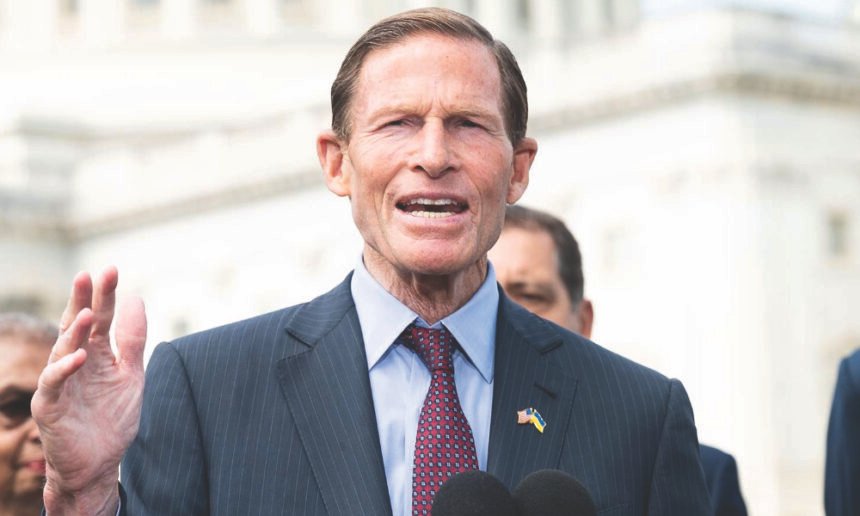
A Trump-appointed federal prosecutor is threatening Sen. Richard Blumenthal with “significant legal consequences” over his investigation into whether donors funding Trump’s $400 million ballroom are getting anything in return from the administration. But the Connecticut Democrat isn’t backing down. He’s making it clear that a warning from the Justice Department won’t stop him from asking tough questions about the president’s controversial project.
“I will not be intimidated,” Blumenthal declared.
The confrontation began after U.S. Attorney Aaron Reitz sent the senator a letter demanding that he preserve emails, communications and other records related to his investigation into the ballroom’s financing.
Reitz also cited federal criminal statutes, including one involving conspiracies to deprive people of their constitutional rights, and warned of “significant legal consequences” if relevant records were destroyed.
The letter does not explicitly say Blumenthal is under criminal investigation or facing charges. But the timing and language of the warning have raised serious questions about the administration’s approach to congressional oversight.
Blumenthal wasn’t having it.
In a sharply worded response, the senator called Reitz’s warning baseless and described it as the latest in what he sees as a series of attempts by the Trump administration to intimidate members of Congress.
“Your implied threat of an investigation is baseless,” Blumenthal wrote. “I will not be intimidated.”
And he made clear that the investigation would continue.
Blumenthal, who is expected to become chair of the Senate Permanent Subcommittee on Investigations, said he plans to pursue inquiries into the administration’s use of taxpayer money and the corporate interests supporting Trump’s projects.
“The public deserves to know the terms under which dozens of American companies were persuaded to donate millions of dollars to the president’s vanity projects,” he wrote.
More specifically, Blumenthal wants to know whether companies and wealthy donors received anything in return for their contributions — including dismissed lawsuits, lucrative government contracts or favorable regulatory treatment.
Those are questions the public has a legitimate interest in seeing answered, particularly when some of the donors have business before the federal government.
Reitz, meanwhile, took the confrontation public, accusing Blumenthal of trying to intimidate Americans because of their constitutionally protected associations with Trump.
“Congress is not a weapon to be wielded against the American people,” Reitz wrote on X, adding that he was taking the first step to stop what he called an abuse of power.
Blumenthal responded by turning the document-preservation demand back on the prosecutor, ordering Reitz to preserve his own records as well — including communications with White House and Justice Department officials concerning the letter.
In other words, if the Justice Department wants records preserved, Blumenthal wants to see those communications preserved, too.
The money behind Trump’s ballroom
The dispute centers on the enormous fundraising operation behind Trump’s planned White House ballroom — a project whose donors, financing and rapidly escalating costs have attracted growing scrutiny.
According to records obtained by The Washington Post, private donors had committed approximately $333 million to the project. The list includes major corporations, wealthy Republican donors and businesses with interests before federal agencies, The Independent reports.
Nvidia and Apple each pledged $25 million, as did the Adelson family and Dish Network chairman Charles Ergen. Amazon, Comcast, Microsoft, T-Mobile and Caterpillar were among other major corporate contributors.
The Post also reported previously undisclosed contributions from major corporations and other powerful interests.
The donations do not, by themselves, establish that contributors received favorable treatment from the administration. But Blumenthal wants to know whether any such arrangements exist — and whether the public is being left in the dark about potential conflicts of interest.
The ballroom itself has become another major controversy.
Trump demolished the White House’s East Wing to make room for the roughly 90,000-square-foot project, which administration lawyers have described as a heavily fortified facility with extensive national security features.
Those descriptions include missile-resistant and drone-proof construction, ballistic glass, military-grade ventilation, bomb shelters and medical facilities.
The original price estimate was approximately $200 million. The projected cost has since climbed to as much as $600 million, with taxpayers potentially covering a substantial portion.
Trump has repeatedly promoted the project, even as questions continue to mount over its cost and the powerful interests helping finance it.
Democrats prepare for a wave of investigations
The confrontation with Blumenthal is also unfolding amid broader tensions between the White House and incoming Democratic congressional investigators.
Just days after Democrats scored major victories in the midterm elections, White House counsel Will Scharf sent a separate warning to Rep. Robert Garcia, the top Democrat on the House Oversight Committee.
Scharf accused Democrats of making “abusive and capricious threats” by promising investigations into the Trump administration. He also suggested that some planned oversight activities could cross into criminal conduct.
Garcia rejected the warning, making clear that Congress does not need the White House’s permission to investigate the administration.
“Congress’ authority comes from Article I of the Constitution, not from the permission of the White House,” he said.
Democrats are preparing to use their congressional oversight powers more aggressively, including through subpoenas, hearings and investigations into the administration and Trump’s allies.
And that appears to be setting up a major confrontation over how far the administration will go to challenge those investigations.
A warning letter from a Trump-appointed prosecutor isn’t going to make those investigations disappear.
“I will not be intimidated,” Blumenthal said.
And he’s not backing down.