








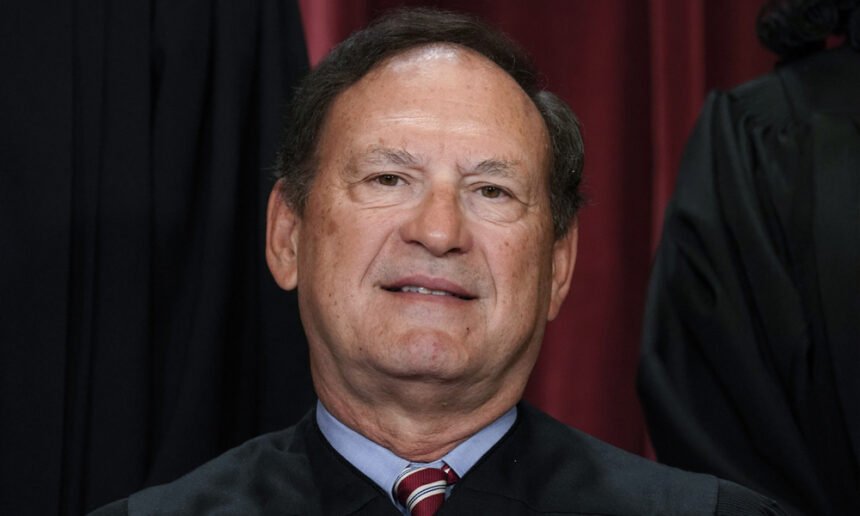
Supreme Court Justice Samuel Alito is facing new ethics questions after reports revealed that his son has been quietly working inside Donald Trump’s Treasury Department while the Supreme Court considers cases directly involving the agency.
And critics say the arrangement reeks of conflict of interest.
According to a bombshell report from NOTUS, Philip Alito has been serving as an attorney inside the Treasury Department’s Office of the General Counsel for months — an influential office that advises Treasury Secretary Scott Bessent on major legal and policy matters tied to taxes, federal funding, economic policy, and high-profile Trump initiatives.
The problem? The Supreme Court is actively hearing cases involving the Treasury Department, including challenges connected to Trump’s controversial tariffs and his legally dubious $1.776 billion “Anti-Weaponization Fund” — the massive slush fund critics say is designed to reward Trump loyalists and Jan. 6 allies with taxpayer money.
And despite all of that, Justice Alito has not recused himself.
Even more striking: Philip Alito’s role inside Treasury was apparently kept unusually quiet.
According to the report, he has no public résumé, no LinkedIn profile, no visible Treasury biography, and outdated professional records that obscure where he works.
One former government official described him as keeping an intentionally low profile inside the department.
“Everybody knew who he was,” the official said. “He’d just say ‘Phil,’ not Phil Alito.”
But officials inside Treasury reportedly understood exactly why he had the job.
“There’s no doubt he got that position because of who he is,” another former official bluntly told NOTUS.
Philip Alito reportedly works in Treasury’s “front office,” where attorney-advisers are briefed on major issues across the department and provide legal guidance on sensitive matters.
That includes issues that could very realistically end up in front of the Supreme Court.
In one especially glaring example, Philip Alito was already working at Treasury while the Supreme Court heard a major challenge to Trump’s emergency tariff powers last year.
Justice Alito did not recuse himself from that case.
Instead, he joined a dissent after the Court ruled that Trump lacked authority to impose sweeping tariffs — a decision that triggered massive refund obligations for the administration.
Now, the ethics concerns are only growing.
Treasury is deeply involved in Trump’s new “Anti-Weaponization Fund,” the $1.776 billion taxpayer-funded program that critics describe as a political reward system for people claiming they were unfairly targeted by the Justice Department.
Democracy Forward has already warned the fund is “on a collision course with the Constitution,” while former Capitol Police officers have called it “a corrupt sham.”
And if those legal fights eventually reach the Supreme Court, Justice Alito could once again find himself ruling on matters tied to the same department employing his son.
Treasury insists there’s nothing improper about the arrangement.
A department spokesperson claimed Philip Alito is technically detailed from the U.S. Attorney’s Office for the Eastern District of Virginia and does not advise on matters “reasonably expected” to come before the Supreme Court.
The Supreme Court echoed that defense, saying Philip Alito did not work directly on the tariff litigation.
But critics say that explanation misses the larger issue entirely.
The concern is not whether Philip Alito personally drafted a brief in one specific case.
The concern is that the son of a sitting Supreme Court justice quietly landed a politically connected position inside one of the most legally consequential agencies in Trump’s administration while that same administration repeatedly appears before the Court.
And unlike lower court judges, Supreme Court justices effectively police themselves on ethics issues.
That reality has already fueled years of controversy surrounding Samuel Alito, whose undisclosed luxury trips, wealthy benefactors, and partisan flags flown outside his homes have repeatedly sparked calls for stronger ethics rules at the Court.
Now, this latest revelation is adding even more fuel to the growing perception that the Supreme Court’s conservative majority operates under a completely different set of standards than everyone else.
Because for ordinary judges, even the appearance of a conflict can become a serious issue.
For the Supreme Court, apparently, it’s business as usual.