









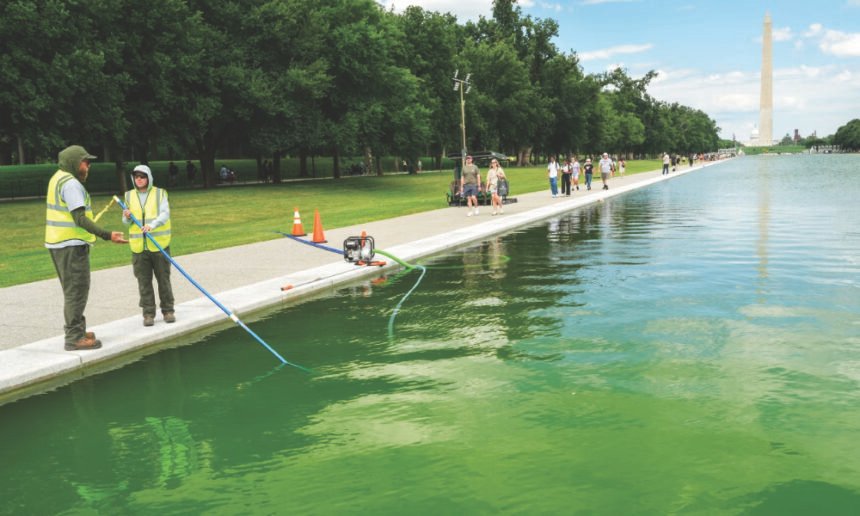
Donald Trump’s Reflecting Pool project was supposed to be a simple story: renovate it, take credit, and brag about it. Instead, it is quickly becoming a case study in corruption playing out in plain sight.
Just days after the Reflecting Pool was renovated, the Trump administration handed a $1.7 million no-bid contract to Ohio-based Greenwater Services to install a purification system next to the Lincoln Memorial. What followed quickly raised eyebrows and a growing number of questions.
Here’s what makes the timeline unusual: the contract was issued after the pool had already been renovated, and before any algae bloom or water-quality crisis had emerged.
In other words, the “cleanup” came before there was anything to clean.
Soon after, the Reflecting Pool turned into a murky green stretch of algae-filled water, raising fresh doubts about whether the project had been properly done—or even necessary in the first place.
The decision to bypass competitive bidding was justified under an emergency exemption, with officials arguing there was not enough time to follow standard procurement procedures ahead of upcoming national celebrations.
But critics are now asking a simpler question: emergency response to what, exactly?
Greenwater Services has also drawn scrutiny for its political connections. The company is owned by the J.J. Cafaro Investment Trust, led by businessman John J. Cafaro, who has donated more than $300,000 to Trump-affiliated political committees and lives near Trump’s Mar-a-Lago resort in Florida. Trump has previously described Cafaro as a “fantastic man.”
The Interior Department has insisted the contract was awarded strictly on technical merit, stating the firm had the “expertise, workforce, and materials” needed to complete the project.
Still, the optics are difficult to ignore: a no-bid federal contract awarded in the absence of an active problem, to a politically connected firm tasked with installing a system intended to prevent an issue that had not yet appeared.
The Reflecting Pool itself, one of the most iconic landmarks in the country, had just undergone a $14 million renovation aimed at restoring its appearance and infrastructure ahead of major national commemorations.
At the time Greenwater was brought in, there was no reported algae outbreak, no visible contamination crisis, and no declared emergency related to water quality.
Still, the contract moved forward.
Officials later said the project involved upgrading the pool’s filtration system using “nanobubble” technology, which is designed to break down algae, bacteria, and other contaminants through microscopic oxygen injection. The system has been promoted as a long-term solution to recurring issues that have affected the Reflecting Pool for decades.
But even as the technology is described as preventative and advanced, the timing of its deployment has triggered scrutiny.
Because prevention is one thing.Procurement without a problem is another.
Since then, workers have been seen performing additional maintenance at the site, including adding hydrogen peroxide to the water system as part of ongoing adjustments. The project has been labeled a “regional and national priority” ahead of July 4 and broader 250th anniversary celebrations.
But the timeline is doing most of the talking.
A $14 million renovation. A $1.7 million no-bid contract. A system designed to solve a problem that, at the time, did not yet exist.
By the time algae actually did appear later, the central question had already formed: Why was the fix funded before the failure ever existed, and why did it not prevent the water from turning green?