








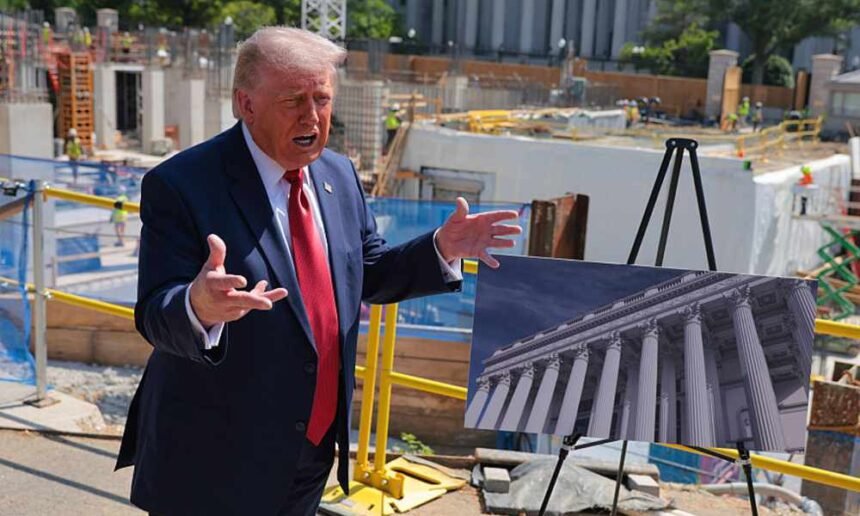
Donald Trump really wanted this to be a clean story. A lavish new White House ballroom for him and his billionaire friends to party in, a shiny legacy project wrapped in gold branding, Trump style. Funded by donors. No taxpayer dollars involved.
Now a leak has hit, and it doesn’t just complicate that narrative. It blows it up.
Internal records obtained by the Washington Post peg the total cost of the White House ballroom project at roughly $600 million.
That alone would be enough to raise eyebrows. But the real problem is what those same records say about who’s paying.
Because despite repeated White House claims that taxpayers are not funding the project, the breakdown tells a very different story.
According to the leaked document, about $300 million is labeled as “private funding.”
The rest is coming from federal sources Including: $155 million from the Secret Service, $149 million from the White House Military Office, $3 million from the Executive Residence.
That’s not zero taxpayer cost. That’s hundreds of millions in public money routed through government agencies.
Trump’s promise was simple. The math wasn’t. And it turns out, he was lying.
Trump repeatedly insisted the ballroom would not cost taxpayers “a single cent.”
At one point, he said the project would stay under $200 million. Later, the White House floated $300 million. By December, the number had climbed to $400 million.
Now internal estimates have landed at $600 million, far above every public figure previously offered.
Federal records cited in the report indicate that government payments to contractor Clark Construction were already moving before the most recent public statements.
Tens of millions in federal funds had reportedly been approved through various agencies, even as officials continued to insist taxpayers were not footing the bill.
So while the messaging stayed consistent, the financial reality quietly moved ahead of it.
One of the more controversial details in the leaked breakdown is how the costs are distributed.
The Secret Service, traditionally focused on protection, is listed as covering $155 million. The White House Military Office accounts for another $149 million.
Critics have questioned why agencies tied to security and operations are absorbing what is, at its core, a construction and renovation project.
Supporters argue it’s part of broader infrastructure and security upgrades. Skeptics call it BS.
Congress wasn’t buying it either
Even before the leak, funding was already politically unstable. In early June, seven Republicans joined Democrats in blocking public funding for the ballroom project.
But despite the leaked figures, the White House has not shifted its public stance.
Spokesperson Davis Ingle said Trump and “generous American patriots” are funding the project. Clark Construction has declined to comment on specific cost details, citing confidentiality.
But the leaked breakdown has already done its job: it puts hard numbers next to a simple political promise — and shows the gap between them.
This isn’t just a debate about a building. It’s about whether the public-facing version of the project matches the financial reality underneath it.
Because on one side: no taxpayer cost. Donor-funded construction. Fixed budget claims
And on the other: $600 million total cost.Hhundreds of millions tied to federal agencies. Rising estimates over time.
Those two versions don’t comfortably coexist.
And according to the leaked records, the official story doesn’t survive contact with the numbers. It gets blown up.