









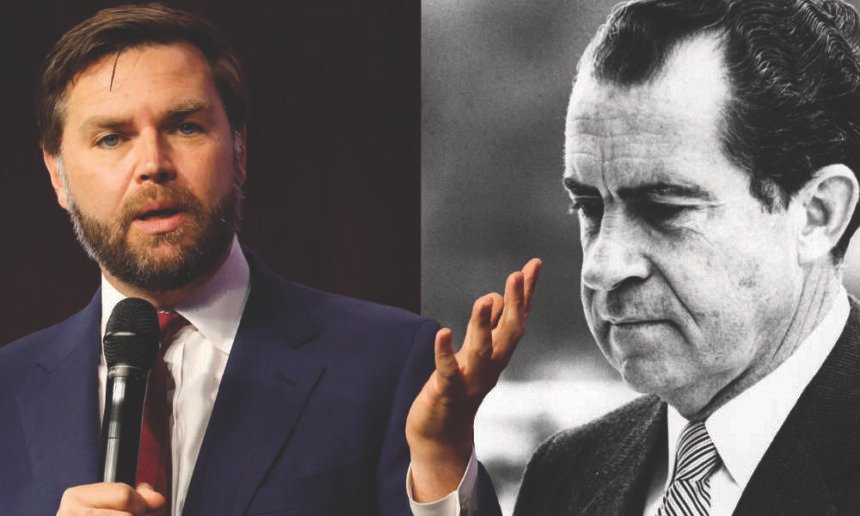
Vice President JD Vance is getting attention after suggesting that the crimes that forced Richard Nixon out of office would barely make a dent in today’s political climate. And the response from journalists and commentators was immediate, and blunt.
Speaking Thursday at an event hosted by the Richard Nixon Foundation, Vance offered a surprisingly sympathetic take on the only U.S. president to resign in disgrace.
“I think Nixon’s historical legacy is enjoying a bit of a renaissance, and deservedly so,” Vance said. “If Watergate happened tomorrow, it would be like a 12-hour news story. The idea that it took down a presidency is crazy.”
The comments landed in an awkward historical space: Nixon resigned in 1974 after the Watergate scandal exposed a break-in at the Democratic National Committee headquarters and a subsequent cover-up that triggered a constitutional crisis and nearly certain impeachment.
At the time, even members of his own party turned against him as the scope of the misconduct became clear.
Vance’s suggestion that Watergate would be a minor news cycle today quickly ricocheted across political media, where it was interpreted in very different ways depending on the audience.
Some critics noted that the vice president may have unintentionally made a broader point about the modern information environment, just not in the way he intended.
“The quiet part out loud he said,” one journalist remarked, highlighting how normalized scandal can feel in today’s political landscape.
Others were more blunt.
“He’s right, and that’s bad,” wrote Aaron Reichlin-Melnick of the American Immigration Council.
Independent journalist Gary Legum added a sharper take: while Watergate might only dominate headlines briefly today, that’s largely because modern politics is already saturated with scandals of comparable scale.
Vance’s comments also reopened a familiar debate about how the media environment has changed since the 1970s, when Watergate unfolded over months of sustained investigative reporting that ultimately reshaped public trust in government.
Today, critics argue, rapid news cycles, fragmented attention, and constant political crisis have made it harder for any single scandal to dominate public discourse in the same way.
Supporters of Vance’s broader point suggest he was simply acknowledging that shift.
But the reaction suggested something else was happening in real time: a recognition that the comparison between eras doesn’t necessarily flatter the present.
Nixon’s resignation remains one of the most dramatic endings to a presidency in U.S. history, driven by abuses of power that triggered bipartisan condemnation and a historic constitutional reckoning.
Vance’s framing of Watergate as something that would barely register today sparked immediate pushback because of what it implies about modern standards.
Watch the clip below:
JD Vance: "I think Nixon's historical legacy is enjoying a bit of a renaissance, and deservedly so. I joked that if Watergate happened tomorrow, it would be like a 12 hours news story. The idea that it took down a presidency is crazy." pic.twitter.com/osy0V3QLyN
— Aaron Rupar (@atrupar) June 25, 2026