








The Immigration and Customs Enforcement officer who fatally shot a Colombian father in front of his young daughter this week is now facing intense scrutiny after relatives and court records painted a disturbing picture of a man they say never should have been carrying a badge and a gun.
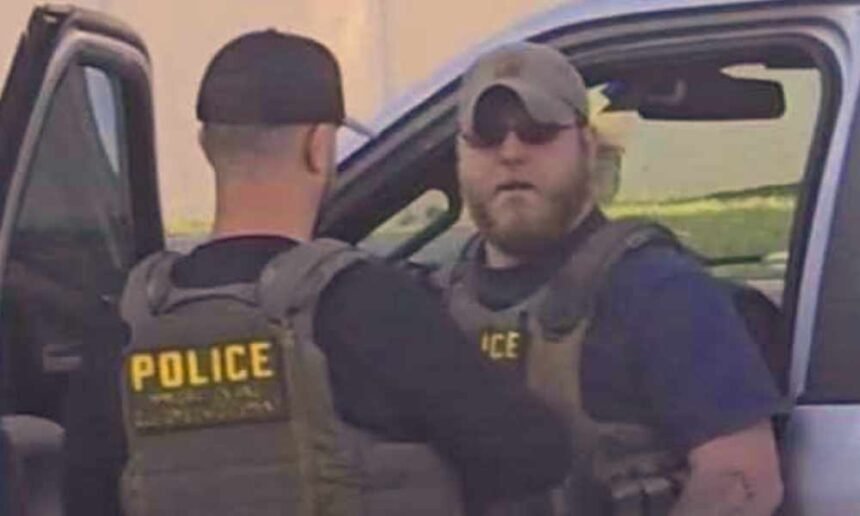
According to an investigation by The Associated Press, 37-year-old David Brouillette, the ICE officer who shot and killed 25-year-old Johan Sebastián Durán Guerrero in Biddeford, Maine, has a long history of alleged violence, severe mental illness, and repeated accusations of abuse from multiple family members.
The revelations are raising serious questions about how the Department of Homeland Security vetted him before hiring him as part of President Donald Trump’s aggressive immigration crackdown.
Durán Guerrero was killed Monday during an encounter with ICE agents near his home. DHS has claimed the Colombian national attempted to drive away, saying officers feared for public safety before Brouillette opened fire.
But as the investigation into the shooting continues, attention has shifted to the man who pulled the trigger.
Multiple relatives told the Associated Press that Brouillette struggled with severe bipolar disorder and attention deficit disorder from childhood and was hospitalized several times after suicide attempts. One family member described him as “extremely mentally ill” and said relatives eventually cut off contact because they feared he would become violent.
His ex-wife, Ashley Brouillette, said she was stunned when he told her last year that he’d been hired by ICE.
Because of his long history of psychiatric issues, she initially thought he was having another mental health episode and didn’t believe him.
She only realized he was telling the truth after videos of Monday’s fatal shooting began circulating online.
Ashley said Brouillette later admitted to her that he had shot and killed Durán Guerrero, insisting the shooting was justified because he believed the victim was trying to run him over with his vehicle.
Their 18-year-old daughter, Madison, told the AP that her father gave her the same explanation.
Court records reviewed by the AP reveal years of domestic violence allegations involving Brouillette.
Ashley said she divorced him after he became physically abusive during her pregnancy. She alleged that he once threw boiling water at her while she was holding their infant daughter.
His second ex-wife also sought multiple protection orders, alleging he stalked and harassed her and physically abused one of their daughters. According to court filings, she accused him of tackling the teenager, dragging her through the house as she cried, and smashing spaghetti into her hair during one outburst.
One filing urged the court to intervene because Brouillette “needs counseling or something for his PTSD & depression.”
The AP also obtained a voicemail Brouillette allegedly left for Ashley last winter after she obtained a restraining order against him.
In the message, he repeatedly insulted her before saying that she and the women in her family “should have your f—— throats cut.”
Ashley said Brouillette later contacted her after Monday’s shooting, not to apologize, but to ask her not to discuss the abuse allegations because, she said, “the most important thing is his character right now.”
According to relatives, Brouillette was initially rejected by military recruiters because of his mental health diagnoses. They say he was encouraged to stop taking his medication for a year before reapplying, eventually serving in Afghanistan with the U.S. Army.
One family member believes the deployment only intensified his struggles.
“Afghanistan destroyed him,” the relative told the AP. “They took someone who was extremely mentally ill and turned him into a killing machine.”
After leaving the military, Brouillette worked a series of jobs in law enforcement and corrections before eventually joining ICE during the Trump administration’s hiring surge to expand immigration enforcement.
ICE has refused to confirm that Brouillette was the officer involved, citing a policy against identifying agents. The agency defended the unnamed officer, saying he has nearly a decade of federal law enforcement experience and has completed required use-of-force training.
The White House referred questions about the shooting to ICE.
Monday’s killing marks at least the 11th death involving immigration agents since Trump returned to office and dramatically expanded ICE operations.
As more details emerge about Brouillette’s past, observers are asking how someone accused of years of violent behavior, repeated domestic abuse, and severe mental health struggles ended up carrying a federal badge—and whether better vetting could have prevented another deadly encounter.