




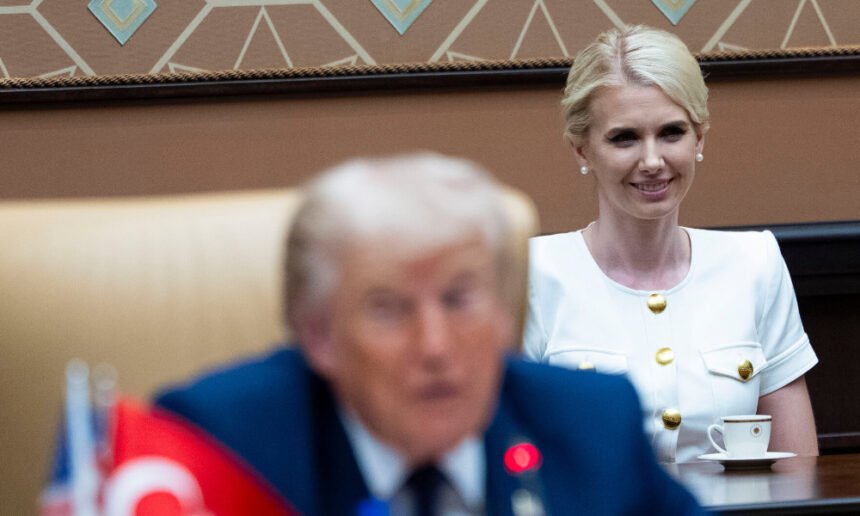
A bizarre video from nearly a decade ago has resurfaced, raising even more questions about Natalie Harp, the young blonde woman who has become a constant presence at President Donald Trump’s side.
Harp was in her mid-20s when the video was recorded. In the clip, she makes extraordinary claims about a medical crisis she says nearly killed her and credits Trump with ultimately saving her life.
The video is raising new questions because some of the most dramatic details she describes were later absent from a widely circulated essay about her illness, the story that eventually caught the attention of Fox News and Trump himself.
And the timeline is raising eyebrows, too.
The clip appears to have been recorded in 2017 and posted online in 2018, years before Harp reportedly entered Trump’s orbit as a White House aide.
It also emerged as scrutiny intensifies over her unusually close relationship with the president, including her role in controlling communications reaching Trump.
The bizarre story she told on camera
In the 96-second selfie-style video, Harp says a nurse accidentally connected her to an IV bag containing sterile water instead of saline in 2015.
She claims the mistake caused hemorrhagic shock and nearly killed her.
Then she makes an extraordinary assertion.
“I was the victim of a medical error,” Harp says in the video, claiming she lost “100 percent of the average person’s blood platelets, but only 30 percent of my own.”
She attributes her survival to what she describes as a rare blood condition.
She also says she later developed a rare form of bone cancer, failed to respond to two rounds of chemotherapy and was rejected from clinical trials.
At one point, sitting on what appears to be a bench inside a courthouse or other government building, she says she had been “denied appointments.”
But perhaps the strangest part comes when she connects her ordeal to Trump.
Wearing a pink MAGA hat, Harp tells the camera: “The elites thought they held the Trump card. But they didn’t count on Donald Trump—like I did.”
Watch:
Here's a creepy video Trump's obsessed mistress Natalie Harp made with unverifiable medical claims to promote her loyalty to Trump. https://t.co/Jwi9GiWUQd pic.twitter.com/F1fI6m6eks
— KT "Special MI6 Operation" (@KremlinTrolls) August 21, 2026
Some of those claims disappeared later
Harp later told a similar story in a LinkedIn essay about her illness.
But several of the most dramatic details from the resurfaced video don’t appear in that later account.
The LinkedIn essay has since been deleted, but it helped launch Harp into the political spotlight after it caught the attention of Fox News.
In the essay, she described being told by California’s health-care system that she should prepare to die and said she had been offered a list of end-of-life options, including opioids, barbiturates, medical marijuana, disability and Do-Not-Resuscitate orders.
She also credited Trump with helping save her life through his support for the Right to Try law.
Trump signed the measure in May 2018. It allowed certain terminally ill patients who had exhausted approved treatment options to seek experimental drugs.
Harp’s story became part of Trump’s broader political campaign around health care.
Her appearance on Fox & Friends in June 2019 brought her story to a much larger audience—and apparently caught Trump’s attention.
Days later, Trump invited her onstage at a Washington event and praised her television appearance.
But the medical claims raise questions
The resurfaced video contains claims that appear difficult to reconcile with the later version of Harp’s story.
Harp says in the video that she was the “only survivor” of a sterile-water infusion.
But medical literature has documented other patients surviving accidental sterile-water infusions.
That doesn’t by itself establish that Harp’s account is false. Medical emergencies can be extraordinarily complicated, and individual circumstances can differ.
But it does raise a legitimate question about why the most dramatic version of her story appeared in the earlier video and was not repeated in her later account.
The original social media post that accompanied the video reportedly described Harp as the “only survivor” of a medical error that had killed thousands.
That claim, too, deserves scrutiny.
From Trump supporter to White House insider
Harp’s story eventually transformed her from a young Trump supporter into a prominent advocate for his political agenda.
She joined Trump’s 2020 campaign advisory board and spoke at the Republican National Convention that year.
At the convention, she described her medical ordeal in even more dramatic terms, saying doctors had allegedly told her she was a burden to her family and country and that choosing to die early would save others.
Now, years later, Harp occupies a very different position.
She reportedly works as a special assistant and executive assistant to Trump, earning roughly $150,000 a year.
And her access to the president has become a growing source of concern among some people inside and around the administration.
Reports say she has been screening calls from foreign leaders, while questions have also been raised about her initial refusal to obtain a basic security clearance.
Her unusually close relationship with Trump has reportedly unsettled other MAGA aides and even raised concerns among White House security officials.
Newly surfaced love letters allegedly written by Harp to Trump have added another layer to the controversy.
The Daily Beast recently published what it described as an astonishing collection of letters from Harp to the president.
Sen. Jon Ossoff, the Georgia Democrat, has also seized on the relationship, arguing at a recent rally that Trump appears more interested in traveling the world with his much younger assistant than actually doing the job of president.
Trump is 80. Harp is 35.
The resurfaced video doesn’t prove that Harp fabricated her medical history, nor does it establish that she did anything improper.
But it does raise questions about the evolution of her story, and about how someone who became politically prominent by telling that story eventually ended up with extraordinary access to the president.
The timeline is particularly striking.
The video shows Harp expressing an intense devotion to Trump years before she says she entered his orbit professionally.
Today, she reportedly has a role in controlling who gets through to the president.
That combination—an unusually devoted aide, extraordinary access to an aging president, questions surrounding her past claims and an increasingly public power struggle inside the White House—is exactly why the scrutiny isn’t going away.
The question isn’t simply who the woman standing beside Trump is.
It’s how much influence she has, how she got there, and who is actually watching the person with access to the president.