






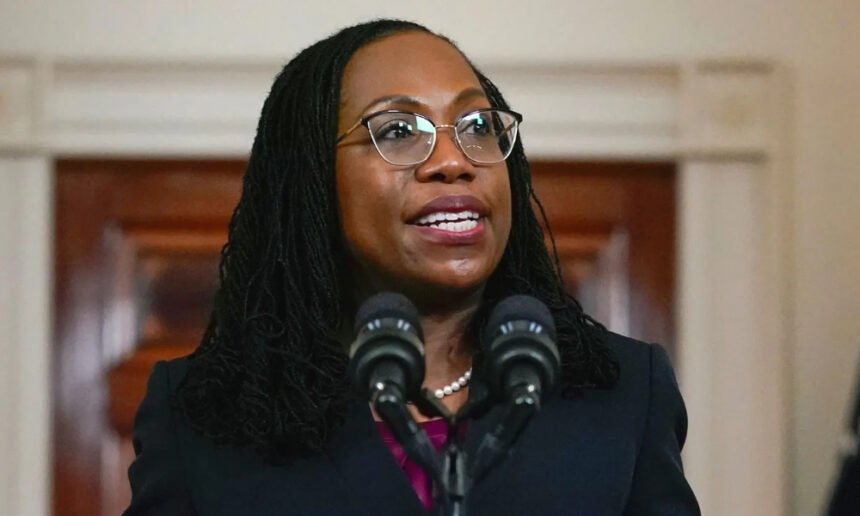
Supreme Court Justice Ketanji Brown Jackson delivered a blistering dissent Monday after the court’s conservative majority cleared another legal hurdle for President Donald Trump’s effort to reshape mail-in voting ahead of the November midterms.
Jackson accused the majority of needlessly throwing the upcoming elections into turmoil, warning that the ruling could leave states scrambling to figure out how to respond while Election Day rapidly approaches.
“This ruling…needlessly injects chaos and uncertainty into the upcoming midterm elections,” Jackson wrote.
She also described the court’s handling of election challenges as part of a “Kafkaesque nightmare” that its own precedents have been creating for states seeking to challenge potentially unlawful election policies.
The Supreme Court did not rule that Trump’s executive order is constitutional.
Instead, the conservative majority lifted a lower-court injunction that had blocked parts of the order from being implemented. Another nationwide injunction targeting one provision remains in effect.
Still, the ruling gives Trump additional room to advance his plan.
Trump’s executive order directs the Department of Homeland Security to provide states with lists of U.S. citizens and instructs the U.S. Postal Service to establish new rules governing the transmission of mail-in ballots.
Twenty-three states and the District of Columbia challenged the order, arguing that the Constitution gives states—not the president—the authority to administer elections.
U.S. District Judge Indira Talwani agreed with the states, finding that portions of Trump’s order “unconstitutionally violate the separation of powers.” She issued an injunction in June blocking the order, which was later upheld by an appeals court.
The Supreme Court’s conservative majority, however, concluded that the states had not demonstrated enough concrete harm from regulations that had not yet taken effect. The justices therefore determined that the states did not yet have sufficient standing to challenge the policy.
Jackson strongly disagreed.
In her dissent, she argued that the states had already demonstrated injury and warned that the majority’s reasoning could create an impossible dilemma for election officials.
Wait until the administration’s rules actually cause harm, and states may not have enough time to challenge them before the election.
Challenge them now, and the court says the harm is still too hypothetical.
That is the Catch-22 Jackson says the majority has created.
Justices Elena Kagan and Sonia Sotomayor also dissented in a separate statement.
And the legal battle is far from over.
The Supreme Court’s ruling leaves the door open for additional challenges to Trump’s executive order. CNN Supreme Court analyst Steve Vladeck has noted that the Postal Service has already issued new mail-ballot rules as part of the administration’s effort to implement the order, and those rules could face their own legal challenges.
Meanwhile, state election officials are preparing for the November election with the clock ticking.
Jackson warned that the court’s decision could force those officials into a frantic scramble.
“A stay grant puts the Plaintiff States in a precarious position,” Jackson wrote, arguing that election officials could soon have to challenge the administration’s rules or take on the potentially “impossible task” of complying with a new federal mail-ballot regime.
That’s what Jackson finds so troubling.
The court has removed one of the legal barriers standing in Trump’s way without actually deciding whether the underlying policy is constitutional.
“When the Government’s obvious goal is to interfere with the Plaintiff States’ practices and prerogatives in a manner that the Constitution does not authorize,” Jackson wrote, “it is both a serious legal error and a grave misuse of our equitable emergency powers to let the Executive proceed even one step further.”
The message from Jackson is blunt: The Supreme Court hasn’t settled the fight over Trump’s mail-voting order. It has simply moved the fight closer to Election Day.
And with the midterms approaching, the uncertainty Jackson warned about may be exactly what state election officials can least afford.