








With the midterm elections just days away, Vice President JD Vance had an opportunity to connect with young voters over one of their biggest concerns: the soaring cost of buying a home and starting a family.
Instead, he cracked a joke about a Republican senator’s backside.
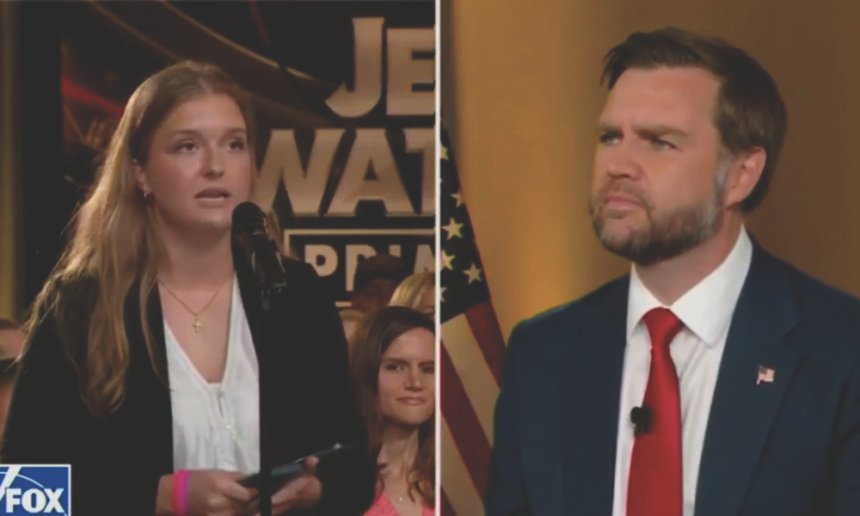
The awkward exchange unfolded Thursday night during a Fox News town hall at Texas Christian University in Fort Worth, where Kate White, a senior and vice president of the school’s Turning Point USA chapter, asked Vance how Republicans expect young Americans to start families when homeownership and the cost of raising children feel increasingly out of reach.
White pointed to the pressure young people face to marry and have children while dealing with housing prices and everyday expenses.
“What the right doesn’t acknowledge most of the time is how disincentivized we are currently because of the cost of owning a home and the general expenses of raising a family,” she said.
She then asked how the administration expects young people to start families when the average American home now costs more than $415,000.
Vance thanked White for her question and support. Then came the bizarre response.
“I’ve only been asked one question about [Ohio Sen.] Jon Husted’s ass,” he said.
The remark drew laughter from the audience and Fox News host Jesse Watters. Vance had previously joked with Watters that he was “jealous” of President Donald Trump’s repeated praise of Husted’s physique.
But White had asked about housing affordability, not a senator’s backside.
When Vance finally addressed the actual question, he blamed the housing crisis on immigration.
“The reason why housing exploded in the United States of America is in part because we allowed 20 million illegal aliens into our country,” he said.
Watch the clip below:
Q: How do you expect us to start families young when the average price of a home feels out of reach?
JD VANCE: I want to point out that I’ve only gotten one question about Jon Husted’s ass https://t.co/mFgYuuRQIN
— Aaron Rupar (@atrupar) October 30, 2026
It wasn’t the first time Vance had made that argument. In September 2025, he told Fox News that “30 million illegal immigrants” had taken away American homes. But he offered no convincing explanation for how that claim could be true.
PolitiFact previously found that Vance’s argument did not hold up, noting that the number of undocumented immigrants in the country was far below the figure he cited.
Vance did acknowledge that Republicans have not paid enough attention to the affordability problems facing younger Americans.
“We don’t pay enough attention to the affordability problems that are affecting young people. Most Republicans don’t. I think I’m an exception,” he said.
That admission, however, came after an answer that left many viewers wondering whether the vice president understood the question in the first place.
The exchange quickly drew criticism online, including from people who have worked in Democratic and Republican politics.
Jon Favreau, a former Obama speechwriter and Crooked Media host, shared the video and asked: “How is this real and how is he this bad at politics? Or humor? Or interacting with other humans?”
Sarah Matthews, who served as deputy White House press secretary during Trump’s first term, wrote on X: “I genuinely cannot believe this is a real exchange between a voter and the Vice President of the United States.”
Journalist Mehdi Hasan was even more blunt, arguing that if Vance becomes the Republican presidential nominee in 2028, he would be “eminently beatable.”
Even experts who study political communication questioned the vice president’s decision to respond that way.
Katherine Jellison, a history professor emerita at Ohio University, told HuffPost that Vance has long had an awkward and unusual communication style. But even by his standards, she said, the joke about Husted was an unusual choice.
“He risks turning off some young voters with that kind of response,” Jellison said, warning that the exchange could make voters question whether Vance is ready for a national campaign in 2028.
Michael Phillips-Anderson, an associate professor of communication at Monmouth University, studies how politicians use humor to navigate difficult questions.
He explained that politicians sometimes use jokes to deflect from subjects they would rather avoid. But Vance’s attempt was different.
Phillips-Anderson described the Husted remark as a “total non-sequitur,” arguing that it wasn’t particularly clever and did nothing to help Vance or the Trump administration.
He suggested Vance could have connected with the audience by sharing his own childhood experiences with housing instability instead of reaching for an unrelated joke.
That would have allowed him to acknowledge the very problem White was raising while buying time to formulate an answer.
Tom Hollihan, a communications professor at USC Annenberg, said White wasn’t trying to trap Vance with a political stunt. She was asking a serious question about an issue affecting a growing number of young Americans.
And that, he suggested, is precisely the challenge facing Republicans heading into the midterms.
And White’s question wasn’t an isolated concern.
A Harvard Youth Poll conducted between September 30 and October 7 found that nearly half of young Americans were worried about their personal finances. Even more concerning for the country’s political establishment, 27% expected to be worse off financially than their parents — a first in the poll’s history.
The survey also found that young Americans’ intention to vote was lower than it was ahead of the 2018 and 2022 midterms, with the biggest decline among young Republican voters.
That is a problem for a Republican Party that needs to keep younger voters engaged after making gains with them in 2024.
For Vance, Thursday’s exchange offered a simple opportunity: take a young voter’s concerns seriously, explain what Republicans plan to do about affordability, and demonstrate that he understands the financial pressures facing his generation.
Instead, he delivered a punchline about a senator’s backside before blaming immigrants for the housing crisis.
And with young Americans increasingly worried about whether they can afford the future they were promised, that may not have been the answer Republicans needed.