









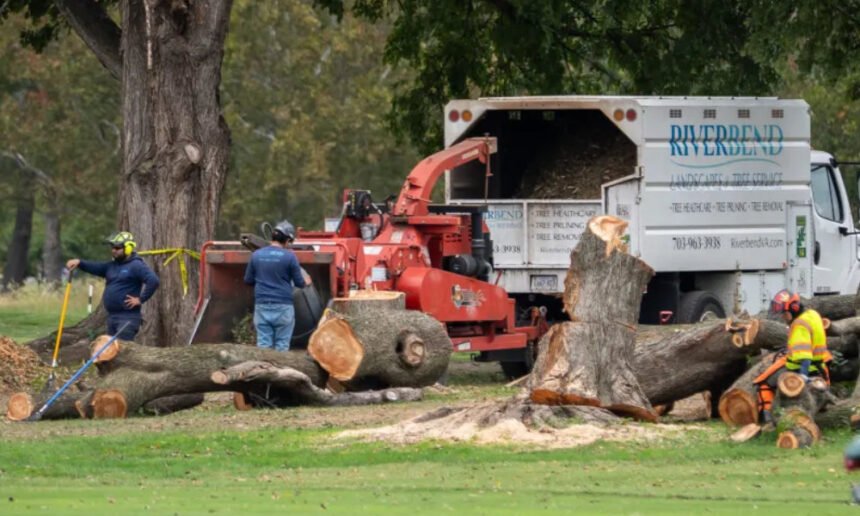
A federal judge delivered a blistering rebuke to Trump administration officials Monday after the government cut down 529 trees at a historic Washington, D.C., golf course, accusing officials of undermining their credibility with the court.
U.S. District Judge Ana Reyes repeatedly raised her voice during a hearing over work at East Potomac Golf Links, where the National Park Service has begun removing trees as part of the administration’s plans to transform the century-old public golf course into a championship-level venue.
Reyes said she had repeatedly instructed the government to notify her before carrying out major work. Instead, officials proceeded with the tree removal without giving the court adequate notice.
“I trusted you all not to do precisely what you have done,” Reyes told the government’s attorneys.
The removal of more than 500 trees, she said, “has cost the government all of its credibility” in the case. The judge added that she was “at a total loss” to understand the administration’s actions.
When a government attorney argued that officials had done their best to comply with her previous orders, Reyes wasn’t buying it.
“No you did not do your best. You did your absolute worst,” she shot back.
And when Justice Department attorneys said they hadn’t known the details of the tree-cutting plan, the judge offered another blunt response.
“Ignorance is not an excuse.”
Reyes ultimately ordered the tree removal halted through at least 7 a.m. Tuesday, warning that even the slightest violation could trigger contempt proceedings.
“If that order is violated by two seconds, there are going to be contempt proceedings,” she warned.
The hearing put the administration under mounting pressure to explain why officials moved ahead with the work and whether they had properly informed the court.
Deputy National Park Service Director Frank Lands testified that he learned about the plan on October 5, after the Interior Department directed him to carry it out. The tree removal began five days later.
Lands said he had been instructed to implement a seven-year-old plan “as soon as practical,” but he could not explain why the work had suddenly become urgent.
Reyes ordered Lands to preserve all communications related to the project, including notes from the October 5 meeting. No records were to be destroyed.
The judge also called for Interior Department Deputy Chief of Staff Gregory Wischer to testify, seeking further answers about how the decision was made and why the government proceeded without adequate notice.
“I’m beyond disappointed in the government right now,” Reyes said.
The dispute is another complication for an administration pursuing an ambitious makeover of the nation’s capital, where Trump’s renovation plans have drawn scrutiny over the treatment of public spaces, historic landmarks and federal property.
East Potomac Golf Links, located in southwest Washington, is a 106-year-old public course with a history that extends well beyond golf.
In 1941, Black golfers challenged segregation at the course. The protests prompted then-Interior Secretary Harold Ickes to order that the facility be opened to players of all races, giving the site an important place in the history of civil rights in the nation’s capital.
Now, the Trump administration wants to overhaul the course into a championship-style venue. Officials say the work follows recommendations in a 2019 National Park Service report that called for removing hundreds of trees and vegetation to restore the landscape.
The Interior Department defended the project Monday, saying the work would restore the course’s historic character and reopen views of nearby landmarks, including the Washington Monument, the Potomac River and the Washington Channel.
The department also said the National Park Service recognizes the importance of trees to the park and its visitors, describing the work as part of its responsibility to care for the property.
But opponents argue that the government cannot simply push ahead with a major transformation without complying with federal environmental and historic preservation laws.
The lawsuit was brought by individual golfers and the DC Preservation League. They argue that East Potomac is more than a golf course: It is part of a historic district listed on the National Register of Historic Places and an important public recreational space.
The plaintiffs also warn that turning the course into a different kind of venue could alter its historic landscape and make it less affordable for ordinary golfers.
The latest confrontation began October 9, when the government notified the court that restoration work involving tree removal was planned. Two days later, the plaintiffs reported that 529 trees had already been felled, arguing that the damage to the historic landscape could not be undone.
The government, meanwhile, argued in court filings that the latest tree-cutting was separate from the broader redevelopment challenged in the lawsuit.
That distinction did little to resolve the judge’s concerns about how the work was carried out and whether officials had followed her instructions.
Democracy Forward President and CEO Skye Perryman criticized the administration’s approach, accusing it of moving quickly to make irreversible changes to a cherished national landmark in service of what she called one of Trump’s “pet vanity projects.”
The plaintiffs are asking the court to intervene before further damage is done.
The East Potomac project is part of Trump’s wider effort to change the appearance of Washington, D.C., including renovations to fountains, the Lincoln Memorial Reflecting Pool and other prominent sites.
Those projects have not all gone smoothly.
The administration’s work on the Lincoln Memorial Reflecting Pool involved draining it, relining it and repainting it “American Flag Blue.” After the pool was refilled, algae bloomed and the paint began peeling. Trump blamed vandalism, and the pool was subsequently drained again for repairs.
The administration has also faced legal scrutiny over its demolition of the White House East Wing to make way for a new ballroom, a project that prompted court intervention before construction was allowed to continue.
The East Potomac dispute raises another question about the administration’s renovation push: Can officials move quickly to reshape public landmarks without running afoul of legal requirements and court orders?
For now, the tree-cutting has been halted, and the judge has ordered further testimony from Wischer. Now, the government must answer for what happened at East Potomac, and the court’s instructions cannot be treated as an afterthought.