









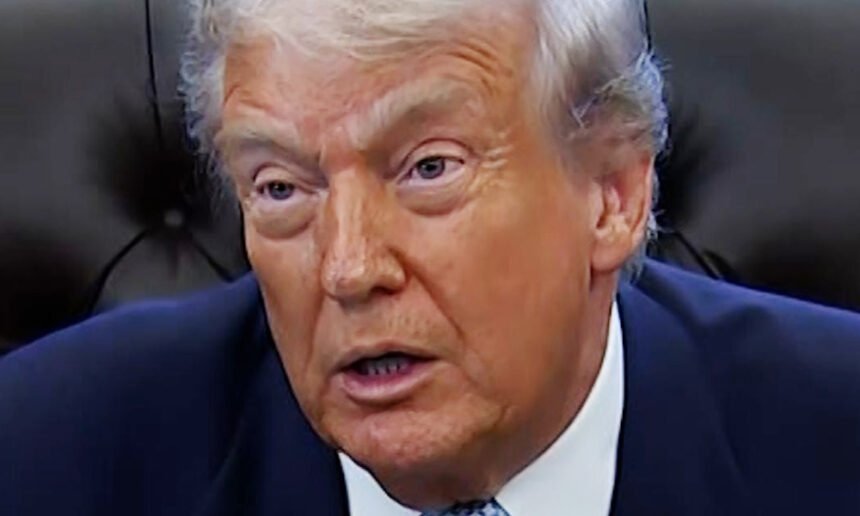
Donald Trump has a message for Americans who don’t want a massive artificial intelligence data center built near their homes:
Get poor.
That’s essentially the argument the president made Monday as he lashed out at Americans pushing back against the rapid expansion of data centers across the country.
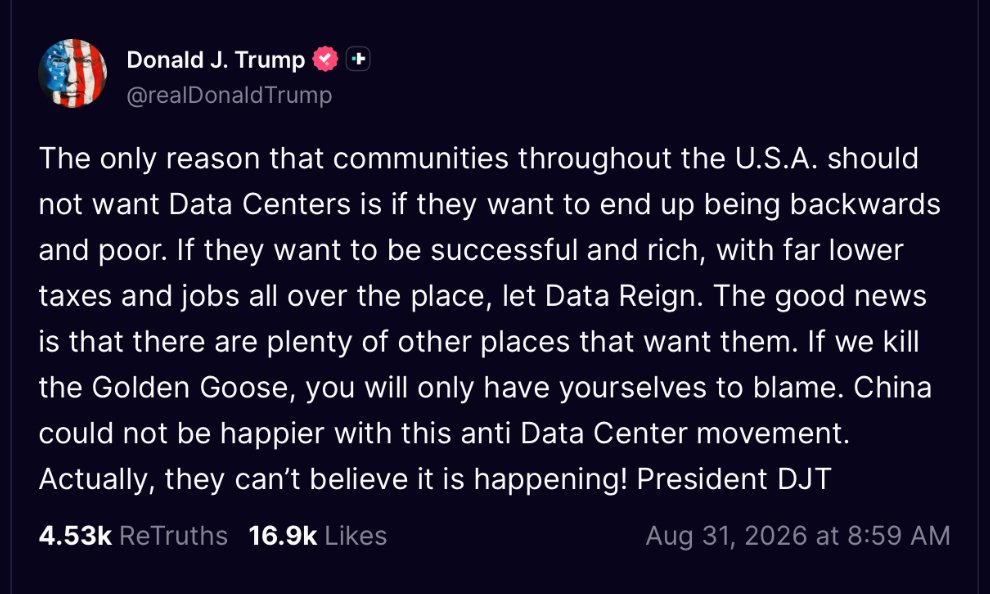
“The only reason that communities throughout the U.S.A. should not want Data Centers is if they want to end up being backwards and poor,” Trump wrote on Truth Social.
“If they want to be successful and rich, with far lower taxes and jobs all over the place, let Data Reign.”
He added: “The good news is that there are plenty of other places that want them,” he continued. “If we kill the Golden Goose, you will only have yourselves to blame. China could not be happier with this anti Data Center movement. Actually, they can’t believe it is happening!”
There’s just one problem with Trump’s argument.
Most Americans don’t want the golden goose anywhere near their backyard.
A Gallup poll conducted earlier this year found that 71 percent of Americans oppose building AI data centers in their communities.
Nearly half—48 percent—strongly oppose the idea, while another 23 percent somewhat oppose it.
Only 27 percent support building data centers in their own communities.
So this isn’t some tiny group of anti-technology activists standing in the way of America’s AI future. It’s a majority of Americans.
And increasingly, they’re being joined by Republicans who have discovered that voters aren’t necessarily thrilled about turning their communities into industrial hubs for artificial intelligence.
Take Texas.
Gov. Greg Abbott ordered an audit of data center projects in the state earlier this month as he campaigns for reelection.
A University of Texas Texas Politics Project poll found that 57 percent of Texans either strongly or somewhat oppose building data centers in their communities.
And Texas isn’t some Democratic stronghold where Republicans can simply dismiss the opposition as partisan politics.
It’s one of the country’s biggest centers for data center development.
Republican candidates elsewhere are starting to notice the political danger, too.
Earlier this month, Michigan Republican Senate candidate Mike Rogers announced support for a one-year moratorium on data center development as he fights for an open Senate seat in a competitive race.
Trump, meanwhile, seems to be taking the opposite approach: Build them. And if you don’t like it, apparently you’re choosing to be poor.
But the concerns driving the opposition aren’t particularly mysterious.
Data centers consume enormous amounts of electricity.
The World Resources Institute has found that a modern AI data center can use as much power as 100,000 homes, with some facilities requiring considerably more.
Then there’s the water.
Data centers use massive amounts of water for cooling. A mid-sized facility can consume as much as 300,000 gallons a day.
That means communities aren’t simply being asked to approve another office building or warehouse.
They’re being asked to accommodate facilities that can place enormous demands on local power grids and water supplies while polluting the surrounding environment.
And residents are increasingly worried about what that means for them.
Will electricity rates rise? Will water resources be strained? Will taxpayers be forced to pay for infrastructure upgrades? Will the economic benefits actually outweigh the costs to people who already live there?
Those questions matter even more at a time when Americans are already struggling with the cost of living.
Trump, however, doesn’t seem particularly interested in the objections. After all, no one is building a data center near his properties.
There’s another interesting wrinkle here.
Some of the resistance is coming from the very voters and communities Republicans need to keep on board in the November midterms.
Trump was just in Texas last week raising money for Republican Senate candidate Ken Paxton as the GOP fights to hold onto a Senate seat in a state Republicans have dominated for decades.
Now Trump is telling Texans and other Americans who don’t want giant AI facilities in their neighborhoods that they’re essentially voting for poverty.
That’s a risky political message.
Because voters may not care how many jobs a data center promises to create if they believe they’re going to pay for it through higher utility bills, strained infrastructure or increased pressure on local resources.