








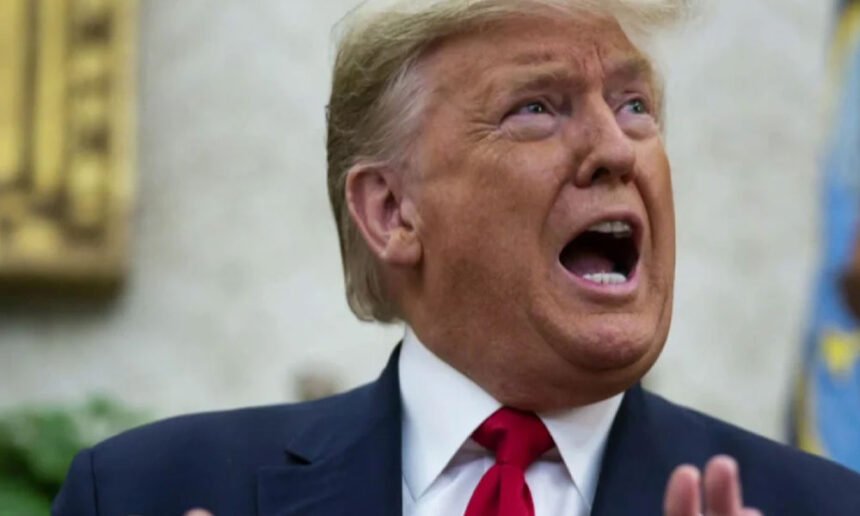
A new report paints a chaotic picture inside the White House—one where Donald Trump was reportedly sidelined during a critical national security moment after what officials describe as an hours-long meltdown.
According to The Wall Street Journal, Trump spiraled into a frenzy after learning that two U.S. airmen were missing when their fighter jet went down in Iran. The situation was already tense. Trump, however, made it worse.
Officials say the president’s outburst became so disruptive that aides took the extraordinary step of keeping him out of the room during key briefings—opting instead to feed him updates in smaller, controlled doses.
The episode reportedly triggered Trump’s long-standing obsession with the Iran Hostage Crisis and the failed rescue mission under Jimmy Carter—a historical moment Trump has repeatedly cited as politically catastrophic.
Behind closed doors, Trump feared history was about to repeat itself—this time, with him as the cautionary tale.
The downed aircraft, an F-15E Strike Eagle, set off a high-risk recovery operation. One airman was quickly rescued, but the second triggered a two-day scramble involving U.S. forces racing against Iranian threats on unfamiliar terrain.
Instead of projecting calm, Trump reportedly unraveled.
As the crisis dragged on, officials say he lashed out over rising gas prices and fumed about European allies who refused to back the U.S. and Israel’s sudden escalation against Iran. At one point, aides described him wandering a near-empty West Wing, furiously venting as tensions mounted overseas, obsessing over the political fallout and the 1979 hostage crisis.
Even after the mission succeeded, the volatility didn’t stop.
Trump kicked off Easter Sunday with a profanity-laced rant on Truth Social, threatening Iran in explicit terms. According to the report, he later admitted to an adviser that the outburst was intentional—an attempt to appear “unstable” enough to intimidate Tehran.
But even Trump seemed unsure of the strategy’s success, repeatedly asking aides, “How’s it playing?” as backlash grew—including from his own base after he referenced Allah in the same breath as his Easter message.
Days later, Trump escalated again, warning in another post that an entire civilization in Iran could be wiped out if his demands weren’t met.
The White House has pushed back on the portrayal. Press Secretary Karoline Leavitt insisted Trump “remained a steady leader,” framing the broader military operation as a success in curbing Iran’s nuclear ambitions.
Meanwhile, reality tells a more fragile story.
A shaky ceasefire between the U.S. and Iran is on the brink of collapse, and despite Trump’s claims of victory, tensions in the Strait of Hormuz—a critical artery for global oil—remain dangerously high. Less than a day after Trump declared the situation resolved, Iranian forces reportedly opened fire on a tanker passing through the strait.