








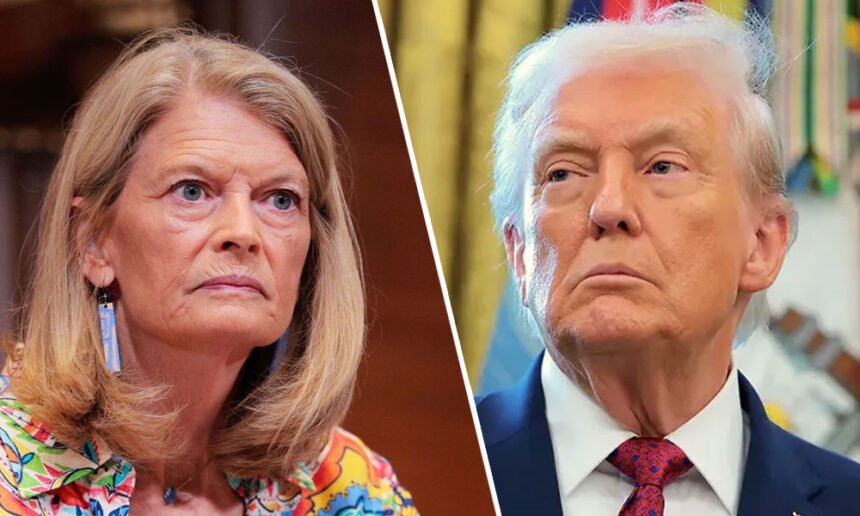
Sen. Lisa Murkowski of Alaska just gave the rest of the GOP a political headache — publicly rejecting a Trump‑proposed election overhaul bill that’s set to reshape voting rules ahead of the 2026 midterms.
Murkowski on Tuesday became the first Republican in the Senate to oppose the Safeguard American Voter Eligibility (SAVE) Act, a sweeping piece of legislation backed by former president Donald Trump that would impose nationwide proof‑of‑citizenship requirements and other strict voter ID mandates for federal elections.
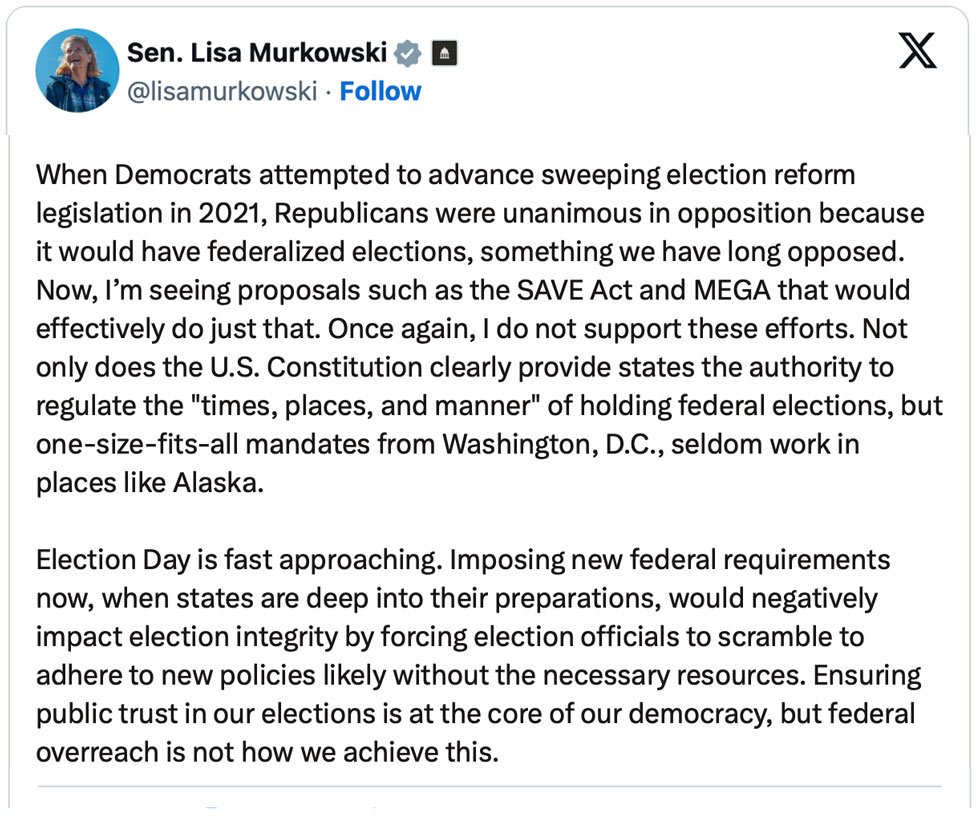
Writing on X, the centrist lawmaker warned that the SAVE Act and its companion, the Make Elections Great Again (MEGA) Act, risk turning federal elections into a one‑size‑fits‑all project run out of Washington — undermining the very state control of elections Republicans have long preached they support.
“Once again, I do not support these efforts,” Murkowski wrote, echoing her party’s longtime opposition to federalizing election administration. “Not only does the U.S. Constitution clearly provide states the authority to regulate the ‘times, places, and manner’ of holding federal elections, but one‑size‑fits‑all mandates from Washington, D.C., seldom work in places like Alaska.”
Murkowski’s break with GOP leadership lands at a moment when Republicans are gearing up to debate and potentially pass the SAVE Act through the House — a bill that would require documentary proof of U.S. citizenship to register to vote and impose criminal penalties on election officials who register anyone without the proper paperwork.
Supporters of the bill, including top House Republicans and Trump loyalists, present it as a way to “bolster confidence in the electoral system,” arguing that photo ID and stricter eligibility rules will reassure voters. But critics — from Democrats to nonpartisan election experts — counter that this is a solution in search of a problem, aimed at suppressing turnout among groups less likely to have certain IDs or documents.
Murkowski’s stance highlights a rare crack in GOP unity: she reminded colleagues that Republicans once unanimously opposed Democratic election reform efforts precisely because they would impose national standards on how elections are run. Now, she argued, the party appears poised to do the same.
“Election Day is fast approaching,” Murkowski added, warning that new federal requirements slapped on state systems already in mid‑cycle preparations could force election officials into chaos, hurting election integrity rather than helping it.
Her decision to oppose the legislation doesn’t automatically kill it — the Republican‑controlled House has already moved forward with the bill and similar measures. But in the Senate, where the 60‑vote threshold and a potential Democratic filibuster loom, Murkowski’s rebellion could signal deeper skepticism inside the GOP about dramatic federal election reforms.
Whether this dissent grows into a larger Senate revolt, or fizzles under party pressure, could shape the future of election law debates in Washington long after the 2026 midterms conclude.