








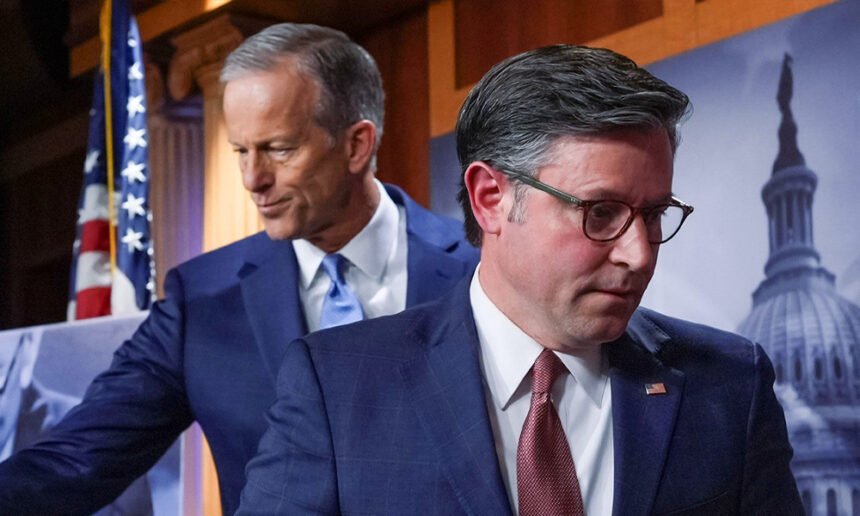
Republicans on Capitol Hill are starting to say the quiet part out loud: if the political winds don’t shift — and soon — the 2026 midterms could blow the party off the map.
After a bleak set of off-year elections on Nov. 4, GOP lawmakers are staring down numbers that look worse each week. Losses in New Jersey, Virginia, and pockets of the country that were supposed to be safe have shaken the confidence of a party used to shrugging off bad cycles. Now, Republicans admit the warning signs are stacking up fast: a cooling economy, stubbornly high prices, and health insurance premiums that voters are furious about.
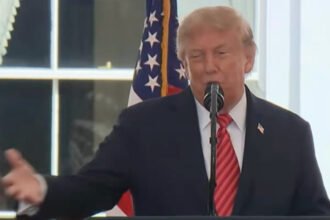
And hovering over all of it is the thing they’re most afraid to say publicly: Donald Trump’s approval rating is dragging them under.
“If we are where we are today in the beginning of the second quarter [of 2026], then I think we’re in for a really rough time in November,” said retiring Sen. Thom Tillis (R-N.C.). He didn’t try to soften it. “If you mess with health care … if we don’t get health care policy right, if we don’t get some of the cost policies right, we’re going to have major headwinds next year.”
What’s really spooking GOP lawmakers is Trump’s approval rating collapsing to 41.9 percent in the latest Decision Desk HQ (DDHQ) average, while his disapproval has jumped to 55.7 percent.
For Republicans running in tight districts, that’s basically the political equivalent of a flashing red “evacuate” sign.
One GOP senator who attended a recent strategy meeting put it bluntly: “The numbers are terrible.” The senator didn’t bother talking about silver linings. “You saw what happened a couple weeks ago [on Nov. 4]: Republicans didn’t win anything anywhere.”
Virginia drove the point home. Former Rep. Abigail Spanberger (D) didn’t just win the governor’s race — she won by 15 points. Democrats then flipped more than a dozen seats in the House of Delegates, including seats Republicans didn’t even consider at risk.
“There are a lot of warning signs blinking,” the senator said. “We’re increasingly on defense on the Senate side. … I think there’s a lot of concern.”
House Control Is Already Slipping
Republicans still have a three-seat cushion in the Senate, but even senior party members say the House may already be functionally gone.
“This was not an unexpected development,” one senior GOP senator said about the punishing polling. He pointed to the math that keeps party strategists up at night: “Look at the 2018 midterm: We lost 41 seats in the House. The Speaker can only lose three this time.” His conclusion was blunt. “I would expect to lose the House; I’m just trying to be objective.”
Redistricting — which Republicans once believed would hand them a small army of new seats — has turned into a legal mess. A Texas map that looked like a slam dunk was struck down, then temporarily revived by Justice Samuel Alito. Meanwhile, Democrats could pick up as many as six new seats in California and Utah.
As one Democratic strategist put it: “Looking where we are now, that’s absolutely not the case,” referring to the old belief that Democrats were doomed in redistricting.
Senate Map: Still Favorable, Still Dangerous
Republicans admit Democrats now have a real shot at flipping GOP-held seats in North Carolina, Maine, and Ohio. One of the biggest question marks is whether first-term Sen. Jon Husted (R-Ohio) can survive against former Sen. Sherrod Brown without Trump on the ballot driving turnout.
If Republicans lose those three seats, the Senate becomes a 50-50 tie, saved only by Vice President Vance’s tiebreaker.
Democrats are also circling races in Iowa, Texas, and Alaska, where they’re trying to convince former Rep. Mary Sattler Peltola to take another swing — this time at Sen. Dan Sullivan.
Republicans, meanwhile, are eyeing Georgia and Michigan. Michigan in particular has them feeling optimistic, with former Rep. Mike Rogers trying to claim the seat being vacated by retiring Democratic Sen. Gary Peters. Democrats, as usual, may complicate their own chances with a messy primary featuring Haley Stevens, Abdul El-Sayed, and Mallory McMorrow.
The Trump Problem — And the Democratic Energy Surge
Republican strategists insist Trump’s slump is mostly fallout from the 43-day shutdown and will fade. But even they admit the president’s numbers are pulling down candidates everywhere.
At the same time, Democrats say their base is more energized than at any point since 2020. “There’s enormous new energy,” said Sen. Jeff Merkley (D-Ore.). “I saw it in my town halls where I’ve had five times as many people come this year as last year.”
Republicans are hoping progressive challengers in places like California’s 22nd and Colorado’s 8th blow up Democrats’ chances, but so far, those candidates seem to be boosting enthusiasm rather than fracturing it.
Time Is Running — and Everyone Knows It
Republicans keep saying they have time to recover. They’re right, technically. But they also know the clock is ticking, and the currents aren’t moving their way.
Right now, the polls aren’t just bad — they’re brutal. And unless something dramatic changes, Republicans may be walking straight toward the very thing they fear: a 2026 wipeout.