







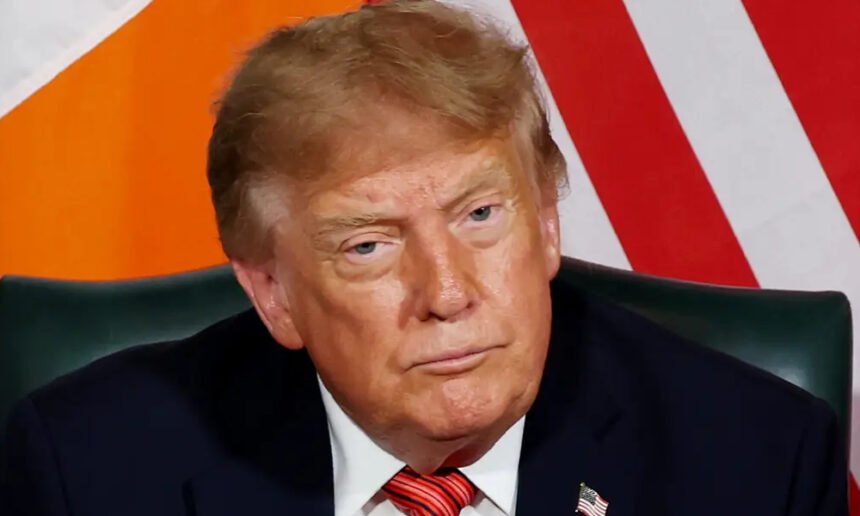
Donald Trump arrived in Ireland on Saturday to an official welcome from the country’s leaders, and a much less friendly reception from protesters who made clear they would rather see him somewhere else.
“We don’t want him here” was the message from journalist and author Justine McCarthy, who joined demonstrations against the president’s visit.
Trump arrived in Dublin amid one of the largest security operations ever mounted by Ireland’s police, with protests planned in both Dublin and County Clare. Phoenix Park was closed to the public for much of the visit, while major traffic restrictions were imposed around Dublin and Doonbeg.
And the opposition to Trump’s visit is not exactly a fringe sentiment.
A poll conducted by the Sunday Independent and Ireland Thinks found that 69% of people surveyed did not support the visit.
Trump, however, appeared unimpressed by the protests.
Asked about demonstrations, he said he had not seen any and suggested that if there was one, it “can’t be a very big one.”
“I haven’t seen any protests,” Trump said. “It’s a friendly protest, let’s say.”
McCarthy offered a very different assessment.
“We don’t want him here,” she told the Independent.
McCarthy said she was protesting because of what she described as Trump’s treatment of women, U.S. policy toward Gaza and Iran, and his rejection of the seriousness of climate change.
Those concerns reflect several of the issues that have fueled opposition to Trump’s visit, with protesters in Ireland particularly focused on U.S. policy in the Middle East and Ireland’s longstanding position on military neutrality.
But Trump’s visit was not entirely about protests.
During his meeting with Taoiseach Micheál Martin, Trump also waded into one of Ireland’s most politically sensitive issues: the future of Northern Ireland.
Trump said he would “love to see” Ireland unified and suggested that reunification is eventually going to happen.
“It’s going to happen eventually,” Trump said. “It may as well happen now.”
The comments immediately touched off a sensitive diplomatic issue. Under the Good Friday Agreement, Northern Ireland’s constitutional future is ultimately determined by the people of Northern Ireland through the agreed democratic process. British Prime Minister Andy Burnham’s office said Saturday that his position remains unchanged: there is currently no majority public support for holding another referendum on Irish unity.
For now, though, the president’s arrival has produced a distinctly divided reception: formal meetings with Ireland’s political leaders inside heavily secured government compounds, while protesters outside make clear that not everyone is rolling out the welcome mat.